


Introduction
Patent risk does not appear only at the moment of product launch. It builds across the entire product lifecycle — in the engineering decisions made before launch, in the competitor filings that publish while development is underway, and in the assertion and monitoring challenges that continue after a product reaches market.
XLSCOUT addresses patent risk at each of these stages through two complementary tools: FTO Module for patent clearance and TechScaper LLM for continuous technology monitoring. Together they give IP teams continuous visibility from early R&D through post-launch competitive intelligence.
What Is Full Lifecycle Patent Risk Management?
Full lifecycle patent risk management means maintaining patent clearance and competitive intelligence across every stage of a product’s development and commercial life — not just the pre-launch FTO check that is the most common intervention point.
A full lifecycle approach covers:
- Early R&D: identifying which technical directions carry infringement risk before engineering resources are committed
- Mid-development: monitoring newly published competitor patents that may affect features currently in development
- Pre-launch: comprehensive FTO clearance in all target markets before commercial release
- Post-launch: tracking competitor filings that may create enforcement risk or licensing opportunities as the product matures
- Portfolio strategy: connecting monitoring intelligence to continuation filing, whitespace identification, and portfolio development decisions
Why Lifecycle Patent Risk Management Matters
The cost of managing patent risk increases significantly at each stage of the product lifecycle. An infringement risk identified at the whiteboard stage costs engineering hours to resolve. The same risk identified at the design-freeze stage costs weeks. At the pre-launch stage, it costs months of redesign and delayed revenue. After launch, it can cost millions — or more. The $1.9 billion in patent damages awarded in US courts in the first half of 2025 alone reflects the difference between risk managed early and risk encountered at the litigation stage.
At the same time, tightening IPR institution standards have reduced the post-grant challenge options available when infringement risk is discovered after launch. The combination of rising litigation costs and declining challenge options makes early, continuous risk management the only economically viable approach.
The Limits of Point-in-Time FTO Analysis
A single pre-launch FTO search is already incomplete before it is finished
The standard pre-launch FTO search is a point-in-time analysis. By the time it is complete, new competitor patents have published. Patents that were pending applications at the time of the search may have issued with broader claims. The clearance opinion is already partially outdated before it reaches the attorney’s desk.
Monitoring without clearance intelligence misses the connection to product features
A competitive patent monitoring programme that is not connected to the specific product features under development tells IP teams what competitors are filing — but not whether those filings create clearance concerns for specific products. The intelligence is interesting but not actionable for FTO purposes.
Neither tool alone provides the full picture
FTO clearance without ongoing monitoring leaves the post-launch period unprotected. Monitoring without clearance capability produces intelligence that cannot be directly acted on for product risk management. The combination is what gives IP teams continuous visibility.
How XLSCOUT FTO Module and TechScaper LLM Work Together
XLSCOUT FTO Module and TechScaper LLM share the same underlying patent database and are designed to work as complementary tools within a unified patent risk workflow.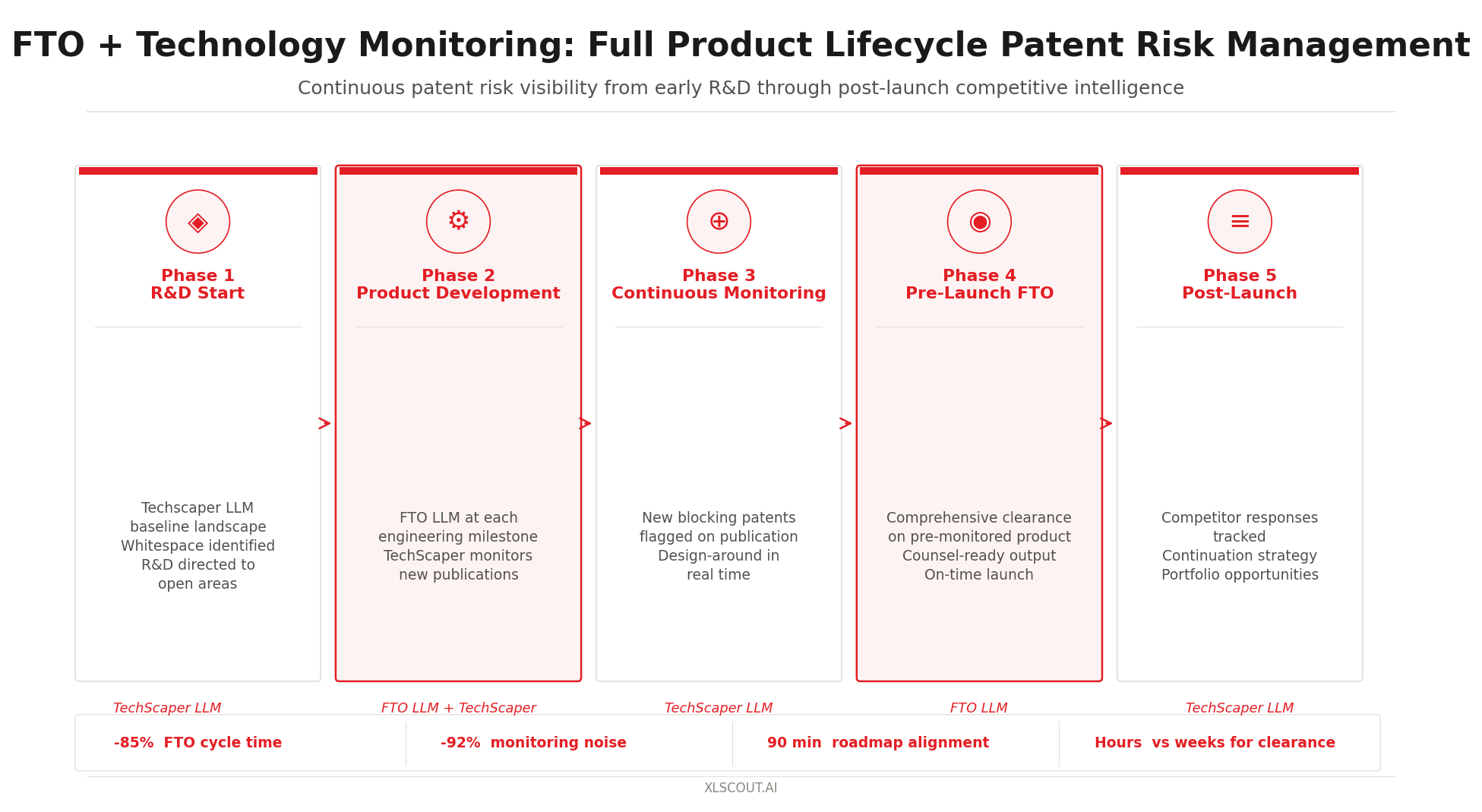
1. Early R&D: FTO Clearance at the Feature Level
At the beginning of a development cycle, FTO Module’s Smart Feature Extraction identifies which planned product features carry the most patent risk — before engineering resources are committed. The precision AI patent search runs against those features and surfaces any active competitor patents that may affect the technical direction of the project.
This is not a comprehensive pre-launch clearance. It is a risk-informed signal that allows engineering and IP teams to align on which technical approaches are viable before the product architecture is set. Design-around decisions made at this stage cost hours, not months.
2. Mid-Development: TechScaper Monitors for New Publications
While development is underway, TechScaper LLM monitors the competitor patent filing environment continuously. New publications in the technology areas relevant to the product under development are automatically classified against the taxonomy and flagged if they raise potential FTO concerns.
TechScaper’s noise-reduction capability — delivering only the signals that matter at confidence thresholds calibrated to each team’s needs — means that mid-development monitoring does not create alert fatigue. The team receives relevant intelligence, not a weekly data dump.
3. Pre-Launch: Comprehensive FTO Clearance
Before commercial launch, FTO Module runs a comprehensive patent clearance exercise across all target markets — US, EU, Japan, Korea, Taiwan — covering the final product specification with full Para-Picx™ visual search coverage for hardware and semiconductor features.
The pre-launch clearance is faster and more complete than a traditional outside counsel search because TechScaper’s mid-development monitoring has already surfaced the most recently published competitor patents relevant to the product. The attorney does not need to search for what the monitoring system has already identified.
4. Post-Launch: Competitive Intelligence and Portfolio Opportunities
After launch, TechScaper continues monitoring competitor filing activity — tracking whether competitors are responding to the product’s commercial success with new filings in adjacent technical areas, whether licensing opportunities are emerging from portfolio overlap, and whether patent positions need to be strengthened through continuation applications. The connection to patent continuation strategy is direct: TechScaper monitoring identifies where competitor filings are encircling existing IP positions, and that intelligence drives the continuation filing decisions that protect those positions.
The whitespace intelligence generated by TechScaper also informs patent licensing campaign development — identifying which market segments represent the strongest licensing targets based on the overlap between the IP team’s portfolio and competitor product activity.
Why This Matters Across All Regions
The lifecycle approach to patent risk management is relevant in every geography, but the specific dynamics differ by region.
In the United States, the combination of declining IPR institution rates and active patent assertion at fast-track venues makes early clearance and continuous monitoring a competitive necessity. In the European market, the Unified Patent Court has created pan-European enforcement reach that makes competitive monitoring of UPC-facing competitor portfolios essential for any company with significant EU market exposure.
In Japan, Korea, and Taiwan, the image-heavy nature of patent filings in semiconductor and hardware technology makes Para-Picx™ visual search a critical component of FTO clearance for any product with APAC supply chain exposure. The guidance on patent filing in Japan illustrates how different JPO filing conventions are from Western practice — differences that require dedicated coverage, not a standard English-language keyword search.
XLSCOUT FTO Module and TechScaper LLM: Signature Use Cases and Value
- FTO clearance: TechScaper tags surface only true overlaps; IP and engineering resolve in-record. Cycle time reduced by 85%; fewer late-stage design changes.
- Competitive monitoring: confidence-ranked alerts and heat-maps show where rivals are surging. Noise reduced by 92%; teams move earlier on competitive signals.
- Whitespace discovery: heat-maps score technology nodes by density, velocity, freshness, and strategic fit. One 90-minute workshop to align IP and R&D roadmaps.
- Para-Picx visual FTO: circuit layout and device schematic prior art found in a single search alongside text-based results. Critical for hardware, semiconductor, and APAC market clearance.
Why XLSCOUT Stands Out
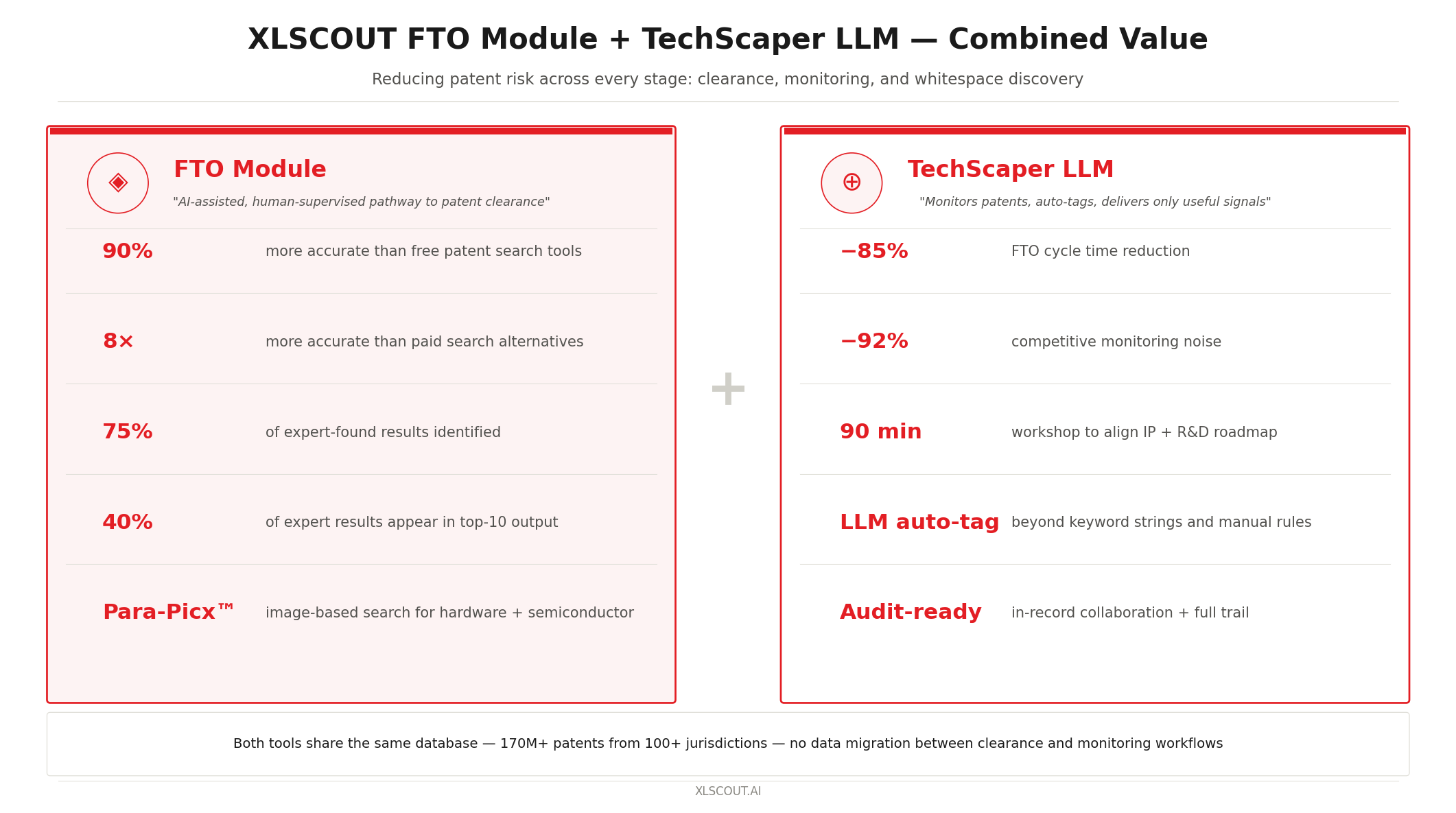
- FTO Module: 90% more accurate than free tools; 8X more accurate than paid alternatives; 75% expert mirror; 40% top-10 capture
- TechScaper LLM: noise reduced 92%; LLM auto-tagging beyond keyword strings; your taxonomy not ours
- Para-Picx™: image-based FTO search for hardware and semiconductor products; up to 3 features per analysis
- Shared database: both tools access the same global patent and NPL database — no data migration between clearance and monitoring workflows
- FTO cycle time reduced 85% with TechScaper monitoring feeding pre-launch clearance
- Continuous improvement: real-time feedback loop (Retag / Keep / Mute) improves TechScaper precision over time
- Audit-ready: in-record collaboration with full audit trail across both tools
The most effective IP teams are not the ones that run the best point-in-time FTO. They are the ones that maintain continuous patent risk visibility across the full product lifecycle — catching risks early when they are cheap to resolve, monitoring continuously when new risks emerge, and building portfolio positions in the whitespaces their competitors have not yet found. XLSCOUT FTO Module and TechScaper LLM are designed to make that continuous approach operational.
See How XLSCOUT Supports Full Lifecycle Patent Risk Management
If your IP team is looking to move from reactive FTO clearance to continuous patent risk management across R&D, launch, and post-launch, XLSCOUT FTO Module and TechScaper LLM support the full workflow.