


Introduction
Approximately 50% of all patents granted by the USPTO come from continuation applications.
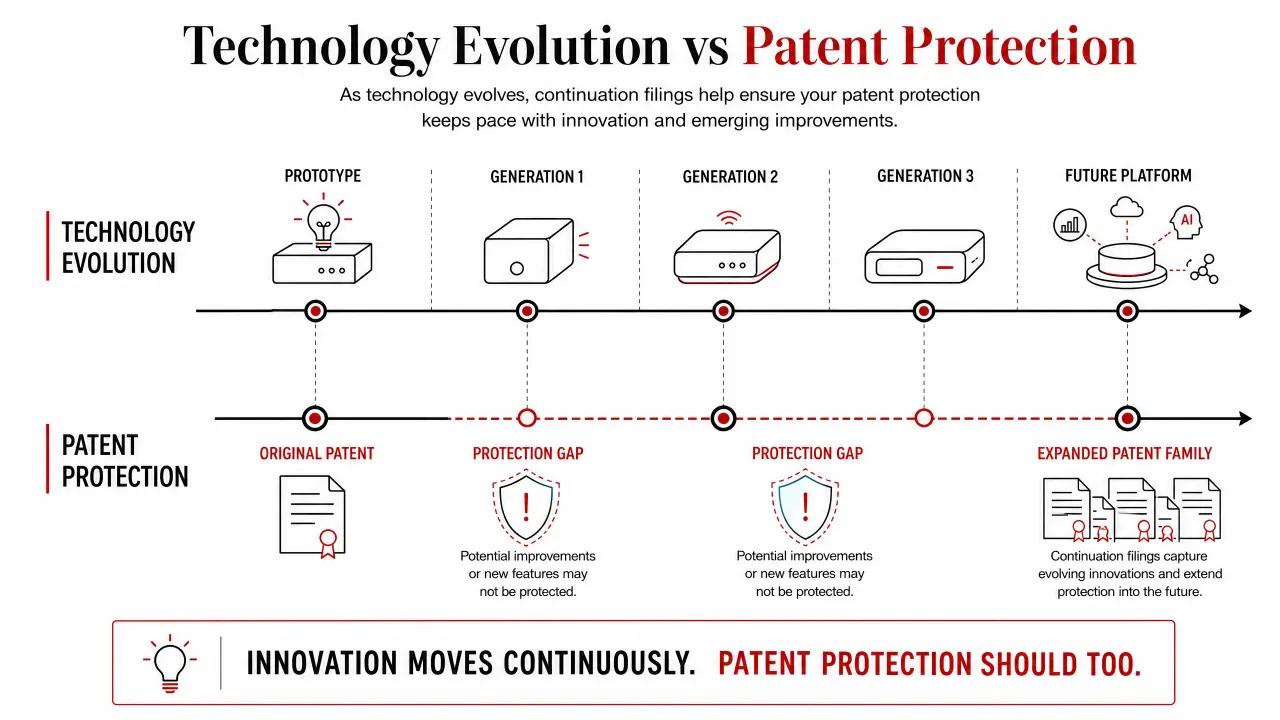
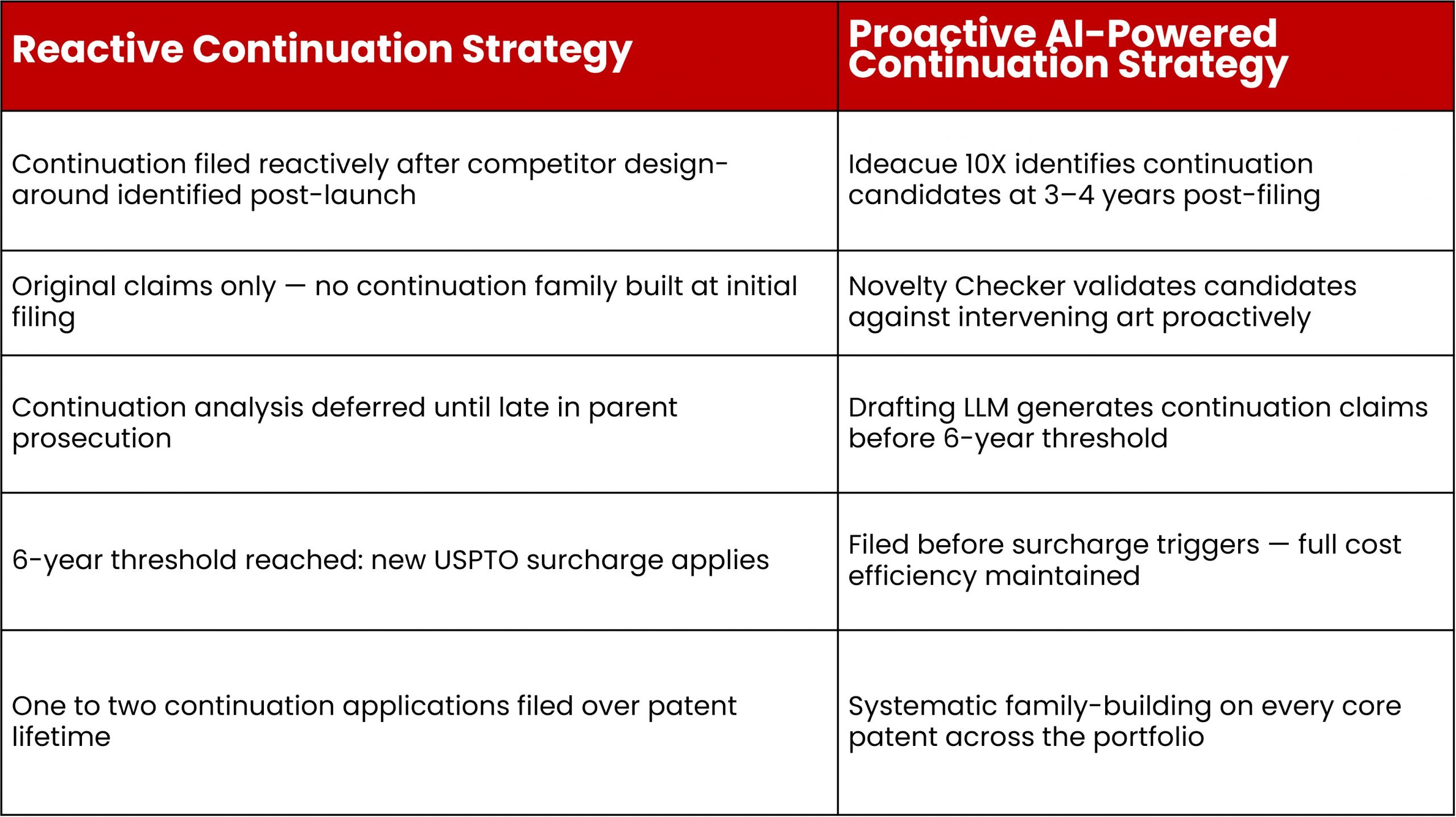
Most companies file continuations reactively — when a product changes, when a claim is challenged in litigation, or when a competitor’s design-around exposes a gap in the original claim scope. The companies consistently outperforming on patent quality file proactively: using AI to identify continuation candidates before competitors design around the original, and before the original patent’s prosecution history limits the continuation’s claim options.
In 2025, the USPTO introduced a new surcharge for continuation applications on parent applications older than six years — adding cost pressure that makes the question of when and what to file more consequential than ever.
Why Continuation Strategy Matters More in 2026
Three trends are making proactive continuation strategy more valuable in 2026 than at any point in the previous decade:
- USPTO pending applications grew from 1.045 million in 2021 to 1.195 million in 2024. A growing backlog means longer pendency periods for new continuation applications — making early filing more important.
- The new 2025 USPTO surcharge for continuations on parent applications older than six years adds significant cost for teams that wait too long. Filing before the six-year threshold avoids this cost.
- AI-powered prior art analysis has made competitor design-arounds faster and cheaper to construct. A patent family without continuation coverage is more vulnerable than it was five years ago.
4 Continuation Opportunities Most IP Teams Are Missing
Opportunity 1 — Product Evolution Not Covered by Original Claims
The commercial product that ships 18 months after filing includes features, system interactions, and technical components not described in the original claims. A continuation application filed while the parent is still pending — targeting the actual commercial product rather than the prototype that was the subject of the original filing — captures the IP protection the patent family needs.
Opportunity 2 — Competitor Design-Around Exposure
A competitor analyses the original patent and designs around it by using an alternative technical approach that falls outside the original claim scope. A continuation filed with broader or differently-directed claims — while the parent application is still pending — can cover that alternative approach before it reaches the market.
Opportunity 3 — Licensing Leverage Gap
Original claims are often narrowly written to survive prosecution. They are technically valid but commercially narrow — limiting licensing leverage in negotiations. Continuation claims with broader scope, filed while the parent is pending, provide the licensing leverage the original cannot. This is particularly important in semiconductor, automotive, and industrial technology licensing campaigns.
Opportunity 4 — The Inverted Pyramid Prosecution Anchor
File a narrow, high-likelihood-of-allowance claim first to establish a granted patent date — the “anchor.” Then use the continuation to add progressively broader claims that benefit from the anchor date. This strategy — gaining traction in US patent practice in 2025–2026 — builds a patent family with a known grant date and expanding claim scope without waiting for the broader claims to clear examination.
Step 1 — Using Ideacue 10X to Identify Continuation Candidates
Generative AI Surfaces Alternative Technical Approaches From the Original Disclosure
Fed with the specification of a granted or pending patent, Ideacue generates alternative technical approaches covered by the original disclosure but not claimed in the original application — the continuation white spaces the R&D team may not have identified because they were focused on getting the original patent granted, not on building a family.
Idea Dashboard Prioritises Continuation Candidates by Commercial Strength
The Idea Dashboard allows IP teams to evaluate and compare continuation candidates by commercial relevance, scope breadth, and likelihood of allowance — enabling structured prioritisation before routing to patent counsel for drafting. The dashboard turns a subjective “which continuation should we file?” decision into an evidence-based comparison.
Ideacue produces for continuation strategy:
- Alternative technical implementations covered by the original disclosure but not yet claimed in any pending application
- System-level claim candidates where original claims cover only method or apparatus claims
- Use-case extensions — new commercial applications of the original invention that fall within the original disclosure’s scope
- Dependent claim candidates that would survive inter partes review better than broad original claims, building a more defensible claim pyramid
Step 2 — Novelty Checking Continuation Candidates Against Intervening Prior Art
Because continuation applications are filed after the parent, prior art that arose between the priority date and the continuation filing may affect the patentability of continuation claims — depending on how those claims are directed and whether they claim the same priority date as the parent.
Automated Novelty Report Against Post-Priority-Date Prior Art
Novelty Checker LLM validates each Ideacue-generated continuation candidate against the post-priority-date prior art landscape — identifying which continuation claim candidates are still clearly novel and which require modification or narrowing to avoid intervening art that did not exist when the parent was filed.
Contextual Mapping With Specific Prior Art Passages
The novelty report maps each continuation candidate’s features against the closest post-priority prior art, with the specific passages from each reference shown inline. IP teams can immediately assess which claim direction to pursue and how to differentiate from intervening art before the drafting begins.
Step 3 — Drafting Continuation Claims With Drafting LLM
Continuation Claims Generated Around Validated Candidates
Drafting LLM generates continuation claims targeted at the specific candidates identified by Ideacue 10X and validated by Novelty Checker LLM — producing broader independent claims, differently-directed claims covering alternative implementations, and dependent claims designed to build a defensible prosecution record.
AI Chatbot Handles Continuation-Specific Drafting Tasks
The integrated chatbot assistant handles continuation-specific instructions: “Generate a system claim corresponding to method claim 1 in the parent application,” “Broaden independent claim 1 to cover the alternative implementation identified in the Ideacue output,” “Add specification support for the new claim direction — ensure Section 112 written description requirements are satisfied.”
Compressed Timeline From Candidate Identification to Filed Application
Continuation applications that previously required one to two weeks of attorney drafting time can be generated, reviewed, and refined in hours using Drafting LLM — making continuation filing economically viable for a wider set of candidates than traditional per-hour attorney cost models allow.
Timing: When to File and What the 2025 Fee Rule Means
USPTO continuation timing rules:
- A continuation must be filed while the parent application is pending — before it issues as a patent or is abandoned. Once the parent issues, the continuation window closes.
- New 2025 USPTO surcharge: continuation applications on parent applications filed 6+ years ago now carry an additional filing surcharge. This adds meaningful cost for teams that delay continuation decisions.
- Recommended timing: Ideacue continuation analysis should be run at 3–4 years post-filing — allowing time to evaluate candidates, run Novelty Checker validation, draft with Drafting LLM, and file before the 6-year surcharge threshold triggers.
Fifty percent of granted US patents come from continuations. The teams filing them proactively — with AI identifying the candidates, validating the prior art, and drafting the claims — are building patent families that protect their commercial products as they evolve, not as they were first conceived in the lab.