


Introduction
Every 5G smartphone, connected car, and industrial IoT device sold in Europe operates on standard essential patents.
Standard essential patents — SEPs — are patents that must be infringed to implement a technical standard. 3GPP for 5G, ETSI for Wi-Fi, IEEE for Bluetooth. Every company manufacturing standard-compliant products in Germany, Italy, Denmark, or the UK is a potential licensee — or a potential defendant.
SEP licensing is Europe’s most complex and most litigated patent battleground. AI is changing how both sides prepare.
What Makes SEP Analysis Different From Standard Patent Infringement Analysis
SEP licensing involves specific concepts that distinguish it from ordinary patent infringement and clearance work.
Essentiality
A patent is “standard essential” if it is technically impossible to implement the standard without infringing the patent. The essentiality determination — proving or disproving that the patent is truly essential — is the most contested question in SEP proceedings. Studies consistently show that only 20–30% of declared SEPs are technically essential.
FRAND Licensing Obligations
SEP holders who declare their patents to standard-setting organisations (SSOs) such as ETSI or 3GPP must commit to license on Fair, Reasonable, and Non-Discriminatory (FRAND) terms. What constitutes FRAND is a question that European courts — particularly in Germany and the UK — have litigated extensively and continue to develop.
SSO Mapping
To assert a SEP, the patent holder must demonstrate that the claim elements read on the technical standard specification — typically 3GPP Technical Specifications (TS) or IEEE 802 standards. This requires claim-by-claim mapping against the standard document, which Standigger LLM automates.
Why Germany and the UK Are Europe’s SEP Courtrooms
SEP disputes are disproportionately concentrated in two European jurisdictions.
- Germany is the most active SEP enforcement forum in Europe. The bifurcation system — infringement decided separately from validity — means injunctions can be granted quickly while FRAND obligations are argued in parallel. Düsseldorf and Munich courts have extensive SEP expertise. The Mannheim Local Division of the UPC also handles SEP-FRAND proceedings.
- The United Kingdom has become the preferred forum for FRAND rate-setting. The UK Supreme Court and Patents Court have jurisdiction to set global FRAND rates — determining what a worldwide SEP licensee must pay — even where the underlying patents are not UK patents. This jurisdiction has been upheld in multiple cases and is now an established feature of UK patent practice.
European SEP terminology:
- SSO — Standard Setting Organisation (ETSI, 3GPP, IEEE, ITU, IETF)
- FRAND — Fair, Reasonable, and Non-Discriminatory licensing terms
- EoU chart — Evidence of Use chart mapping patent claims to standard specification sections
- Essentiality determination — technical analysis confirming a claim is truly essential to implementing the standard
- Implementer — company manufacturing standard-compliant products (potential licensee)
“The UPC has introduced SEP-FRAND proceedings as a distinct case type, with the Milan, Paris, and Hamburg local divisions handling the first wave of SEP cases under the new UPC framework.”
— UPC Court of First Instance statistics, October 2025
The SEP Licensing Workflow — Where AI Changes the Economics
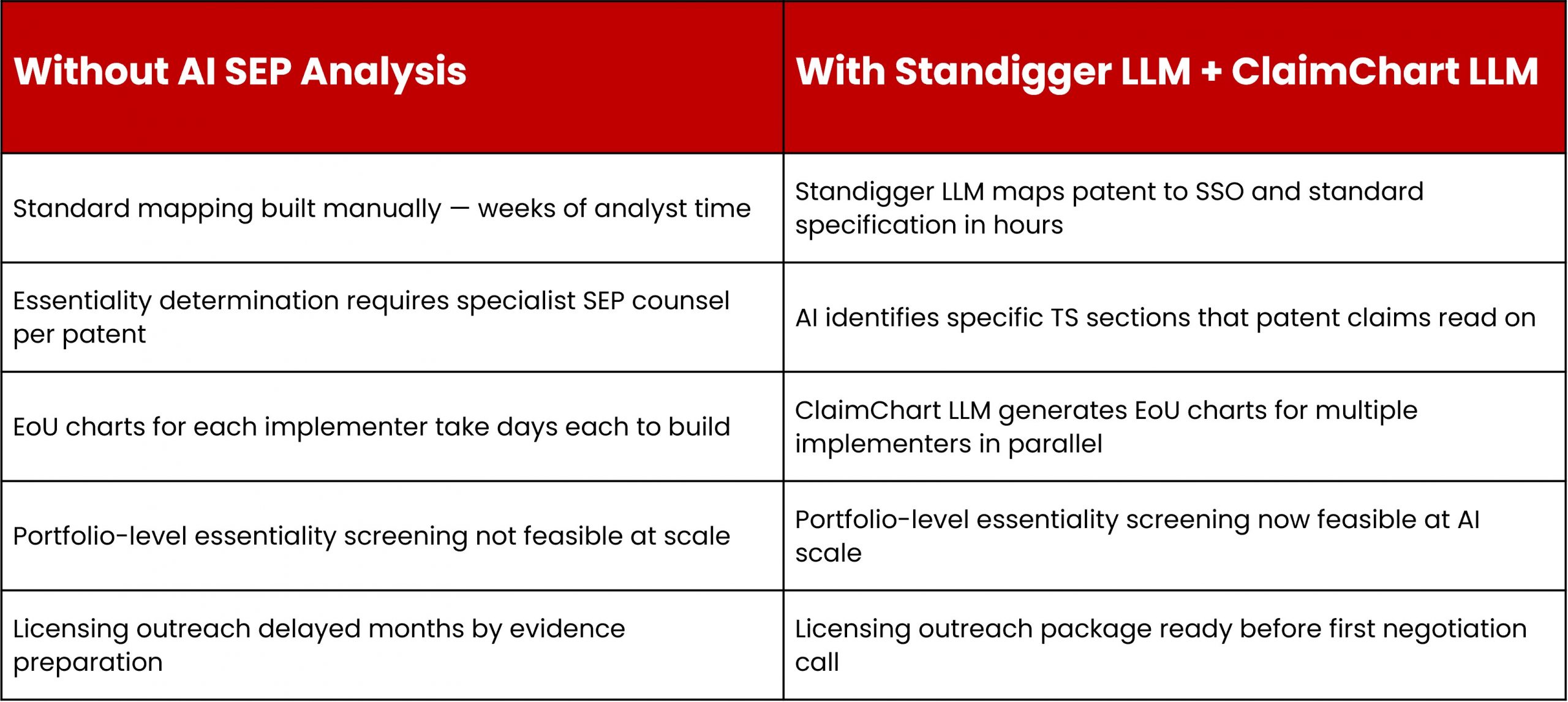
Whether you are a SEP holder seeking to license or an implementer challenging essentiality, the analytical foundation is the same: claim charts mapping patent claims against the technical standard specification.
For SEP Holders
- Identifying which declared patents are genuinely essential to the standard
- Generating EoU charts mapping claim elements to specific sections of the 3GPP Technical Specification or IEEE 802 standard
- Identifying which implementers’ products implement the standard and therefore read on the essential claims
- Building a licensing outreach package with EoU evidence ready before first contact
For Implementers
- Challenging the essentiality of asserted patents — proving that standard-compliant products can be built without infringing specific claims
- Assessing FRAND rate exposure across an asserted SEP portfolio
- Identifying design-around opportunities where the standard allows optional implementation paths that avoid the asserted claims
How Standigger LLM Supports SEP Analysis
Standigger LLM is XLSCOUT’s dedicated platform for standard-to-patent mapping, purpose-built for SEP analysis.
Four-Step Workflow: Patent → SSO → Standard → EoU Chart
Enter the patent number. Standigger LLM identifies which Standard Setting Organisations have specifications that the patent reads on, identifies the specific standard versions and Technical Specification sections, and delivers an AI-generated claim chart mapping each claim element to the corresponding standard specification section.
Identify Potential Standard Setting Organisation
Standigger LLM identifies which SSOs — ETSI, 3GPP, IEEE, ITU, IETF — have specifications that overlap with the patent’s claim elements. For SEP portfolio holders, this is the first step in understanding which standards the patents may be essential to and in which SSO’s declared patent pool they should be registered.
Identify Top Overlapping Standards and Implementing Products
Beyond identifying the SSO, Standigger LLM identifies the specific standard versions and Technical Specification sections that the patent claims read on — and which products implementing those standards are therefore potential licensees.
AI-Generated Claim Chart Delivered to Inbox
Standigger LLM delivers an AI-generated claim chart mapping each patent claim element to the corresponding section of the technical standard specification — the core document for SEP licensing negotiations and essentiality challenges in any forum.
How ClaimChart LLM Completes the EoU Analysis
Once Standigger LLM has established the standard mapping, ClaimChart LLM identifies the target implementers and maps the patent claims against their specific products.
Identify Top Infringers and Their Overlapping Products
Input the SEP patent number. ClaimChart LLM identifies which companies’ products implement the relevant standard — handset OEMs, network equipment vendors, automotive manufacturers implementing 3GPP NR specifications — and their specific implementing products. For 5G SEP campaigns, this means covering the full device ecosystem.
AI-Generated Claim Charts and EoU Charts
ClaimChart LLM generates automated claim charts and Evidence of Use charts mapping the SEP’s claim elements to product implementations. Product documentation, technical specifications, and standards conformance declarations serve as evidence sources. Charts for multiple implementers can be generated in parallel.
The EU SEP Regulation — What European IP Teams Should Prepare For
The European Commission’s proposed SEP Regulation is progressing through the EU legislative process. Key features under the current proposal:
- A new EUIPO essentiality check process — independent technical assessment of declared SEPs before licensing disputes reach court
- FRAND determination procedures through EU-administered mediation before court proceedings begin
- New transparency obligations on SEP holders regarding their licensing terms and royalty rates
- Simplified licensing pathways specifically for SME implementers
For IP teams operating in Germany, Italy, Denmark, and across the EU, the regulation will significantly change SEP licensing dynamics. Building AI-powered essentiality analysis capabilities now prepares teams for the regulatory environment ahead.
SEP licensing is not getting simpler. The EU SEP Regulation, the UPC’s new FRAND jurisdiction, and the UK’s rate-setting role are creating a more complex European landscape. AI analysis tools that map patents to standards at portfolio scale are no longer a competitive advantage — they are a strategic necessity.