


Introduction
Traditional freedom-to-operate analysis is slow, fragmented, and often inconclusive. IP teams spend days running Boolean searches across multiple databases, manually reviewing abstracts, and compiling results into reports that arrive after the engineering decision has already been made. That timeline is incompatible with how product development actually works.
That is why more teams are turning to AI-powered FTO tools. Not to replace qualified patent counsel, but to give counsel better inputs, faster.
What Is Freedom-to-Operate Analysis?
Freedom-to-operate (FTO) analysis is the process of determining whether a product, technology, or method can be commercialised without infringing active third-party patents. It is a foundational step before product launch, market entry, and R&D investment.
An FTO analysis typically helps answer questions such as:
- Which competitors hold active patents in this technology area?
- Do any of those patents claim elements of our product?
- Which product features carry the most infringement risk?
- What design-around options exist if a blocking patent is identified?
- Are we clear to launch in specific markets — US, EU, Japan, Korea, Taiwan?
FTO analysis is used by in-house IP teams, patent attorneys, R&D strategy groups, and legal counsel supporting product and licensing decisions.
Why FTO Analysis Matters
A well-executed FTO analysis does more than prevent infringement claims. It informs which technical directions are viable for R&D investment, supports pricing in M&A and licensing due diligence, reduces the risk of post-launch surprises, and provides the legal foundation for commercialisation decisions across jurisdictions.
The financial stakes are significant. US courts awarded $1.9 billion in patent infringement damages across 21 cases in the first half of 2025 alone. Most of those losses were foreseeable earlier in the product cycle.
FTO analysis is most valuable when it happens early — before engineering resources are committed to a technical direction that a competitor has already patented.
The Limits of Traditional FTO Clearance
It takes weeks, not hours
A standard outside counsel FTO search costs $1,500 to $5,000 and takes two to three weeks. By the time results are delivered, the engineering team has often moved forward anyway. The FTO becomes a post-hoc check rather than a decision input.
It misses non-English prior art
Japan’s JPO, South Korea’s KIPO, and China’s CNIPA collectively process over two million patent applications per year. Most keyword-based FTO searches do not cover these databases adequately. For semiconductor, automotive, and consumer electronics products, that omission is not marginal — it is a systematic blind spot. Guidance on patent filing in Japan underscores how extensively the JPO database diverges from what English-language search surfaces.
It does not scale with product volume
A company launching multiple product lines across multiple markets cannot commission separate outside counsel searches for every feature of every variant. The per-search cost model breaks down at scale.
Results arrive after decisions are made
The most valuable FTO insight is one that arrives before an engineering decision is locked in. Traditional FTO timelines ensure the opposite — results appear when design changes are expensive, not when they are cheap.
How AI Improves Freedom-to-Operate Analysis
AI improves FTO analysis by compressing the search timeline from weeks to hours, extending coverage to non-English databases, enabling image-based search for hardware and circuit patents, and making continuous monitoring practical rather than periodic.
Instead of relying entirely on Boolean strings and manual abstract review, AI enables semantic discovery across large patent sets — finding conceptually equivalent prior art regardless of the specific terminology used. This is the same capability that has transformed AI-powered novelty search and it applies with equal force to FTO clearance.
XLSCOUT FTO Module and Patent Clearance
XLSCOUT FTO Module is not a replacement for qualified patent counsel. It is described by XLSCOUT as “your AI-assisted, human-supervised pathway to precise patent clearance.” The module handles the search and preliminary analysis phase that precedes the formal FTO opinion — giving attorneys better inputs, a more complete prior art picture, and a faster starting point for their analysis.
The core methodology runs in four stages.
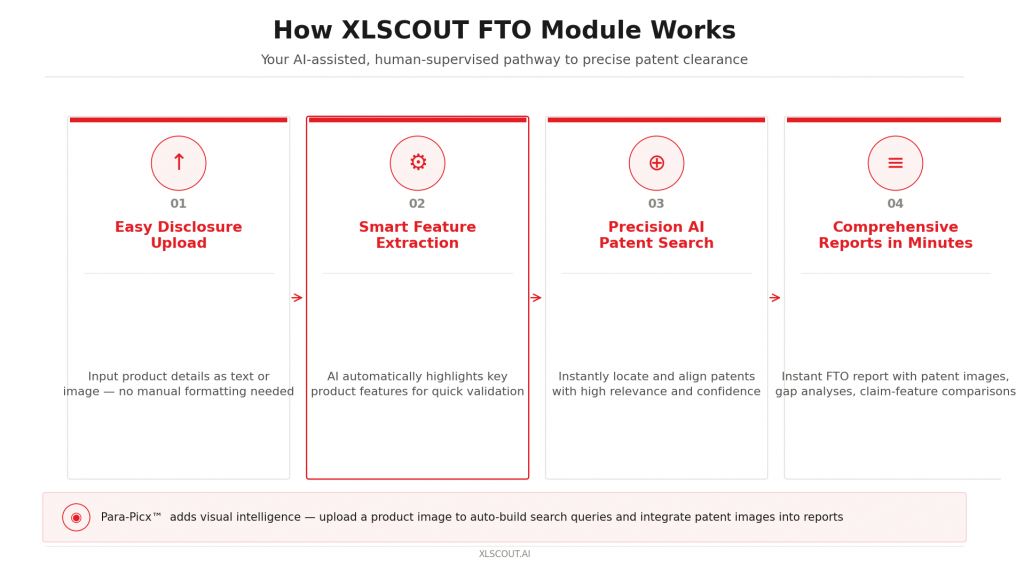
1. Start with Easy Disclosure Upload
One of the most time-consuming steps in traditional FTO preparation is translating engineering documentation into patent claim language before the search can begin. XLSCOUT eliminates that step.
Teams can input product details directly as text or upload documents — including technical drawings and product specification documents — with no manual formatting required. The system accepts how engineers actually document their products, not how patent attorneys need to receive them.
2. Extract the Right Features with Smart Feature Extraction
Once the product disclosure is uploaded, AI automatically highlights the key product features most likely to read on third-party patent claims. These are surfaced for quick validation and editing by the IP team.
This step removes the guesswork from FTO scoping. Instead of relying on an engineer’s intuition about which features carry infringement risk, Smart Feature Extraction applies a trained model to surface the features that matter most for the clearance analysis.
3. Run a Precision AI Patent Search
With the key features identified, XLSCOUT FTO Module runs a precision AI patent search — locating and aligning relevant patents to the product with high relevance and confidence.
The search operates semantically, not just by keyword. That means patents describing the same technical concept in different terminology — or filed in Japanese, Korean, or German — are found by the same search that identifies their English-language equivalents. Coverage extends across global patent databases and non-patent literature simultaneously.
4. Generate a Comprehensive FTO Report in Minutes
The output is an instant FTO report including patent images, gap analyses, and claim-feature comparisons. Teams receive the structured analysis that patent counsel needs to issue an FTO opinion — not a raw search result set that requires hours of manual organisation.
Para-Picx™ adds visual intelligence to the process. Teams can upload a product image to initiate the search — Para-Picx™ extracts product disclosures from the visual and auto-builds the right queries, integrating relevant patent images into the report alongside text-based results.
Why This Matters for Modern IP Teams
Modern IP teams cannot afford to treat FTO as a pre-launch formality. The combination of tightening IPR institution rates at the PTAB and rising patent damages awards has made early, accurate FTO analysis a competitive necessity, not a compliance checkbox.
The operational advantage is measurable. Teams that run FTO clearance earlier in the development cycle face lower design-around costs, fewer last-minute engineering changes, and less exposure to the litigation that follows a missed blocking patent.
Why XLSCOUT Stands Out
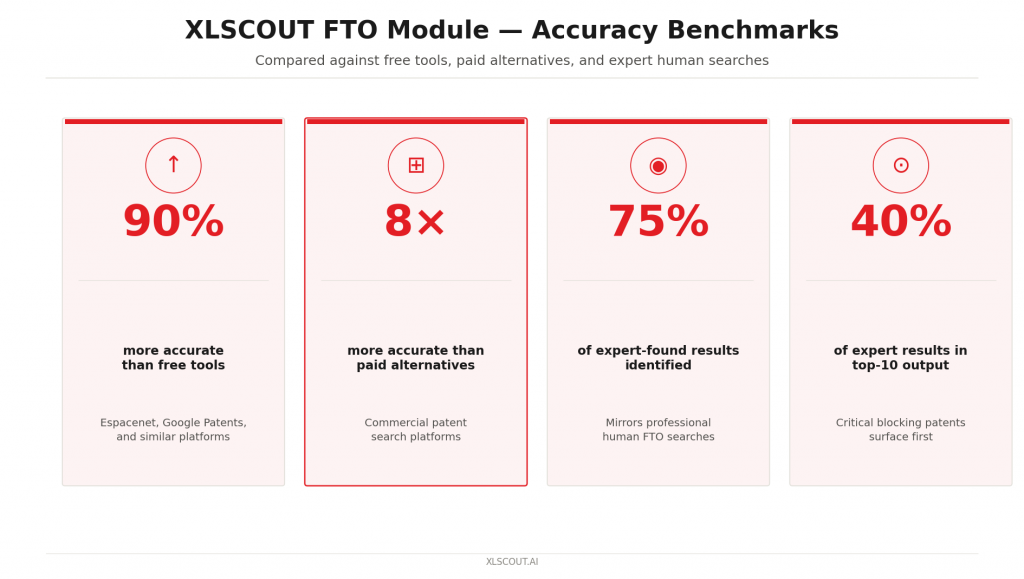
- 90% more accurate than free patent search tools including Espacenet and Google Patents
- 8X more accurate than paid patent search alternatives
- 75% of prior art results found by expert human searches are identified by XLSCOUT FTO Module
- 40% of expert-found results appear within the top 10 delivered by the module — the most critical patents surface first
- Para-Picx™ visual search finds prior art disclosed in patent drawings, not just patent text
- Comprehensive global patent and non-patent literature coverage
- AI-assisted, human-supervised — designed to work alongside patent counsel, not replace it
Freedom-to-operate analysis will always require attorney judgment to produce a defensible legal opinion. What AI changes is the quality and speed of the prior art picture that judgment is applied to. XLSCOUT FTO Module gives that picture its fullest possible resolution, in the time available between engineering sprints.
See How XLSCOUT FTO Module Supports Patent Clearance Workflows
If your team is looking to move beyond manual FTO search and get to clearance decisions faster, XLSCOUT FTO Module supports the full workflow from product disclosure to structured analysis output. Request a demo to see it applied to your product area.