

Introduction
Competitive M&A deal processes give you five to ten days for patent due diligence.
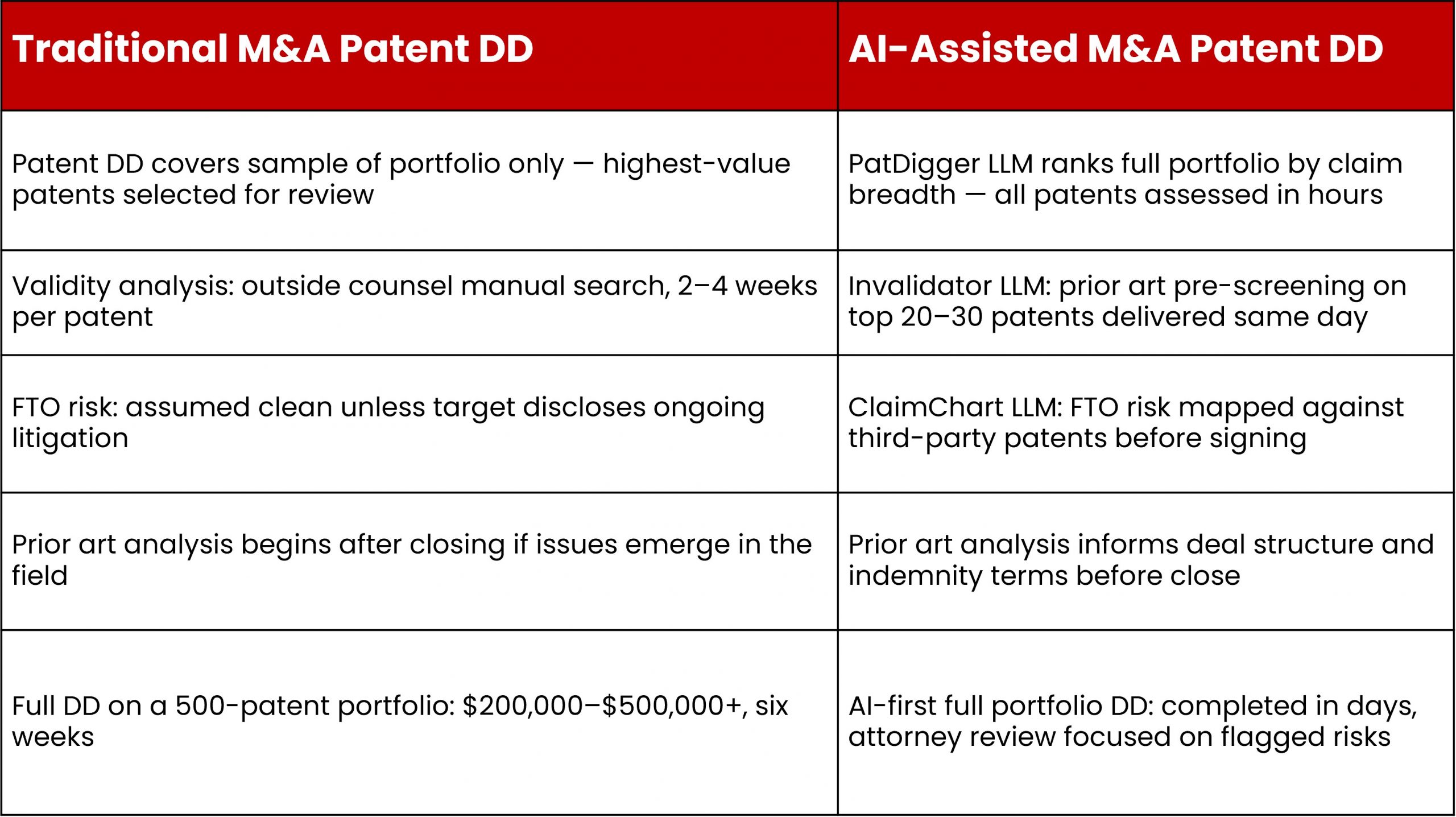
Traditional patent due diligence takes three to six weeks, involves hundreds of billable hours from IP counsel, and — given time constraints — typically covers only a sample of the target’s patent portfolio.
AI changes both the timeline and the scope. Full-portfolio analysis on deal timelines is now possible. The risk that was previously “too expensive to check” can be assessed before closing.
What Patent Due Diligence Actually Covers — The 6 Stages
Patent due diligence in M&A encompasses six analytical questions. AI changes the answer to three of them fundamentally.
- Portfolio inventory and ownership verification. Chain of title review, assignment records, maintenance fee status, and pending applications. This remains primarily a legal and records-based exercise — AI does not replace it.
- Claim scope and breadth assessment. Which patents have the broadest claim coverage? Which are core assets versus peripheral holdings? PatDigger LLM ranks the portfolio by claim breadth and licensing potential — answering this question at portfolio scale.
- Validity and invalidity risk analysis. Which key patents are vulnerable to prior art challenge? Would they survive an IPR petition or district court invalidity defence? Invalidator LLM provides claim-level prior art mapping for the portfolio’s highest-value patents.
- Infringement exposure — FTO for the target’s products. Do the target’s products infringe active third-party patents — creating undisclosed liabilities that become the acquirer’s problem post-close? ClaimChart LLM maps the target’s products against the active patent landscape.
- Licensing encumbrances and third-party agreements. Existing licences, cross-licences, covenants not to sue. Legal review of licence agreements.
- Litigation history and PTAB exposure. Past and pending patent litigation, IPR petitions, and opposition proceedings. Records review.
Stage 2 — Claim Scope Assessment: PatDigger LLM for Portfolio Ranking
Portfolio-Level Patent Ranking by Claim Breadth
PatDigger LLM runs portfolio-level analysis that answers the acquisition team’s most important question: what are we actually buying, and what is it worth? The system ranks the target’s patents by claim breadth and maps each patent against products in the market — identifying which patents represent genuine licensing or enforcement assets versus defensive or peripheral holdings.
Identify Overlapping Products for Portfolio’s Highest-Value Patents
PatDigger LLM delivers AI-generated claim charts for the portfolio’s most commercially valuable patents — showing the claim-to-product mapping that establishes licensing leverage. In a deal context, this tells the acquirer which specific patents drive portfolio value before the deal closes.
Stage 3 — Validity Risk Analysis: Invalidator LLM for Pre-Close Prior Art Screening
90% More Accurate Than Free Patent Search Tools — 8X More Accurate Than Paid Alternatives
Invalidator LLM’s semantic AI search covers 170M+ patents and non-patent literature across 100+ jurisdictions. For M&A due diligence, accuracy matters acutely: a missed invalidating reference that surfaces post-close becomes the acquirer’s problem. The 8X accuracy advantage over paid alternatives translates directly to fewer post-close surprises.
74% of Prior Art Citations in Invalidity Cases Identified by Invalidator LLM
Running the target’s core patents through Invalidator LLM before closing surfaces prior art risks that could devalue or invalidate key assets post-acquisition. This analysis directly informs deal structure: patents with significant validity risk can receive price adjustments, strengthened representations and warranties, or specific indemnity provisions.
Detailed Claim to Prior Art Mapping
Invalidator LLM maps prior art references to individual claim elements — showing which claim limitations have prior art coverage and which appear novel and defensible. For deal valuation, this identifies exactly which claims are most vulnerable to post-close challenge and which are most likely to survive assertion or licensing scrutiny.
Stage 4 — Infringement Exposure: ClaimChart LLM for FTO Risk Identification
Identify Undisclosed Third-Party Patent Exposure Against the Target’s Products
ClaimChart LLM maps the target company’s products against active third-party patents — identifying infringement exposure that does not appear in the target’s litigation history because it has not yet been asserted. This is the undisclosed liability risk that most patent due diligence processes miss entirely.
Claim-Element-Level EoU Analysis Before Closing
The EoU analysis shows exactly where the target’s products read on third-party patents — at the individual claim element level. The acquirer’s IP counsel receives specific evidence needed to assess true FTO exposure before closing, not after the target’s products are shipping under the acquirer’s name and brand.
What AI Patent Due Diligence Still Cannot Replace
AI accelerates the analytical work. It does not replace the legal judgment at the centre of a patent due diligence process.
- Ownership chain verification — assignment records, employee invention agreements, and government IP rights provisions require legal review of original documents
- Licence agreement interpretation — understanding what existing licences permit, restrict, and obligate requires an attorney reading the actual agreements
- Final FTO opinion — the legal freedom-to-operate opinion from registered patent counsel cannot be replaced by an AI-generated analysis
- Strategic assessment — deciding which patent risks matter for the deal, how to price them, and how to structure representations and warranties is a legal and business judgment
The AI tools compress the weeks of analytical groundwork so that attorneys focus exclusively on the decisions that require their judgment — not on the document review and prior art search that precede those decisions.
The deals that close fastest and price most accurately are the ones where patent risk is quantified before signing. AI has made full-portfolio patent due diligence on deal timelines possible for the first time. The question is whether your team will use it.