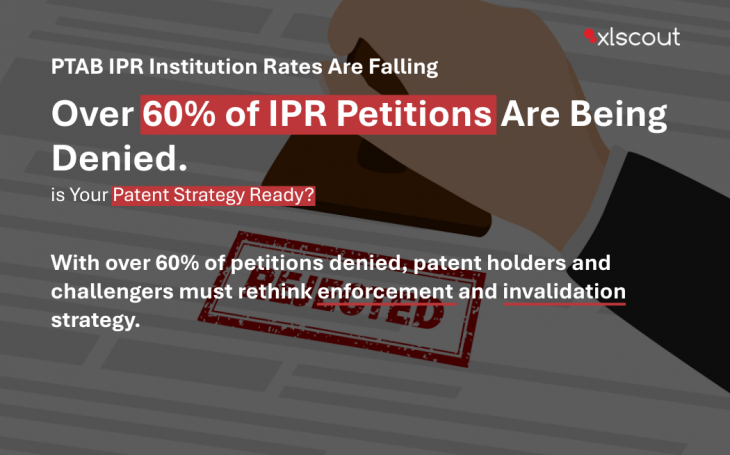
PTAB Is Denying Over 60% of IPR Petitions

Introduction

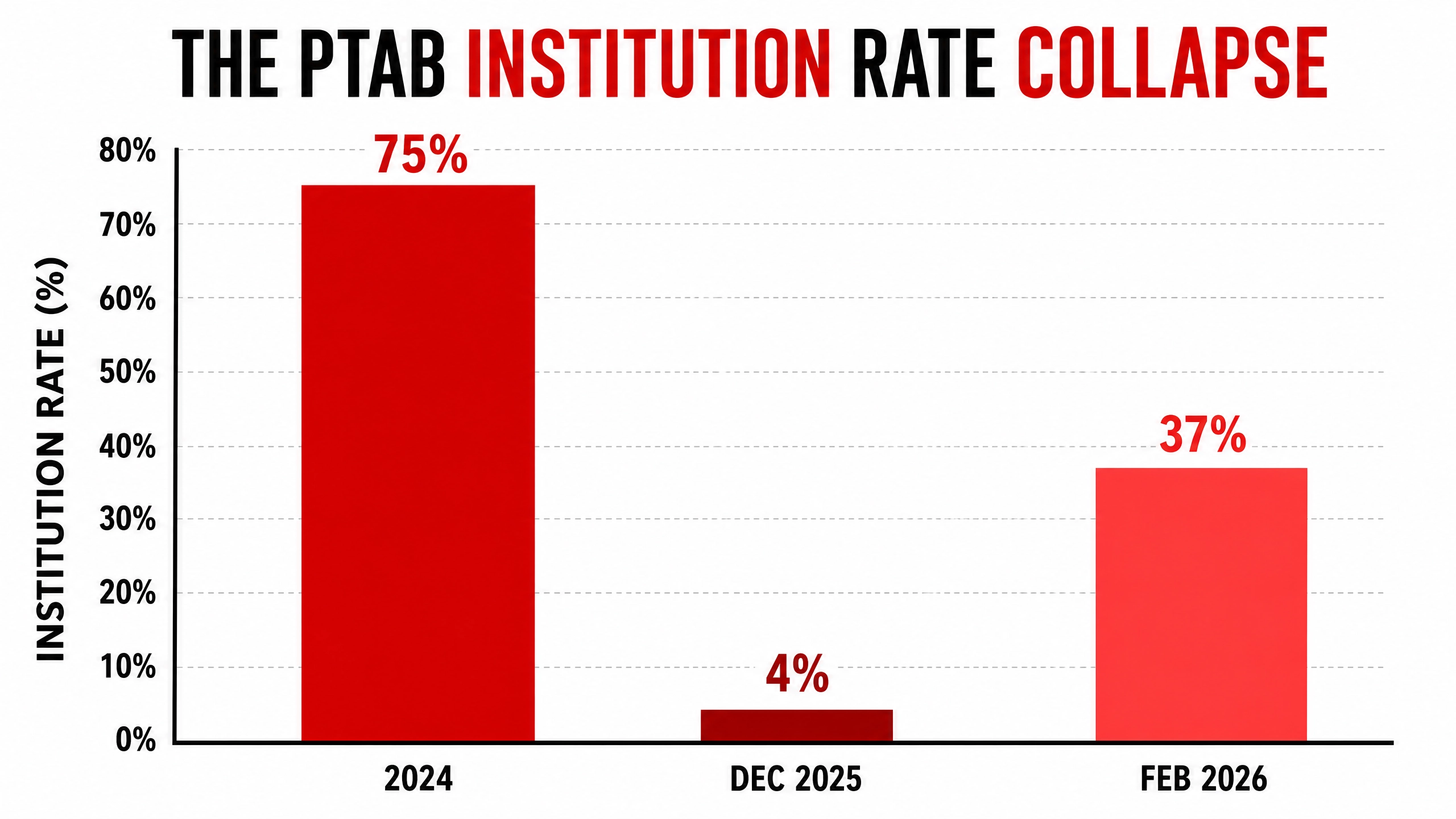
The number that changed everything: in late 2025, USPTO Director John Squires issued 34 consecutive IPR denials — every single petition he personally reviewed. At that point, the institution rate had effectively hit zero.

That was the inflection point. By early 2026, the overall institution rate had dropped 43% from its 2024 baseline — from 65% to around 37%. In Q4 2025, the rate against NPEs fell to just 33.6%. For operating companies, 53.2%.

This is the most consequential shift in US patent enforcement strategy in a decade. If your IP strategy was built on the assumption that IPR is a reliable defensive tool — or that competitor patents are always vulnerable to PTAB challenge — it needs to be rebuilt.

~4%

IPR institution rate at its low point (Dec 2025)

43%

Drop from 2024 baseline (65% → 37%)

+66%

Rise in ex parte reexamination requests in 2025

What Just Changed at the PTAB - and Why

The shift began in early 2025 under Acting Director Coke Morgan Stewart, who introduced new discretionary denial grounds and expanded Fintiv factors. Institution rates dropped from 75% to 46% in months. Then Director Squires took personal control of all institution decisions in October 2025 — and the rate collapsed further.

Two doctrines now define the new landscape. First, Fintiv-based denials: if parallel district court litigation is advanced, the PTAB increasingly defers. Second, and more transformative: the “settled expectations” doctrine. Patents in force for six or more years are now presumed to have established economic expectations that justify denial of IPR institution.

IPR institution rate by quarter

“One of the most consequential developments was the introduction of a ‘settled expectations’ concept for patents older than six years — an approach with no clear precedent in US patent law.”

— Wolf Greenfield IP outlook, February 2026

If You're a Patent Holder: This Is the Best PTAB Environment in Years

For companies on the receiving end of IPR petitions, the shift is unambiguous good news. Patents that would have been instituted and invalidated under the old framework are now surviving. Older patents in force 6+ years carry a presumption of stability that challengers must actively overcome.

Strategic actions for patent holders right now:

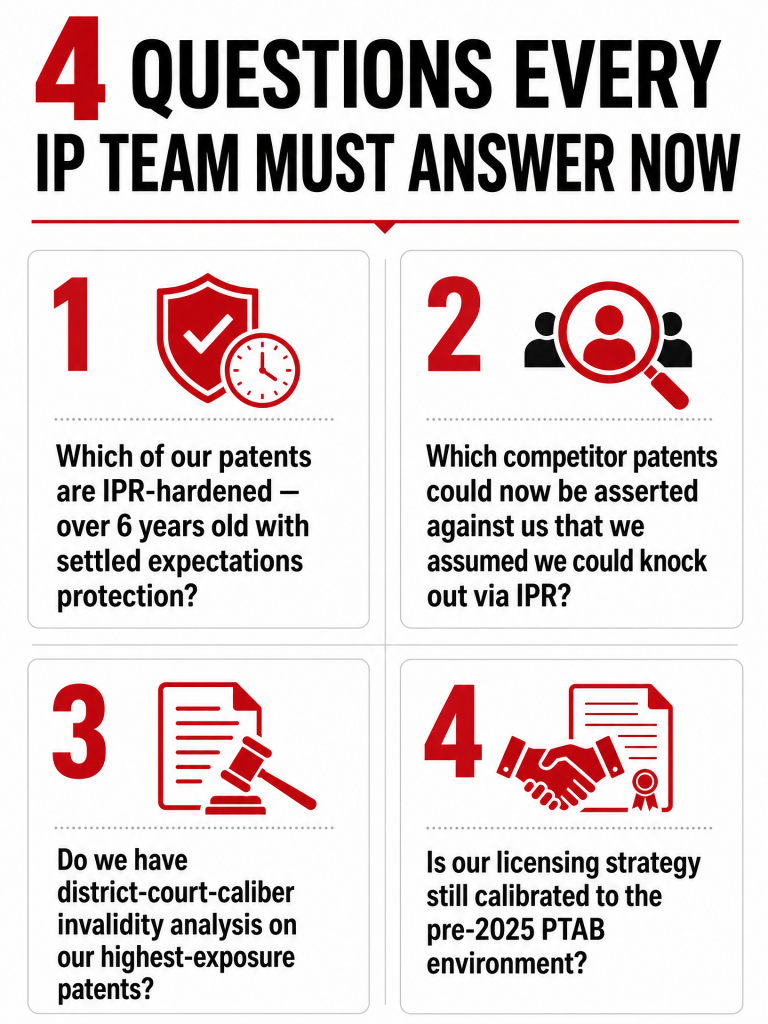
  • Audit your portfolio for ‘IPR-hardened’ assets. Identify patents that are now substantially harder to challenge — these have increased licensing leverage.
  • Reassess settlement positions. If you were conceding leverage to avoid IPR, recalibrate. Challengers have fewer administrative options.
  • Review pending licensing negotiations. Patents you considered too risky to assert may now be assertable on stronger footing.
  • Don’t wait on enforcement. The settled expectations doctrine rewards patents that have been in force — not patents that haven’t been asserted yet.

If You're a Patent Challenger: The IPR Path Just Got Much Harder

For defendants and challengers, the calculus is reversed. The default assumption — that an IPR filing will at least put a patent on the defensive — no longer holds. This changes litigation economics significantly.

Where challengers are pivoting:

    1. Ex parte reexamination. Reexam requests hit an all-time high of 726 in 2025 — a 66% increase over 2024. It’s not perfect, but it avoids PTAB discretion entirely.
    2. District court invalidity defenses. Expensive and slow, but not subject to discretionary denial. Pre-litigation invalidity preparation has become more critical, not less.
    3. Freedom-to-operate and design-arounds. For companies still in development, designing around risky patents before enforcement is now a more attractive option than challenging post-assertion.
    4. Pre-licensing validity screening. Before agreeing to licensing terms, understand the true validity risk — not the assumed IPR-discounted version.

How XLSCOUT's Invalidator LLM Supports the New PTAB Reality

With IPR less accessible, pre-litigation invalidity analysis is now the primary defensive tool. Invalidator LLM gives your IP team the analysis that used to take outside counsel weeks — available before any demand letter changes the timeline.

  • 600+ prior art results, ranked by claim-element overlap — in under an hour.

    ~600 prior art results mapped with the target patent's specific claim elements — in 30–40 minutes. Not a general search. A claim-level prior art map with scored relevance for each result.

  • Claim-element color coding: strongest invalidity arguments surfaced at a glance.

    Color-coded dashboard: green for direct overlap on each claim element, yellow for partial, red for no overlap. Your team sees the strongest invalidity arguments immediately, without manually building the analysis.


  • Automatic multi-reference obviousness combinations — weeks of analysis in minutes.

    Obviousness combinations identified automatically — where two prior art references together address a claim, the system flags the combination and explains which elements each covers. This analysis typically takes outside counsel weeks to construct.

  • Detailed per-reference reports with paragraph evidence and AI mapping commentary.

    Detailed per-reference report: three relevant paragraphs from each prior art result mapped to specific claim elements, with AI-generated commentary explaining the mapping.

  • NPL coverage: academic papers and web results alongside patent prior art.

    Non-patent literature — web sources, academic papers — covered in dedicated sections alongside patent results. Claims with limited patent prior art get searched across NPL automatically.

  • Add your own prior art references: system re-ranks the full result set incorporating them.

    Prior art you've already identified can be added to the search — the system incorporates those references and re-ranks the full result set against them.

The PTAB shift changed how invalidity analysis works. See Invalidator LLM in action.

Why stay behind? Get in touch with us!


Copyrights © 2026 XLSCOUT. All Rights Reserved.