


Introduction
A patent whitespace is not simply a technology no one has patented. It is a technical area where patent density is low enough relative to commercial importance that a filing now — based on current R&D output — can establish a defensible IP position before the space fills. Identifying those areas before competitors is the difference between a first-mover patent position and an expensive design-around exercise.
Traditional whitespace analysis is slow, static, and disconnected from R&D planning. TechScaper LLM replaces the annual whitespace report with a continuous, heat-mapped intelligence layer that keeps R&D and IP teams aligned on the same opportunity map.
What Is Patent Whitespace Discovery?
Patent whitespace discovery is the process of identifying sub-fields within a technology domain where patent density is low relative to commercial importance — areas where novel technical developments can be broadly protected before competitors establish dominant positions.
A whitespace analysis typically answers: where in our technology domain are there filing opportunities? Which areas are already crowded with competitor patents? Where is density increasing rapidly — indicating a space that is closing? A full explanation of the methodology is covered in the guide to patent landscape white space extraction.
Why Whitespace Discovery Matters for R&D Teams
IP teams that identify whitespaces and file into them ahead of competitors are building patent positions that drive long-term commercial value — through licensing revenue, cross-licensing leverage, and freedom to operate in markets that would otherwise require designing around competitor rights.
For European R&D teams running Horizon Europe-funded projects, whitespace analysis also supports the IP management obligations under Article 36 of the grant agreement, which requires beneficiaries to actively identify and protect IP generated during the funded project.
For Asian R&D teams in semiconductor and clean energy, whitespace identification is the basis for the technology scouting programmes that are growing at 22.4% CAGR in 2026 across the patent intelligence market.
The Limits of Traditional Whitespace Analysis
Static reports go stale quickly
A whitespace analysis produced in January may not reflect the filing environment of June. In technology areas where filing velocity is high — semiconductor, AI hardware, EV battery chemistry — a single quarter of competitor filings can materially shift which areas are open and which are closing.
Manual density mapping is slow
Building a whitespace map manually requires exporting large patent result sets, classifying them by technology sub-category, and building density charts from the results. The process that patent landscape analysis traditionally requires — weeks of analyst effort — delivers a picture that is already out of date when it arrives.
Geographic asymmetries are missed
A technology heavily patented at the USPTO but not yet filed at the EPO or JPO represents a geographic whitespace in those markets. Manual analysis rarely has the cross-jurisdictional coverage to surface these asymmetries. The opportunity is missed because the analysis only looks at one database.
R&D roadmap alignment is disconnected
Even when a whitespace map is produced, connecting it to R&D investment priorities requires a separate process. The whitespace insight sits in a slide deck. The R&D roadmap sits in a product planning system. The two are rarely reconciled in the same workflow.
How TechScaper LLM Maps Patent Whitespace
TechScaper LLM generates heat-maps that score technology nodes by density, filing velocity, freshness, and strategic fit to your R&D priorities. Low-density, high-potential nodes surface as whitespace opportunities. High-density, high-velocity nodes are flagged as areas where competitive pressure is intensifying.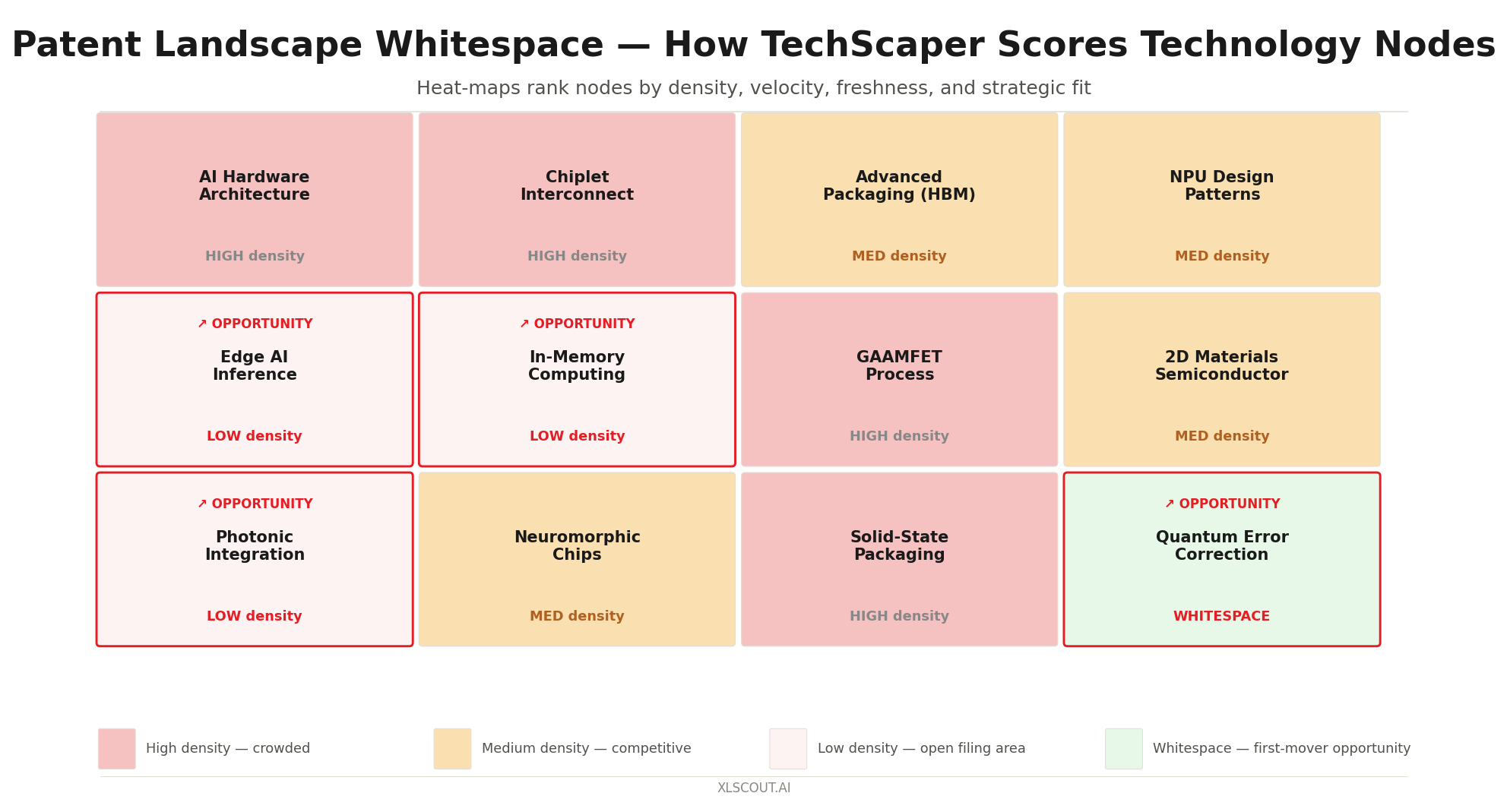
The output is not a static report. It is a continuously updated intelligence layer that reflects the actual state of the patent landscape as new filings enter the database.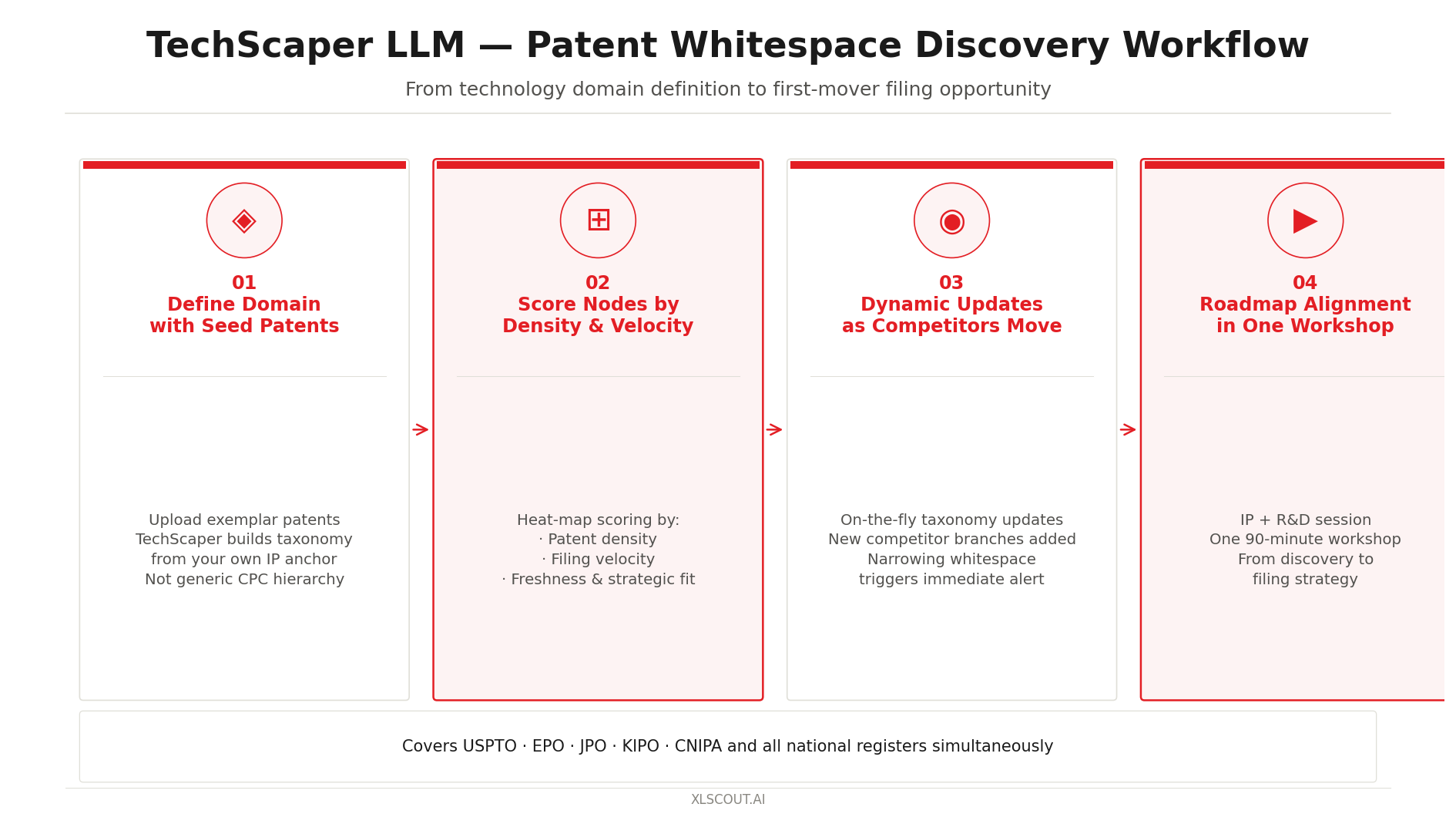
1. Define the Technology Domain with Seed Patents
TechScaper LLM builds the technology map from your own IP anchor — not a generic keyword cluster. Upload exemplar patents that define your technology area, and TechScaper constructs the taxonomy from that specific starting point. Optional taxonomy definitions provide additional precision for teams that already have a structured technology classification system.
This matters because whitespace analysis is only useful if it is calibrated to the technology domain that is actually relevant to your R&D investment decisions — not a generic industry classification that may misrepresent your specific competitive landscape.
2. Score Nodes by Density, Velocity, and Fit
TechScaper’s heat-map scoring evaluates each technology node across four dimensions: patent density (how many patents already exist), filing velocity (how fast new filings are entering the space), freshness (how recently those filings occurred), and strategic fit (how closely the sub-domain aligns with your R&D priorities and capabilities).
Nodes with low density, low velocity, high freshness, and strong strategic fit surface as the highest-priority whitespace opportunities. Nodes with high density and rising velocity are flagged as spaces that are closing — where the filing window is narrowing and first-mover advantage is diminishing.
3. Dynamic Updates as Competitors Move
When a competitor files into a previously low-density node, TechScaper detects the activity within the monitoring cycle and updates the heat-map in real time. If a whitespace you identified is beginning to fill, you receive an alert before the filing activity consolidates into a blocking position.
On-the-fly taxonomy updates allow new competitor branches to be added without re-running the full classification exercise. If a competitor diversifies into an adjacent area — EV charging infrastructure from an EV battery position, for example — TechScaper adapts the monitoring scope to reflect the expansion.
4. Align the Roadmap in One Workshop
TechScaper’s whitespace heat-map becomes the agenda for an IP and R&D alignment session. The heat-map shows where density is low, velocity is manageable, and strategic fit is high. R&D leaders can directly connect those open nodes to active research projects and assess which current R&D outputs could be converted into first-mover patent filings.
One 90-minute workshop to align the patent roadmap with the technology roadmap — using the same whitespace intelligence that both teams can see in the same interface.
Why This Matters for European and APAC R&D Teams
For European teams, the Unitary Patent changes the economics of whitespace filing. A single Unitary Patent filed into a whitespace creates blocking positions across all 18 UPC member states simultaneously — from Germany and France to Denmark, Italy, and 14 other markets.
First-mover value in European whitespaces is disproportionately high relative to the filing cost. European R&D teams using AI for patent ideation are already recognising that whitespace intelligence is what makes ideation strategically productive rather than technically interesting.
For APAC teams in semiconductor, clean energy, and precision manufacturing, whitespace discovery provides the competitive intelligence needed to direct R&D investment toward areas where IP can be broadly protected rather than narrowly carved around existing art.
In Korea, where Samsung and SK Hynix file at very high volume in narrow technical areas, whitespace identification requires the kind of cross-domain, multi-jurisdictional heat-mapping that only AI can produce at operational speed.
Why XLSCOUT Stands Out
- Heat-map scoring by density, velocity, freshness, and strategic fit — not simple patent counting
- Seed patent training: taxonomy built from your IP anchor, not generic CPC classification
- Dynamic updates: whitespace map reflects current filing activity, not a static snapshot
- On-the-fly taxonomy updates when competitors move into adjacent areas
- One 90-minute workshop to align IP and R&D roadmaps using the same whitespace intelligence
- Cross-jurisdictional coverage: USPTO, EPO, JPO, KIPO, CNIPA, and national registers
- Continuous monitoring: narrowing whitespace alerts arrive before opportunities close
Patent whitespace is not a fixed asset. It changes every quarter as competitors file, markets shift, and technology areas mature. TechScaper LLM gives R&D teams a real-time view of that change — so the whitespace opportunities they identify are the ones that actually exist today, not six months ago.
See How TechScaper LLM Supports Whitespace Discovery Workflows
If your R&D team wants to move from periodic whitespace reports to continuous opportunity intelligence, TechScaper LLM makes that operational.