


Introduction
Every patent application begins with a question: has this been done before? The answer — and how quickly and accurately teams can get to it — determines whether an R&D investment is protected or wasted. A patent novelty search conducted before filing separates the inventions worth protecting from the ideas that already exist in the prior art record.
XLSCOUT Novelty Checker LLM applies semantic AI search across 170M+ patents and non-patent literature to deliver novelty assessments that are 90% more accurate than free tools and 8X more accurate than paid alternatives — in hours, not weeks.
What Is Patent Novelty Search?
A patent novelty search — also called a patentability search — is a systematic review of existing prior art to determine whether an invention is new and non-obvious. Under 35 USC §§ 102 and 103, a patent may only be granted for inventions that are novel and not obvious in light of existing public disclosures.
Novelty search is used by:
- R&D teams validating whether a new technical development is worth filing
- Patent attorneys advising clients on patentability before drafting
- University TTOs screening faculty inventions before pursuing protection
- IP teams benchmarking new developments against the competitive patent landscape
Why Novelty Search Matters for R&D Teams
Filing a patent application on an invention that lacks novelty wastes filing fees, prosecution costs, and attorney time. More importantly, it diverts IP budget from applications that could actually be granted. Reducing R&D risk through early novelty detection is one of the highest-return applications of AI in the IP workflow.
Beyond avoiding wasteful filings, novelty search at the R&D stage informs the direction of innovation. When teams understand the existing IP landscape in a technical area, they can direct development toward genuine whitespace rather than into territory already patented by competitors.
The Limits of Traditional Novelty Search
It is too slow for R&D speed
Traditional novelty searches through outside counsel take one to two weeks and cost $1,500 to $3,000. R&D teams generate ideas continuously — and ideas move fast. By the time a search comes back, the team has already moved on or the competitive landscape has shifted.
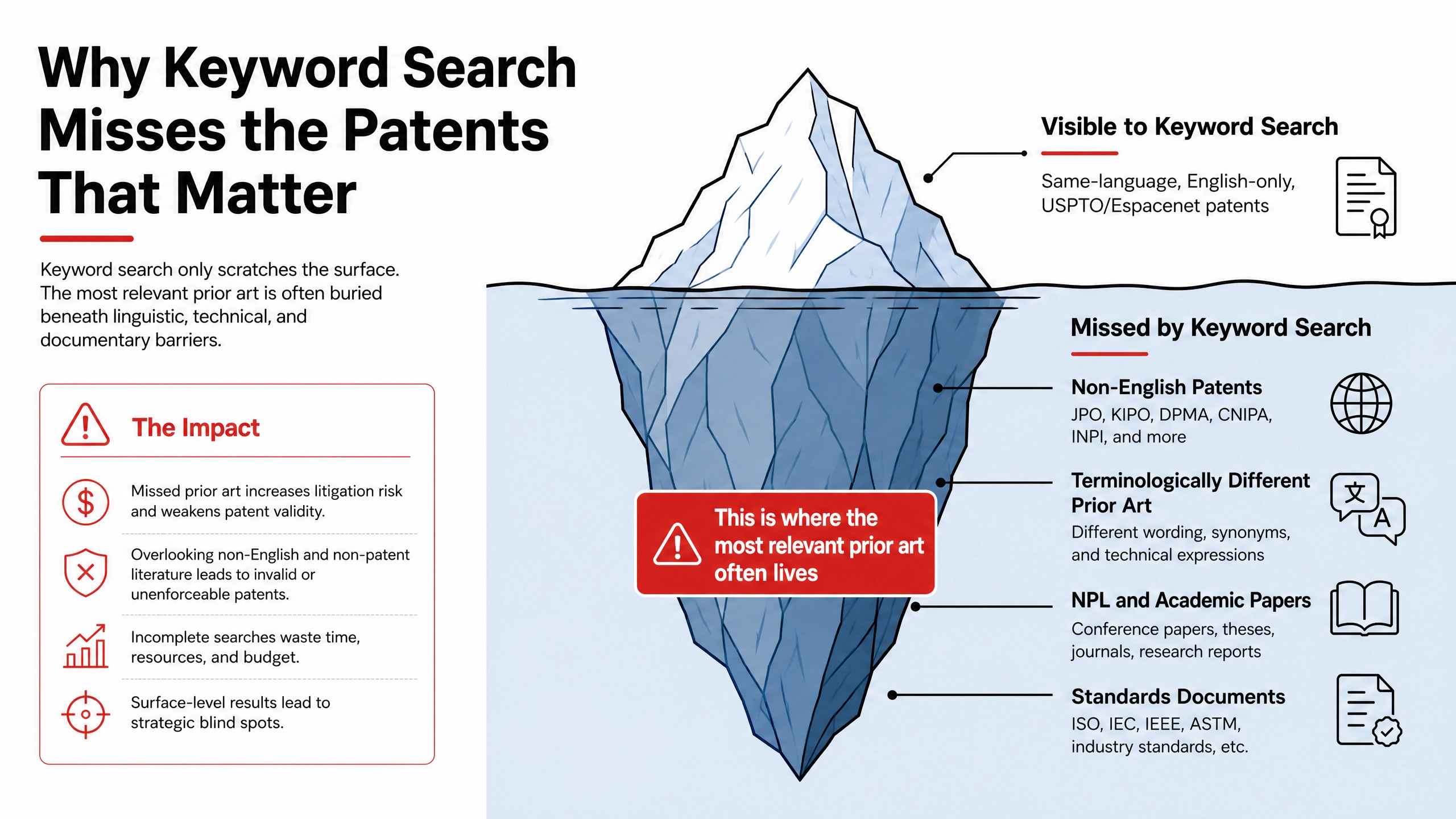
Keyword search misses conceptually equivalent prior art
A semiconductor engineer searching for novelty in a “gate-all-around transistor” may miss prior art describing a “surrounding gate FET” — the same invention in different terminology. Keyword-based searches require the searcher to anticipate every terminological variation before the search begins, which is impossible in cross-disciplinary technology areas.
Non-English prior art is systematically missed
Japan’s JPO, South Korea’s KIPO, and Germany’s DPMA file millions of patents annually in technical areas critical to semiconductor, automotive, and consumer electronics innovation. English keyword searches over USPTO and Espacenet databases cannot adequately index these patent corpora — creating structural blind spots in every conventional novelty search.
Results require extensive manual review
Conventional search tools return large result sets that require attorney review to assess relevance. There is no automated mapping of prior art to specific claim elements, no ranking by relevance to the specific inventive concept, and no differentiation between what is anticipated versus merely related.
How AI Improves Patent Novelty Search
AI novelty search tools replace keyword matching with semantic understanding — finding prior art based on technical meaning rather than specific terminology. The best tools rank results by relevance to the specific inventive concept, map references to claim elements automatically, and extend coverage to non-English databases at the same speed as English-language search.
XLSCOUT Novelty Checker LLM and Patent Novelty Search
XLSCOUT Novelty Checker LLM is purpose-built for patentability analysis — combining ParaEmbed semantic search with automated prior art ranking and multi-jurisdictional coverage in a workflow designed for R&D teams and patent attorneys.
1. AI Search Across 170M+ Patents and NPL
Novelty Checker LLM searches across XLSCOUT’s full patent and non-patent literature database using ParaEmbed — XLSCOUT’s proprietary LLM basedg model trained on 170M+ global patent documents.
The search finds prior art based on what an invention does, not what it is called. This captures the full range of relevant prior art regardless of the terminology an inventor uses to describe their development — including in Japanese, Korean, German, and Chinese patents that keyword searches cannot reach.
2. Automated Prior Art Ranking and Relevance Scoring
Every result is ranked by relevance to the specific inventive concept, with confidence scores indicating how closely each reference maps to the key features of the disclosure. The most relevant prior art surfaces first — not buried in a 200-document result set that requires hours of manual review.
74% of the top prior art results found by expert human searches appear in XLSCOUT’s top-10 results. The references that matter most are the ones that appear at the top of the ranked list.
3. Para-Picx Visual Novelty Search
For mechanical, electromechanical, and semiconductor inventions where the novel concept is expressed in drawings rather than claim text, Para-Picx™ adds image-based novelty search. Upload a product image or technical drawing and receive prior art results matched on visual similarity — the category of existing art that text-only searches systematically miss.
4. Claim-Element Level Prior Art Mapping
Novelty Checker LLM maps each identified prior art reference to the specific claim elements it addresses. Patent attorneys receive a structured analysis showing which elements of the invention are anticipated, which are novel, and which may be obvious in combination with other references — the information needed to advise on patentability and inform claim strategy.
Why This Matters for Modern IP Teams
PatSnap is the market leader in patent analytics but requires significant analyst time to interpret search results — there is no automated claim-element mapping or patentability scoring. IPRally excels at graph-based prior art search but lacks NPL coverage and claim-level analysis. Derwent Innovation is enterprise-priced with a steep learning curve. XLSCOUT Novelty Checker LLM delivers faster, more accurate results in a workflow designed for IP teams without requiring dedicated patent analysts.
Why XLSCOUT Stands Out
- ParaEmbed semantic search: 90% more accurate than free tools, 8X more accurate than paid alternatives
- 170M+ patents from 100+ jurisdictions including JPO, KIPO, DPMA, CNIPA
- Full NPL coverage alongside patent databases in a single search
- Para-Picx visual search for mechanical and circuit patents
- Automated claim-element level prior art mapping — results structured for patentability analysis
- 74% of expert-found top prior art appears in XLSCOUT’s top-10 results
After establishing novelty, teams can move directly to application drafting with Drafting LLM — informed by the prior art landscape identified in the novelty search.
See How Novelty Checker LLM Supports Patentability Analysis
If your R&D team wants to validate invention novelty before committing to filing, Novelty Checker LLM provides the speed and accuracy that makes pre-filing patentability analysis practical at scale.