


Traditional patent invalidity search is a high-stakes, time-intensive process. Litigation teams spend weeks combing through patent databases, non-patent literature, and standards documents — hoping to find the prior art reference that can break an asserted claim. The margin for error is near zero.
AI changes that. XLSCOUT Invalidator LLM applies semantic search, image analysis, and standards mining across 170M+ patents and NPL to surface the most relevant prior art references — ranked, mapped to claim elements, and ready for attorney review.
What Is Patent Invalidity Search?
Patent invalidity search is the process of identifying prior art that anticipates or renders obvious one or more claims of a patent. It is the foundation of inter partes review (IPR) petitions, invalidity contentions in district court, and post-grant proceedings at the USPTO and EPO.
A thorough invalidity search covers:
- Issued patents and published applications across all major jurisdictions
- Non-patent literature — academic papers, technical standards, product manuals, conference proceedings
- Standards documents from 3GPP, ETSI, IEEE, ITU, and similar bodies
- Product and system art from contemporaneous commercial products
Why Patent Invalidity Search Matters
US courts awarded $4.19 billion in patent infringement verdicts across 72 cases in 2024. The ability to find and present compelling prior art is often the difference between a defeated infringement claim and a nine-figure damages award. With PTAB IPR institution rates declining significantly — making post-grant challenges harder to initiate — the quality of prior art discovered before IPR filing has never been more critical.
Invalidity search also supports licensing negotiations, patent acquisition due diligence, and freedom-to-operate analysis by assessing whether blocking patents are vulnerable.
The Limits of Traditional Invalidity Search
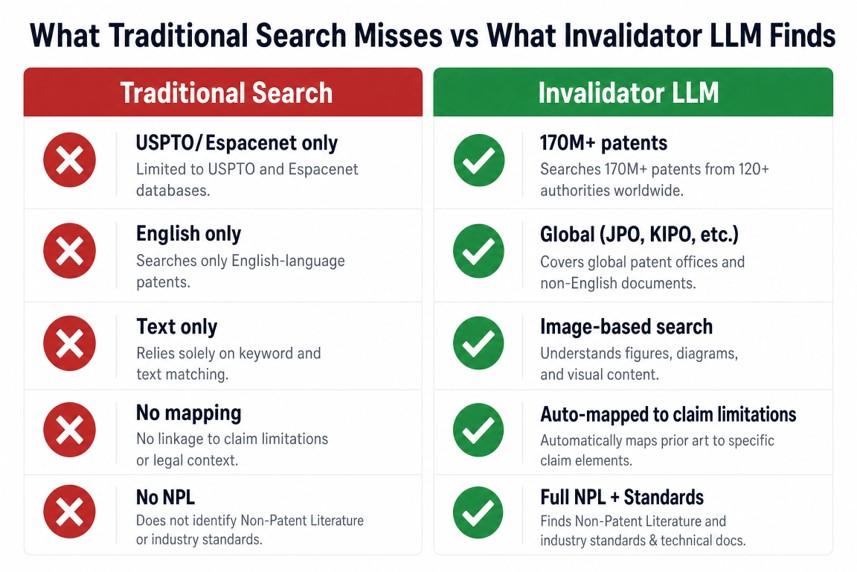
It is slow and expensive
A traditional outside counsel invalidity search takes two to four weeks and costs $5,000 to $15,000 per patent. For portfolios or multi-defendant cases involving dozens of patents, that timeline is incompatible with litigation schedules.
It misses non-English and standards prior art
Keyword-based searches over USPTO and Espacenet databases miss Japanese, Korean, and German prior art that is terminologically inconsistent with English claim language. They also miss standards documents — the technical specifications where the inventive concept often predates the asserted patent by years.
It does not map to claim elements
Most prior art search tools return document-level results. Litigation teams then spend additional days manually mapping each reference to specific claim limitations. This translation step is where prior art is misread and opportunities are missed.
It cannot scale to contested portfolios
When a defendant faces assertion of 10, 20, or 50 patents simultaneously, a traditional one-search-per-patent approach is untenable. Volume invalidity work requires a fundamentally different methodology.
How AI Improves Patent Invalidity Search
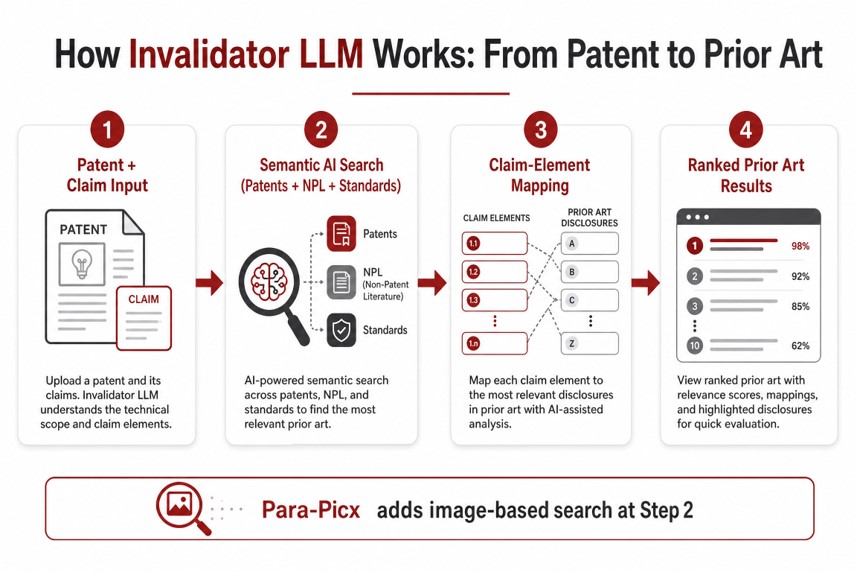
AI improves invalidity search by replacing keyword matching with semantic understanding — finding prior art that describes the same technical concept regardless of the terminology used. It extends coverage to non-English databases and standards documents that keyword tools miss. And it maps results to claim elements automatically, so attorneys receive a ranked, claim-structured analysis rather than a raw document list.
XLSCOUT Invalidator LLM and Patent Invalidity Search
XLSCOUT Invalidator LLM is purpose-built for invalidity search — not a feature within a broader analytics platform, but a dedicated module designed around the specific demands of litigation and IPR proceedings.
1. AI Prior Art Search Across Patents and NPL
Invalidator LLM uses ParaEmbed — XLSCOUT’s proprietary AI embedding model — to search across 170M+ patents from 100+ jurisdictions and a comprehensive non-patent literature database simultaneously.
The search finds prior art based on technical meaning, not keyword matching. A patent claiming “a neural network classifier” is matched to prior art describing “a multi-layer perceptron for pattern recognition” — without requiring the searcher to anticipate every terminological variation in advance.
2. Standards Document Mining
For patents in telecommunications, wireless, video coding, and networking — where technical standards often predate asserted patents by five to ten years — Invalidator LLM searches across 3GPP TDocs, ETSI standards, IEEE specifications, and ITU recommendations.
Standards prior art is frequently the strongest available reference for cellular and Wi-Fi patents. Invalidator LLM makes it searchable at the same speed as patent databases.
3. Claim-Element Level Mapping
Every result is automatically mapped to the specific claim elements it addresses. Attorneys receive a structured analysis showing which prior art references cover which limitations of the independent claims — not a list of documents to read from scratch.
This claim-element mapping is what transforms a prior art search into an invalidity analysis. It is also what allows Invalidator LLM to produce outputs that 74% of the time mirror what expert human searchers find when ranked by relevance.
4. Image-Based Prior Art Search with Para-Picx
For mechanical, electromechanical, and semiconductor patents where the inventive feature is expressed in drawings rather than claim text, Para-Picx™ adds image-based prior art search. Upload a patent figure or product diagram and receive results matched on visual similarity — the class of prior art that text-only searches systematically miss.
5. Continuous Monitoring for New Prior Art
Patent litigation unfolds over months and years. New prior art publishes continuously. Invalidator LLM integrates with XLSCOUT’s patent monitoring to alert litigation teams when newly published patents or NPL references are relevant to cases in progress — so prior art discovery does not end at the petition filing date.
Why This Matters for Litigation Teams
Invalidity search quality determines IPR institution decisions, influences settlement negotiations, and shapes litigation strategy. The difference between a 90%-accurate AI search and a 30%-accurate keyword search is the difference between finding the blocking reference and missing it.
Invalidator LLM delivers 90% more accurate results than free patent search tools and 8X more accurate than paid alternatives. 74% of prior art results found by expert human searches appear in the top-10 Invalidator LLM results — the references that matter most surface first.
Why XLSCOUT Stands Out
- Purpose-built for invalidity — not a feature within a general analytics platform
- ParaEmbed semantic search: 90% more accurate than free tools, 8X vs paid alternatives
- Full NPL and standards coverage (3GPP, ETSI, IEEE, ITU) in a single search
- Claim-element level mapping — results structured for attorney review, not raw document lists
- Para-Picx image-based search for mechanical and circuit patents
- 74% of top expert-found references appear in top-10 results
For teams needing to combine invalidity with claim chart generation, ClaimChart LLM provides the downstream workflow — mapping prior art references to product claim charts for licensing and enforcement.
See How Invalidator LLM Supports Patent Invalidity Workflows
If your litigation team is looking to move beyond keyword-based prior art search, Invalidator LLM provides the speed, coverage, and claim-level mapping that IPR and district court invalidity work requires.