


Introduction
The gap between engineering and IP is a structural problem in most product companies. Engineering teams build to a specification. IP teams review for infringement risk. The two processes rarely happen simultaneously — and the cost of that gap shows up in last-minute design changes, delayed launches, and in some cases, the patent damages awards that follow a missed blocking patent.
AI-powered feature extraction gives both teams a shared starting point: an automatically generated list of the product features most likely to carry patent risk, derived directly from the engineering documentation.
What Is Smart Feature Extraction in FTO Analysis?
Smart feature extraction is the process of automatically identifying which elements of a product disclosure are most likely to correspond to patentable claims in third-party patents. Instead of relying on an engineer to describe the product in patent language — or an IP attorney to manually translate technical documentation — AI extracts the relevant features directly from how the engineering team already documents the product.
The output is a prioritised list of product features, ready for IP team validation, that forms the search basis for the FTO clearance analysis.
Why FTO Clearance for Product Teams Matters
Most FTO analyses are conducted by IP teams in relative isolation from the engineering teams whose products they are clearing. The IP team receives a general product description, runs a patent search, and delivers a report that the engineering team may not have the context to act on.
The more valuable model is FTO clearance that runs alongside engineering — catching patent risk at the feature decision level, before resources are committed to a specific technical implementation. This is the same principle behind reducing R&D risk with early novelty detection applied to the clearance side of the IP lifecycle.
The Limits of Traditional FTO Processes for Product Teams
Engineering teams do not know what to disclose
A product engineer asked to describe their product for FTO purposes will typically describe function — “the device measures pressure and transmits the reading wirelessly.” They will not naturally describe the specific technical implementation details that determine whether their product reads on a competitor’s claim. Without feature extraction, the FTO search is based on the wrong level of abstraction.
IP teams receive documents they have to translate
When engineering teams do provide documentation, IP teams receive CAD files, technical specifications, and functional descriptions — none of which map directly to the claim-element language needed to run an effective patent search. Manual translation is slow and error-prone.
Clearance happens too late
In most product companies, FTO analysis is initiated when a product is near launch — after the significant engineering decisions have already been made. Design-around at that stage is expensive. The earlier the clearance, the cheaper the resolution.
Risk is distributed unevenly
Not every product feature carries equal patent risk. A FTO search that treats all features as equivalent wastes analysis time on low-risk elements and may under-scrutinise the features that matter most. Smart feature extraction allocates analytical depth proportionally to actual risk.
How XLSCOUT Smart Feature Extraction Changes the Workflow
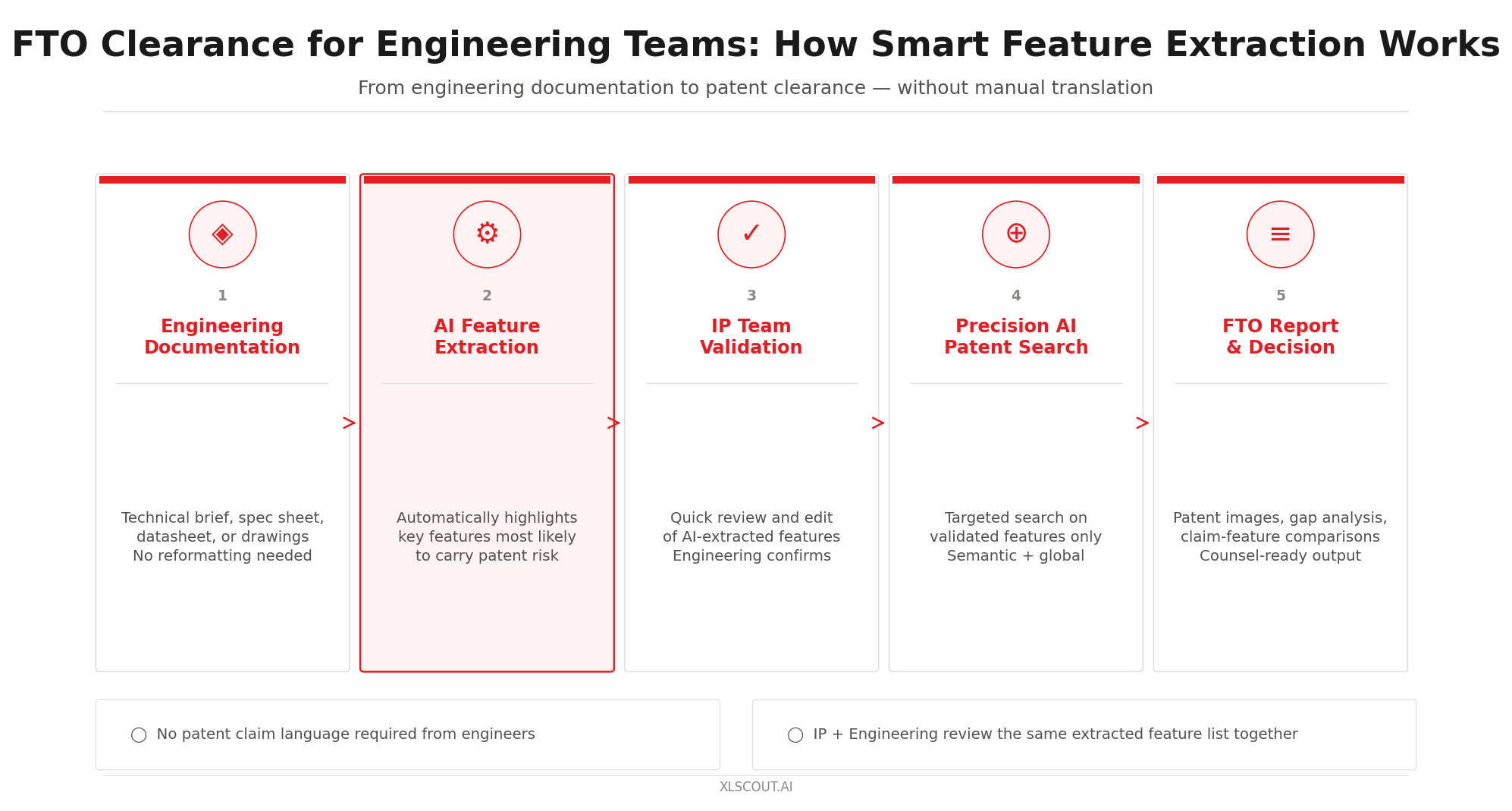
XLSCOUT FTO Module’s Smart Feature Extraction operates directly on the engineering team’s product documentation. The team uploads what they already have — a technical brief, a product specification, a datasheet, or a set of technical drawings. The AI extracts and ranks the key features most likely to map to patent claim elements.
The result is a structured feature list that both engineering and IP teams can review together. Engineers validate that the extracted features accurately reflect the product. IP teams use those validated features as the basis for the precision AI patent search.
1. Upload What Engineering Already Has
XLSCOUT FTO Module accepts product details as text or uploaded documents — technical briefs, specifications, drawings, or datasheets — without requiring any manual reformatting. The input is the documentation engineering teams produce as part of their standard workflow, not a separately prepared patent disclosure document.
2. Extract and Validate Features Together
AI automatically highlights the key product features most likely to carry patent risk. The IP team reviews the extracted feature list and makes quick edits — removing features that are not relevant, adding features the model may have missed, and adjusting priority weighting based on commercial context.
This step creates a shared artefact that engineering and IP teams have both reviewed and agreed represents the product accurately. It is the foundation for the clearance analysis.
3. Run Targeted Patent Search on Validated Features
With the validated feature set, XLSCOUT runs a precision AI patent search — instantly locating and aligning patents to the product with high relevance and confidence. The search is targeted to the features identified as carrying the most risk, not spread uniformly across all product elements.
Coverage extends globally, including non-English language databases where competing technology may have been filed first.
4. Deliver a Report Engineering and IP Can Both Use
The FTO report includes patent images, gap analyses, and claim-feature comparisons in a format that both engineering and IP teams can review together. Engineers can see exactly which of their specific features maps to which competitor claims. IP teams have the structured analysis foundation needed for the formal FTO opinion.
The gap between what engineering built and what IP reviewed — which is where most late-stage surprises originate — is eliminated.
Why This Matters for US Product Teams
The US patent landscape in technology products has become materially more difficult to navigate. IPR institution rates have declined significantly, making it harder to challenge patents after a product is launched. The settled expectations doctrine protects mature patents from post-grant review. And the Eastern and Western Districts of Texas continue to be active venues for patent assertion against product companies.
The combination of a hostile litigation environment and declining post-grant options means that FTO clearance early in the product cycle is not just a best practice — it is increasingly the only cost-effective path to managing patent risk. The alternative is encountering it at the demand letter stage, when the options are expensive. The strategic context here connects directly to what tightening IPR standards mean for patent holders and challengers.
Why XLSCOUT Stands Out
Smart Feature Extraction: automatic identification of the features most likely to carry patent risk
- Works directly from engineering documentation — no translation step required
- Feature validation: IP and engineering review the same extracted feature list together
- Precision AI search targeted to validated features — not uniform keyword coverage
- 90% more accurate than free patent search tools; 8X more accurate than paid alternatives
- Para-Picx™ adds image-based search for hardware and circuit features
- FTO report format usable by both engineering and patent counsel
The goal is not to make FTO analysis a responsibility of engineering teams. It is to give IP teams the tools to run FTO at engineering speed — so clearance decisions happen alongside product decisions, not weeks after them.
See How XLSCOUT FTO Module Supports Product Team Clearance Workflows
If your team is looking to close the gap between engineering documentation and IP review, XLSCOUT FTO Module’s Smart Feature Extraction gives both teams a common starting point. Visit xlscout.ai to learn more.