

Introduction
Patent-ready invention ideas do not always come from the R&D lab in a structured form. Inventors work iteratively — exploring, combining, and refining technical approaches before anything resembles a patentable disclosure. The gap between a promising technical direction and a patent-ready invention is where most IP value is lost.
XLSCOUT Ideacue 10X uses generative AI and LLMs to help R&D teams generate invention ideas, evaluate their novelty against the prior art landscape, and prioritize the strongest candidates for patent filing — all in one connected workflow.
What Is AI Patent Ideation?
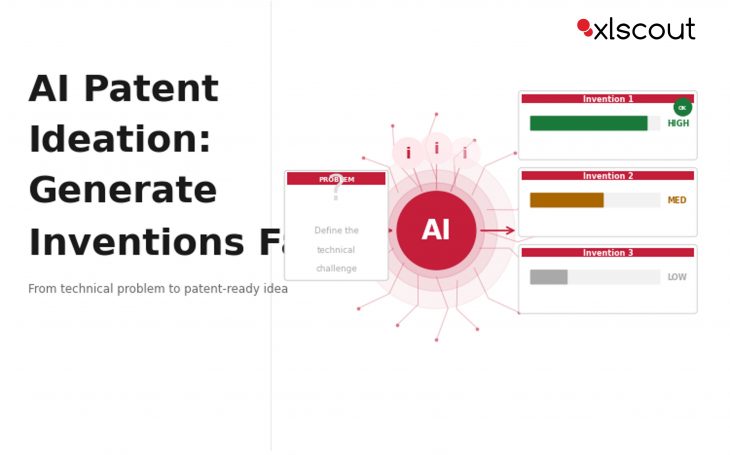
AI patent ideation is the application of large language models to help inventors and R&D teams generate new invention directions, evaluate their technical distinctiveness, and identify the strongest candidates for IP protection.
Effective ideation support helps teams:
- Generate invention ideas in a defined technology domain or in response to a specific technical problem
- Evaluate each idea against existing prior art to identify genuinely novel approaches
- Score and prioritize invention candidates by novelty, breadth, and strategic value
- Move the strongest ideas directly into the novelty search and patent drafting workflow
Why AI Ideation Matters for R&D Teams
The most valuable IP is filed early — when claim scope is broad, when competitors are not yet in the space, and when the invention anchors a technology area rather than incrementally extending it. Systematic AI-assisted ideation gives R&D teams the tools to generate and filter invention ideas at the speed of their development cycles, not the speed of periodic invention disclosure review sessions.
For corporate R&D teams, university research groups, and innovation-led businesses, the ability to continuously surface patentable invention directions from ongoing technical work is the difference between a reactive patent programme and a proactive IP strategy.
The Limits of Traditional Invention Disclosure Processes
Ideation is ad hoc
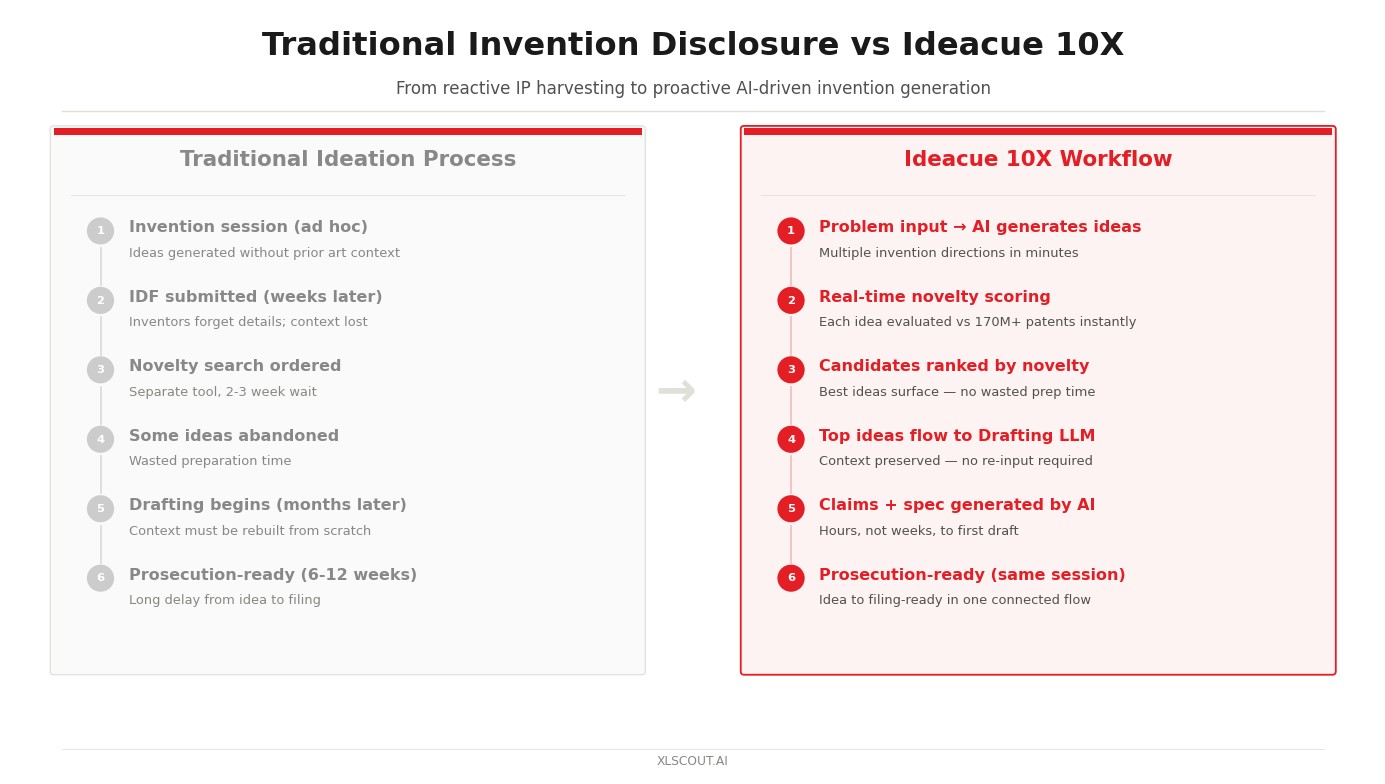
Most IP programmes wait for inventors to come to them. Invention disclosure forms (IDFs) are submitted when an inventor remembers to do it — not systematically harvested from ongoing R&D work. The result is a portfolio biased toward late-stage, narrowly scoped inventions that should have been filed earlier.
Novel ideas are not separated from obvious ones
Without prior art context, R&D teams cannot distinguish between ideas that are genuinely novel and ideas that exist in the prior art. They invest disclosure preparation time in ideas that would fail a patentability search, while genuinely novel developments go undisclosed.
The workflow is disconnected
Traditional ideation sessions, IDF submission, novelty search, and drafting are four separate processes managed by different teams with no shared data. The context from an ideation session that informed a novelty search decision is not available to the attorney drafting the application weeks later.
How AI Improves Patent Ideation
AI ideation tools generate invention directions based on technical problem inputs, evaluate novelty against real-time prior art data, and score invention candidates by their patentability and strategic value. The strongest tools connect ideation directly to novelty search and drafting — so the workflow from idea to application runs in one connected environment.
XLSCOUT Ideacue 10X and AI-Powered Patent Ideation
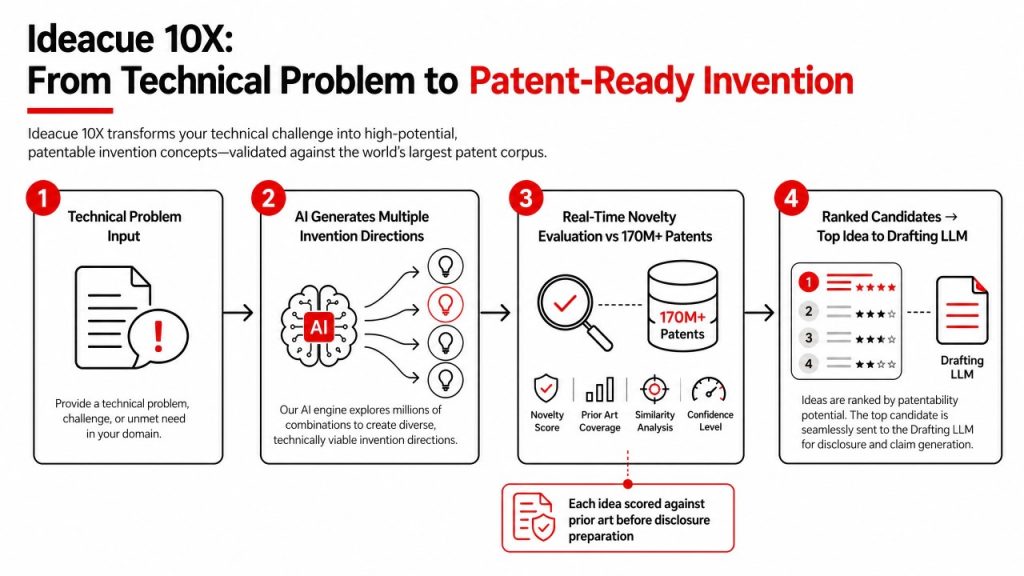
XLSCOUT Ideacue 10X uses generative AI and LLM-based idea evaluation to help R&D teams generate, assess, and prioritize patent-ready invention candidates — and move the strongest ideas directly into the XLSCOUT patent workflow.
1. Problem-to-Idea Generation
Input a technical problem, a development area, or an existing product functionality. Ideacue 10X generates multiple alternative invention directions — different technical approaches to the same problem, novel feature combinations, and adjacent improvement opportunities that R&D teams may not have considered.
The AI draws on its training across the global patent landscape to surface invention directions that are not just technically valid but positioned in areas where IP protection is achievable.
2. Real-Time Novelty Evaluation
Each generated idea is immediately evaluated against existing prior art using Novelty Checker LLM — XLSCOUT’s semantic prior art search engine. Teams see the novelty landscape for each idea before investing any time in disclosure preparation.
This real-time evaluation is the core capability that separates Ideacue 10X from general-purpose AI brainstorming tools. Ideas are not just generated — they are immediately scored against the prior art record that determines whether they can be patented.
3. Invention Candidate Prioritization
Ideacue 10X scores each invention candidate on novelty, claim scope potential, and strategic fit with the R&D team’s defined priorities. The highest-scoring candidates — those with the strongest combination of novelty and strategic value — are surfaced for inventor and IP team review.
This scoring replaces subjective “gut feel” prioritization with data-driven ranking based on actual prior art analysis.
4. Direct Flow to Drafting
The strongest invention candidates flow directly into Drafting LLM — where AI generates the complete patent application from the ideation output. The context established during the ideation session — the problem, the invention direction, the prior art landscape — is carried forward into the drafting workflow without requiring reinput.
This connected workflow compresses what is normally a multi-week, multi-handoff process into a single integrated session.
Why This Matters for Innovation-Led R&D Teams
PatSnap’s innovation intelligence tools help map the landscape but do not generate invention ideas or evaluate novelty in real time. Patlytics automates IDF processing but assumes the invention already exists — it does not assist teams in generating patentable ideas from technical work in progress. Ideacue 10X is designed specifically for the ideation phase — generating ideas, evaluating them, and connecting directly to filing.
Why XLSCOUT Stands Out
- Idea generation from technical problems — not just IDF processing
- Real-time novelty evaluation: each idea scored against 170M+ patents before disclosure preparation
- Integrated with Novelty Checker LLM — seamless prior art evaluation in the same workflow
- Invention candidate scoring: novelty, claim breadth, and strategic fit ranking
- Direct flow to Drafting LLM — context from ideation carried forward to application generation without reinput
- Connects ideation to filing: one platform from idea generation to prosecution-ready application
See How Ideacue 10X Supports AI-Powered Patent Ideation
If your R&D team wants to generate more patent-ready inventions and evaluate them against prior art before investing in disclosure preparation, Ideacue 10X connects ideation, novelty evaluation, and patent drafting in one AI-powered workflow.