

Introduction
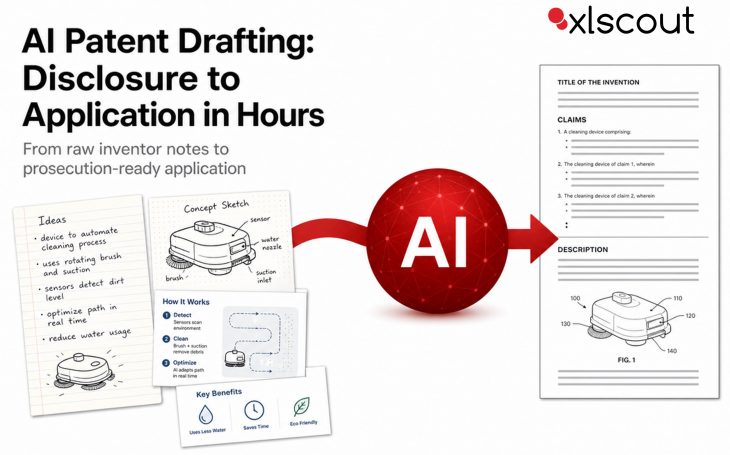
Patent application drafting is one of the most time-consuming tasks in IP practice. A skilled patent attorney typically spends 15 to 30 hours moving from an inventor’s disclosure to a prosecution-ready application — translating technical concepts into claim language, structuring embodiments, and drafting specifications that will hold up under examination. AI patent drafting tools are compressing that timeline significantly.
XLSCOUT Drafting LLM generates complete patent applications from inventor disclosures — claims, detailed description, abstract, and figures guidance — with iterative AI refinement at each stage.
What Is AI Patent Drafting?
AI patent drafting is the application of large language models to automate the conversion of inventor disclosures into structured patent applications. Unlike general-purpose AI writing tools, patent-specific LLMs are fine-tuned on patent corpora and trained to understand claim scope, dependency structure, prosecution history considerations, and the conventions of patent specification writing.
Effective AI patent drafting tools help attorneys:
- Generate independent and dependent claim sets from raw invention disclosures
- Draft detailed descriptions covering multiple embodiments and alternative configurations
- Produce abstracts and summaries aligned with the claims
- Iterate on claim scope with AI assistance during prosecution
Why AI Patent Drafting Matters
Patent application backlogs, client budget pressure, and the increasing volume of invention disclosures from R&D teams are putting pressure on IP departments to draft more applications faster without sacrificing quality. A prosecution-ready application that takes 25 attorney hours at $500 per hour costs $12,500 — before prosecution. At scale, that is unsustainable.
AI drafting does not replace attorney judgment. It eliminates the mechanical translation work — turning a disclosure into a first draft — so attorneys can focus on claim strategy, prosecution decisions, and client counseling.
The Limits of Traditional Patent Drafting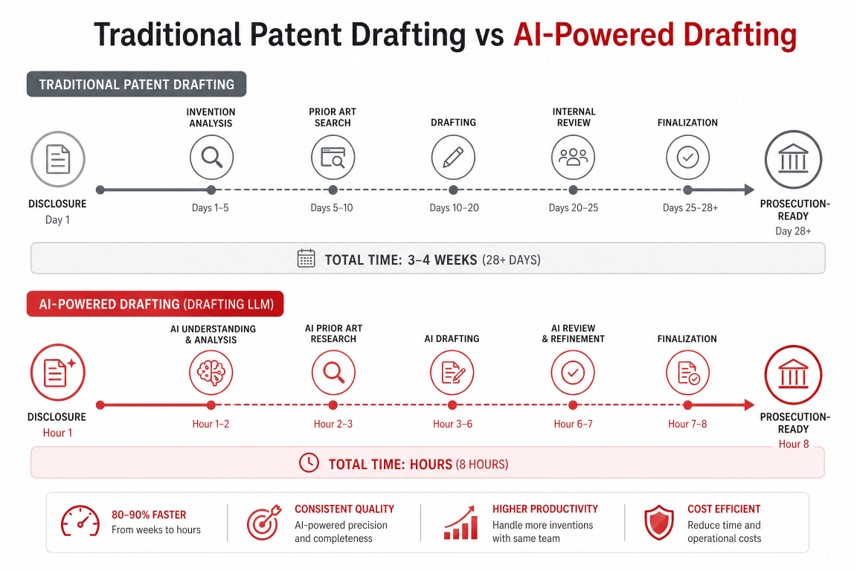
It starts from scratch every time
Each new disclosure means building the claim tree, specification structure, and figure descriptions from zero. Even experienced attorneys spend hours on structural setup before any strategic claim drafting begins. The invention disclosure process is rarely standardized, making every engagement a fresh translation exercise.
Prior art context is not integrated
Traditional drafting happens in isolation from the prior art landscape. Attorneys draft claims without knowing which claim elements are already well-covered by prior art — a gap that only appears during examination. Running a novelty search before drafting is best practice but rarely happens at volume because it doubles the pre-filing timeline.
Iteration is slow
When an examiner rejects claims, the attorney must re-engage with the disclosure, reconstruct the claim strategy, and draft amended claims — repeating many of the original steps. AI-assisted prosecution support can compress this cycle significantly.
Quality is attorney-dependent
The quality of a patent application varies significantly between attorneys, between firms, and between practice areas. AI drafting can establish a consistent baseline quality across the portfolio — surfacing embodiments and claim dependencies that would otherwise be missed.
How AI Improves Patent Application Drafting
AI patent drafting tools improve on traditional workflows by extracting structured inventive concepts from unstructured disclosures, generating claim trees that preserve full scope, drafting specifications with comprehensive embodiment coverage, and enabling iterative refinement through conversational AI interaction.
The strongest tools — unlike general-purpose AI — are trained specifically on patent data and understand how claim scope is defined, how prior art affects claim strategy, and how prosecution history can limit or expand claim interpretation.
XLSCOUT Drafting LLM and Patent Application Drafting
XLSCOUT Drafting LLM takes a complete patent application approach — not a claims-only tool or a specification template generator. It is designed to produce prosecution-ready first drafts that attorneys can refine rather than rebuild.
1. Structured Disclosure Ingestion
Upload inventor disclosures in any format — PDFs, Word documents, presentation slides, or plain text descriptions. Drafting LLM extracts the core inventive concepts, identifies key technical features, and structures the disclosure into the components needed for a complete application.
No reformatting required. The system works with how inventors actually document their ideas, not how attorneys need to receive them.
2. Claim Tree Generation
Drafting LLM generates independent and dependent claim sets that cover the full scope of the disclosed invention. Multiple claim approaches are generated — broad independent claims, narrower fallback positions, and dependent claims covering specific embodiments and alternatives.
The AI understands claim dependency structure, preamble conventions, and means-plus-function considerations — producing claim language that is syntactically correct and strategically structured.
3. Complete Specification Drafting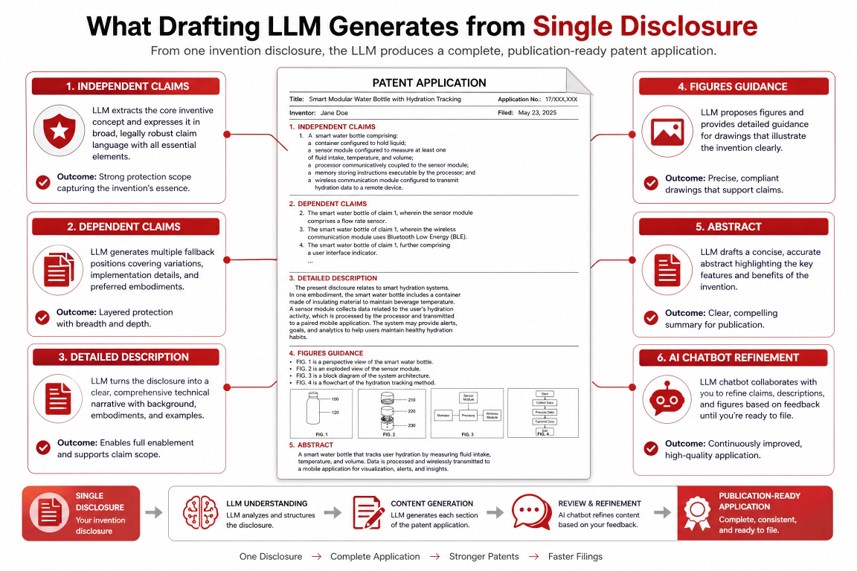
Beyond claims, Drafting LLM generates the full detailed description — covering each disclosed embodiment, alternative implementations, and the operational description of the invention. Abstract and summary sections are produced in alignment with the claims.
The specification is designed to provide written description support for the claims while maintaining flexibility for prosecution amendments.
4. Iterative AI Refinement
Drafting LLM includes an AI chatbot for iterative refinement. Attorneys can request specific claim amendments, broader coverage of particular embodiments, additional dependent claims, or alternative language — and the AI applies those instructions in context, maintaining consistency across the full application.
This iterative capability extends to prosecution. When office action responses require claim amendments, Drafting LLM can propose amended language consistent with the original specification.
Why This Matters for Patent Prosecution Teams
Patlytics AI Drafting CoPilot is positioned for law firms and corporate IP departments at enterprise pricing ($800–2,500 per user per month). Solve Intelligence focuses on prosecution workflows and document editing — strong for office action responses but requiring more structured inputs for initial drafting. XLSCOUT Drafting LLM is designed to generate complete applications from raw disclosures, including for teams without large enterprise budgets.
The practical difference: attorneys receive a prosecution-ready first draft in hours, not days — and spend their time on claim strategy rather than structural setup.
Why XLSCOUT Stands Out
- Complete application drafting: claims, specification, abstract from a single disclosure upload
- Works from unstructured disclosures — PDFs, slides, plain text — no reformatting
- AI chatbot for iterative claim refinement throughout drafting and prosecution
- Pre-draft Novelty Checker LLM integration: run prior art search before drafting to inform claim scope — workflow most competitors do not offer in one platform
- Covers full patent lifecycle: drafting connects to novelty search, prosecution, and portfolio strategy
- LLM fine-tuned on patent-specific data — not general-purpose AI applied to patent documents
See How Drafting LLM Supports Patent Application Workflows
If your team is looking to compress drafting timelines and establish consistent application quality, Drafting LLM is designed to take IP teams from disclosure to prosecution-ready application in hours.