An SOC 2 Type II certified, AI super intelligence platform for innovation and IP: From prior-art searches and AI-assisted ideation to drafting high-quality patents and monetizing innovation!
An SOC 2 Type II certified, AI super intelligence platform for innovation and IP: From prior-art searches and AI-assisted ideation to drafting high-quality patents and monetizing innovation!
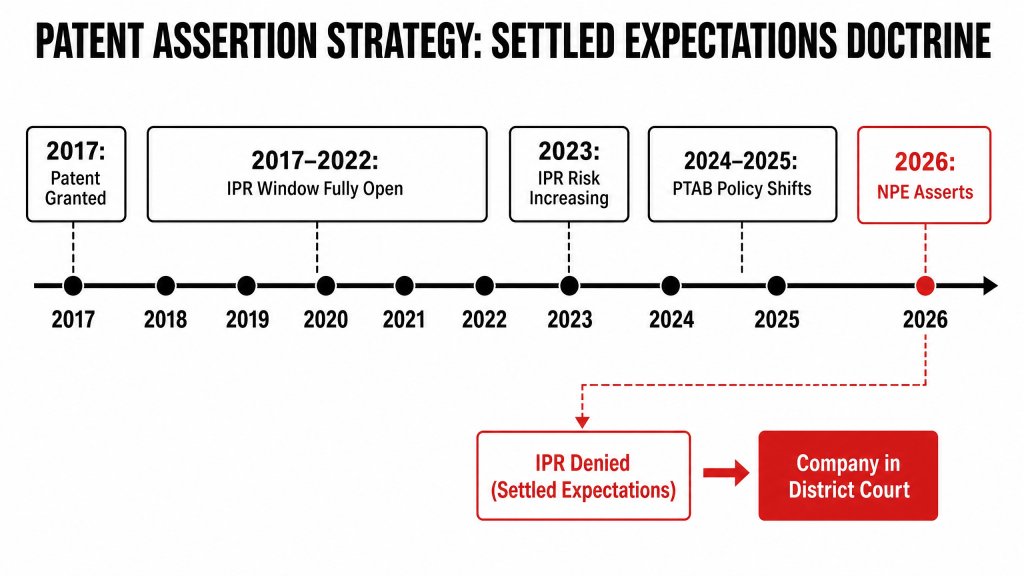
You receive a demand letter. An NPE is asserting a patent granted in 2017. Your natural response: file an IPR to challenge validity. The new reality under the PTAB’s settled expectations doctrine: that 2017 patent has been in force for 8 years, and the PTAB is now highly likely to deny institution.
You’re headed to district court. Expensive, slow, and — if you haven’t been preparing — exposed.
This is not a hypothetical. Multiple IP practitioners have flagged that NPEs are deliberately structuring assertion campaigns around older patents, timing enforcement to maximize the protection the new PTAB framework offers them.
~4%
IPR institution rate at its December 2025 low
6 yrs
Patent age threshold for ‘settled expectations’
+630%
Increase in PTAB procedural denials year-over-year
The 'Settled Expectations' Doctrine: What It Is and Why NPEs Are Using It
Acting Director Stewart introduced the settled expectations doctrine in June 2025. The core principle: patents that have been in force for a significant period create established economic expectations for the patent holder — expectations that warrant protection from PTAB challenge.
In practice, a six-year post-issuance period has emerged as the de facto threshold. Patent granted in 2018? By 2025, an IPR petition faces significant discretionary denial risk. The Federal Circuit has upheld the doctrine in multiple cases, including rejecting mandamus petitions from Google, Motorola, and SAP.
Why Your Existing PTAB Defense Strategy May Not Work Anymore
The old playbook: receive demand letter, file IPR, put the patent on the defensive, negotiate from strength. That playbook assumed a 60-70% institution rate. The current environment is fundamentally different.
What this means practically: companies need to build invalidity cases earlier — before they’re in litigation, not after. The time to find prior art is when you’re not yet under deadline and cost pressure.
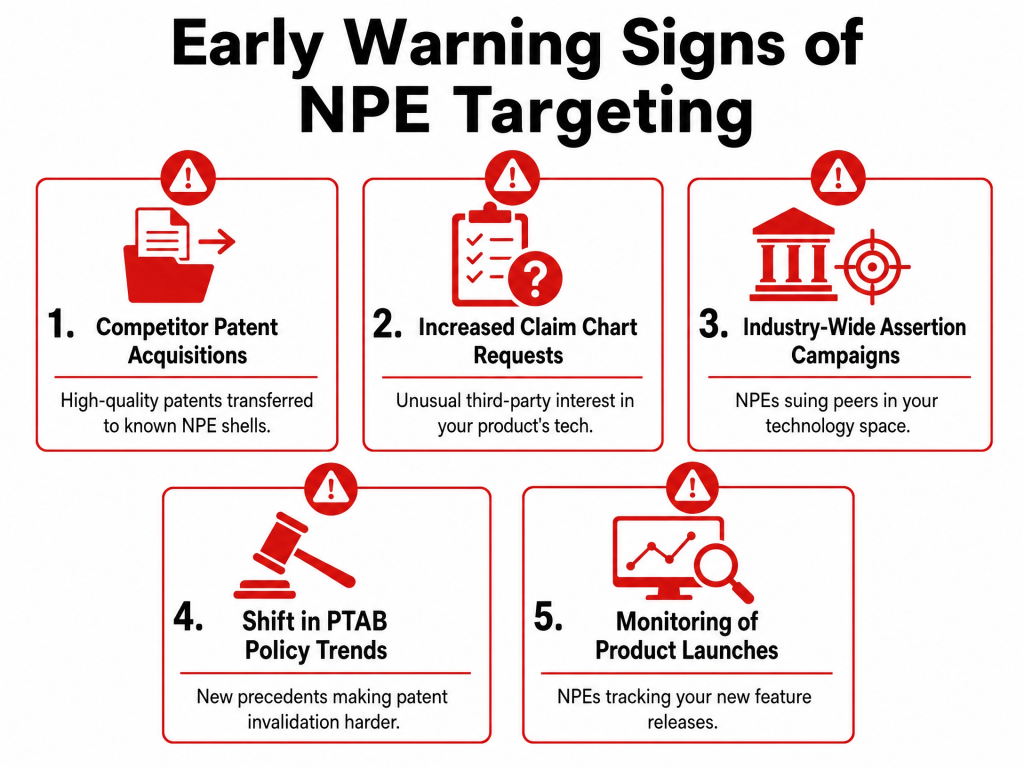
Signs an NPE May Already Be Building a Case Against You
Most companies wait for the demand letter. By then, the NPE has spent months preparing. Watch for these early indicators:
A patent in your technology space recently assigned to an entity with no products or operations
That patent is 5 to 8 years old and has never been asserted
Recent continuation filings claiming priority to the original — broadening claim scope
The entity has started licensing campaigns in adjacent industry verticals
You received a vague licensing inquiry that didn’t name a specific infringement
The 4-Stage Pre-Litigation Defense Framework
Build this before the demand letter arrives:
Patent exposure audit
Identify which third-party patents — including NPE-held assets — represent genuine claim-scope risk to your current product lines. Prioritize by age and enforcement history.
AI-driven prior art mapping
Run automated invalidity searches against your highest-risk exposure patents now. The prior art landscape doesn't expire — build the record while you can work at your own pace.
Claim chart preparation
Understand how the NPE patent's claims map to your products. Know your exposure — and your arguments — before you receive any formal assertion.
Ongoing portfolio monitoring
Track new assignments, continuations, and prosecution activity on NPE patent portfolios that overlap your technology space. Early warning beats expensive reaction.
How XLSCOUT's Invalidator LLM Compress the Preparation Timeline
Invalidator LLM automates the prior art search and claim-by-claim invalidity analysis that typically requires outside counsel.
You input the patent you need to invalidate, and the tool runs search across global patent databases and NPL to identify the strongest invalidity arguments at the claim element level.
600+ prior art results, claim-mapped and ranked in under an hour. ~600 prior art results ranked by semantic overlap with the NPE patent’s specific claim elements in 30–40 minutes — a claim-level prior art map, not a general patent search.
Automatic multi-reference obviousness combinations. Obviousness combinations identified automatically — where two prior art references together address a claim, the system flags and explains the combination. Typically weeks of outside counsel work.
Litigation-ready executive summary: full invalidity assessment. Executive summary with anticipation analysis, obviousness analysis, invalidity assessment, and grounds for invalidation — handed to litigation counsel as a starting document, not a research prompt.
Incorporate your existing prior art: system re-ranks with your references included. Add your own known prior art references — the system incorporates them and re-ranks the full result set against the NPE patent’s claims.
NPL coverage alongside patents. Non-patent literature — web sources, academic papers — covered alongside patents. Claims with limited patent prior art don’t get missed.
NPEs are building cases before you know it. Start building your defense first with Invalidator LLM.