Introduction
The deal has a 90-day close window. The target company has 500 patents. The IP team has three weeks before the acquisition committee needs a patent risk summary.
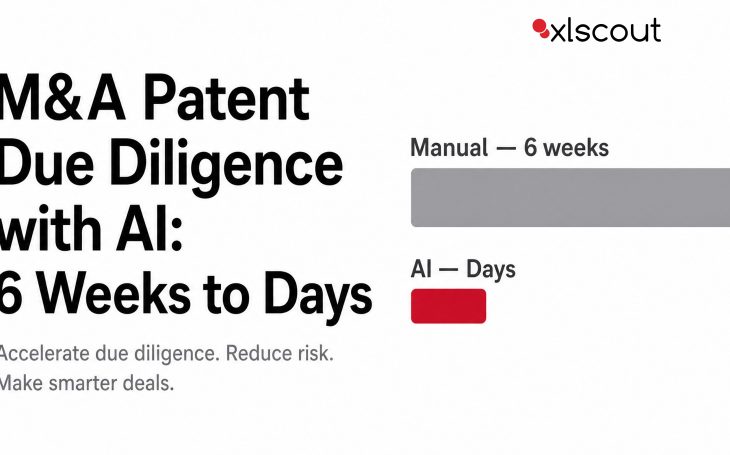
Traditional patent due diligence for a 500-patent portfolio takes 4-8 weeks. In an M&A deal with a 90-day timeline, that leaves no room for iteration, no room for surprises, and no room for the prior art risk that only surfaces under careful analysis.
AI changes the timeline. Not by removing attorney judgment — by removing the manual work that consumes time before attorney judgment can be applied.
What M&A Patent Due Diligence Must Answer
There are three analytical questions that every patent due diligence must answer:
- Portfolio strength: which patents are genuinely valuable — broad claim scope, minimal prior art exposure, active product coverage?
- Prior art risk: which patents are most likely to face invalidity challenge after acquisition — and what is the estimated post-challenge value?
- Coverage gaps: where is the technology portfolio not protected — and what is the competitive exposure in those gaps?
Answering all three for 500 patents in three weeks is not achievable manually. AI makes it achievable — by running the analytical framework across the entire portfolio simultaneously.
AI Phase 1: Portfolio Mapping with PatDigger LLM
The first phase is portfolio overview — understanding the shape of the portfolio before going deep on individual patents.
XLSCOUT’s PatDigger LLM analyses the full patent portfolio — all 500 patents — across technology domains, claim scope, citation networks, and maintenance status. The output is a portfolio map that identifies:
- High-value patents: broad claim scope, strong citation activity, active technology coverage
- Dead weight: patents with no product coverage, no licensing potential, and high maintenance cost
- Prior art exposure flags: patents in crowded technology areas with known prior art density
- Licensing potential: patents whose claims may cover competitor products — a due diligence input that affects acquisition valuation
This portfolio map — which would take weeks to produce manually — is available in hours. It becomes the prioritisation input for Phase 2.
AI Phase 2: Prior Art Risk Assessment with Invalidator LLM
Not every patent in a 500-patent portfolio needs a deep invalidity analysis. Phase 1 identifies the high-value patents — the ones whose value is most dependent on claim validity.
For those patents — the top 20-50 by portfolio value — Invalidator LLM runs a prior art search across 170M+ patents and 220M+ NPL sources. Each search returns a ranked set of the most relevant prior art references, mapped to specific claim elements.
The output for each priority patent:
- Top-15 prior art references ranked by claim element coverage
- AI-generated summary of the invalidity risk level and most vulnerable claim limitations
- §102 and §103 analysis — anticipating references and obvious-combination candidates
The acquiring party’s attorneys use this output to evaluate the genuine patent risk — not the declared patent count.
AI Phase 3: Coverage Gap Analysis with Novelty Checker LLM
The final phase evaluates where the target’s technology is not protected — the areas where the patent portfolio has gaps that competitors can exploit.
Novelty Checker LLM runs a landscape analysis across the target’s technology domains — identifying where the patent density is low relative to competitor activity. These gaps represent either filing opportunities for the acquirer or competitive risks if competitors file into them post-acquisition.
The Output: Deal Memo-Ready Patent Risk Summary
The combined AI analysis produces a structured patent risk summary that the acquisition committee can use directly:
- Portfolio tier classification: high-value, moderate-value, and dead-weight patents identified
- Validity risk ratings: for each priority patent, a risk assessment informed by AI prior art analysis
- Coverage gap map: technology domains where the portfolio is thin relative to competitive activity
- Licensing potential estimate: patents with external licensing value that affect acquisition valuation
The patent due diligence that took 6 weeks manually is now a 3-5 day AI-assisted workflow. Attorney review is concentrated on the judgment calls — valuation adjustments, risk tolerance, filing strategy post-close — not on database navigation.
Why Patent Due Diligence Risk Is Higher Post-Acquisition
Patents are 40%+ more likely to face IPR challenge after acquisition — because the acquisition itself signals commercial value, which signals that the patents are worth challenging.
The acquirer who did not run AI-assisted prior art analysis on the priority patents before close discovers this after the challenge has been filed. The acquirer who ran Invalidator LLM during due diligence already knows which patents are most exposed — and has priced that risk into the acquisition terms.