In 2025, the Federal Circuit issued its first substantive Alice analysis for a machine learning patent — Recentive Analytics v. Fox Corp. For patent attorneys, it is a legal precedent. For R&D teams, it is a warning about which AI inventions are now harder to protect — and what to change now to protect more of what you build.
The good news: AI patents are not dead. The ruling is a recalibration, not a shutdown. But the teams that keep filing AI patent applications the same way they did before this ruling will start seeing § 101 rejections that are harder to overcome.
Recentive Analytics v. Fox Corp. (2025)
THE RULING
The Federal Circuit’s first application of Alice doctrine specifically to machine learning patents. The court found ML claims ineligible where they applied known techniques to a new domain without a specific, concrete technical improvement.
Source: Federal Circuit 2025
The Alice framework asks two questions: Is the patent claim directed to an abstract idea? If yes, does it add “something more” — a concrete inventive concept? The Federal Circuit applied this to an ML-based scheduling optimization patent and found the claims fell short.
The problem wasn’t that machine learning was involved. The problem was how the claims were written: they described using ML to improve scheduling — without specifying what was novel about the ML method itself. The court treated ‘applying ML to X problem’ as an abstract idea, not a technical advance.
The key distinction the ruling draws: claiming the outcome of an ML system (better predictions, faster scheduling, improved accuracy) is different from claiming a novel ML architecture, training method, or system that achieves a specific technical improvement through a concrete inventive step.
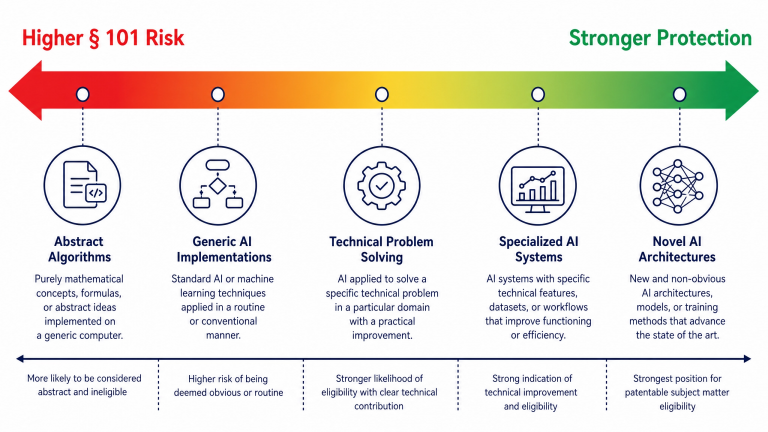
Based on the ruling’s logic, these invention types carry elevated § 101 risk under current Federal Circuit analysis:
The ruling does not close the door on ML patents. It narrows the path. These types remain protectable:
These changes apply to any AI-related application filed after the Recentive ruling:
Instead of 'a system for improving scheduling accuracy,' claim the specific architecture, training method, or system interaction that achieves the improvement. The inventive concept must be in the HOW, not the WHAT.
Examiners and courts distinguish between a business problem (scheduling is expensive) and a technical problem (existing classification methods fail at sparse data distributions). Your specification needs to articulate the technical problem.
If the ML component is the innovation, the specification should describe it with enough detail that the claim isn't reducible to 'using ML for X.' The novel training approach, data architecture, or system interaction should be the specification's focus.
The biggest § 101 vulnerability in AI patent applications is a spec that doesn’t clearly distinguish your ML method from prior approaches. Novelty Checker LLM gives you the differentiation map before filing:
Why stay behind? Get in touch with us!
Copyrights © 2026 XLSCOUT. All Rights Reserved.