

Introduction
Most freedom-to-operate searches stop at text. For software and business method patents, that is often sufficient. For hardware, semiconductor, mechanical, and electromechanical products, it is not.
In these technology areas, the critical prior art is frequently in the drawing — circuit topologies, device cross-sections, physical layouts, process flow diagrams. A text-only FTO search does not reach these disclosures. Para-Picx™ does.
What Is Image-Based Patent Search?
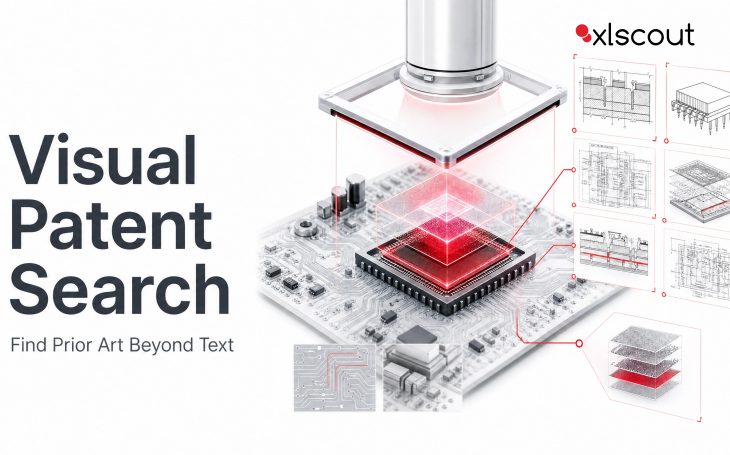
Image-based patent search finds relevant prior art based on visual similarity to a product image or technical drawing, rather than text keyword matching. It analyses the patent figure database — not just the claim text — to surface patents that describe the same circuit topology, physical geometry, or device architecture as the product being cleared.
This capability matters because patent protection for hardware inventions is frequently expressed primarily in drawings. The claim text may describe a “device comprising…” but the specific inventive configuration that creates infringement risk is defined by the figure, not the words.
Why Visual Prior Art Matters for Hardware Teams
The semiconductor, hardware, and consumer electronics patent landscapes in Japan, South Korea, and Taiwan are heavily image-dependent. JPO filings from Renesas, Murata, Sony, and Toshiba use detailed circuit schematics as the primary technical description. KIPO filings from Samsung and SK Hynix in DRAM and NAND architecture rely on cross-sectional diagrams. TIPO filings covering TSMC-adjacent process innovations are defined by process flow visuals. A text-only search of the JPO database misses this entire class of prior art.
Teams that rely on keyword-only FTO for hardware products are receiving a systematically incomplete analysis. The patents they miss are often the most specific to their device configuration — and therefore the most commercially dangerous to overlook.
The Limits of Text-Only FTO Analysis for Hardware Products
Circuit topology is defined in the figure, not the claim
A patent claiming “a semiconductor device comprising a first electrode layer and a second electrode layer” may appear irrelevant in a keyword search. The figure shows a specific physical configuration that may directly anticipate a competing product. Text search cannot make that connection.
Layout-based patents are invisible to keyword search
Physical layout patents — covering die geometry, pin configuration, package dimensions, and routing topology — are almost entirely described in drawings. No combination of Boolean keywords can reliably retrieve patents whose inventive merit is visual.
APAC patent filings are image-heavy by convention
Japanese, Korean, and Taiwanese patent offices have distinct drafting conventions that rely more heavily on figures than their US and European counterparts. An FTO analysis that does not include image search is structurally weaker for any product with APAC market exposure.
Relevant prior art appears in non-claim images
Patent figures in background sections, detailed description sections, and embodiment drawings all constitute prior art disclosures. Text search indexes claim language and titles. Image search reaches the entire figure set.
How Para-Picx Works
Para-Picx™ is XLSCOUT’s visual intelligence layer for FTO and novelty analysis. It adds image-based search to the standard text-based patent clearance workflow, producing a more complete prior art picture for hardware and semiconductor teams.
1. Search by Image
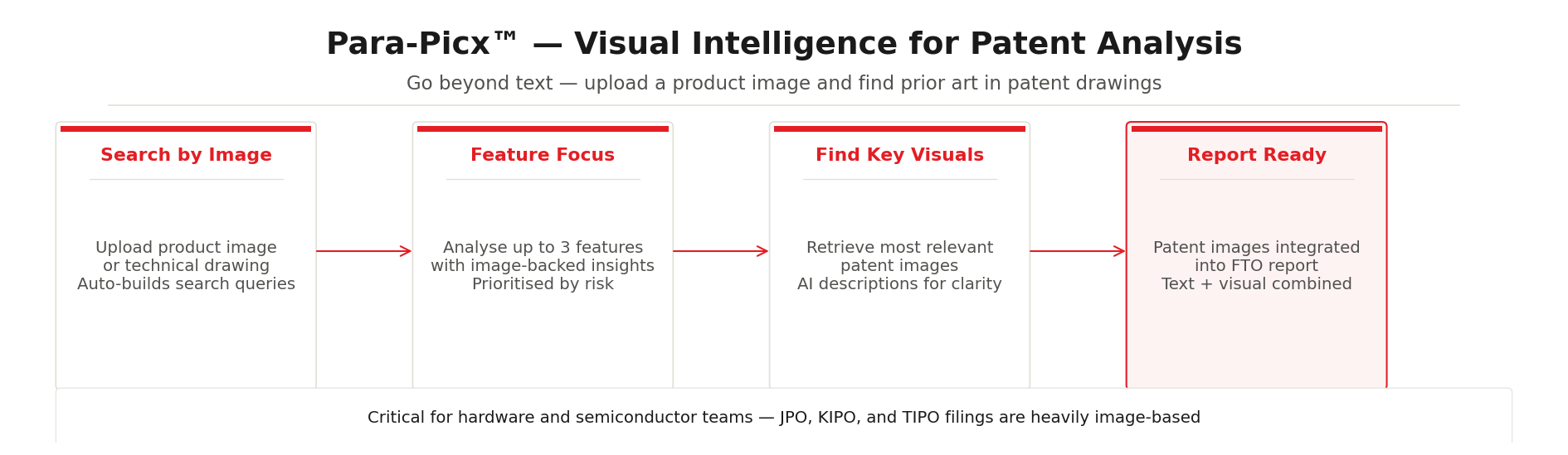
Upload a product image, circuit diagram, device schematic, or technical drawing to initiate the FTO search. Para-Picx™ extracts product disclosures directly from the visual — identifying the key technical features depicted — and auto-builds the right search queries from that extraction.
The team does not need to translate the image into claim language before searching. The visual itself is the search input.
2. Feature Focus
Para-Picx™ analyses up to three product features per search with image-backed insights. Teams can prioritise the features they believe carry the highest infringement risk — whether that is a specific pin configuration, a die architecture, or a thermal management geometry — and receive targeted prior art results for each.
3. Find Key Visuals
The system retrieves the most relevant patent images from across the global database. Each result includes an AI-generated description for quick understanding — so teams can evaluate visual similarity without needing to read through full patent specifications for every result.
4. Report Ready
Relevant patent images are integrated seamlessly into the FTO report output. The final report combines visual and text-based prior art in a single structured document — with the same patent images, gap analyses, and claim-feature comparisons that patent counsel needs to issue the formal FTO opinion.
The combination of Para-Picx™ visual search and standard text search produces what XLSCOUT describes as “smarter searches, sharper insights, and stronger decisions.”
Why This Matters for IP Teams in Japan, Korea, and Taiwan
WIPO’s 2025 data shows Asian countries contributing 56.3% of global PCT applications. For hardware and semiconductor products, the most relevant blocking patents in APAC markets are frequently not indexed by any keyword-based search tool. Para-Picx™ makes JPO, KIPO, and TIPO visual disclosures findable alongside English-language art — in the same search, in the same report. The guidance on patent filing in Japan highlights how extensively image-based disclosure is used in JPO practice relative to Western conventions.
For semiconductor IP teams at TSMC-adjacent companies in Taiwan, fabless designers in Korea, and electronics groups in Japan, Para-Picx™ addresses the specific structural gap in their FTO workflow that text-only tools leave open.
XLSCOUT FTO Module Accuracy Benchmarks
The XLSCOUT FTO Module — including Para-Picx™ visual search — delivers measurable accuracy advantages over alternative approaches:
- 75% of prior art results identified by expert human searches are found by the FTO Module
- 40% of those expert-found results appear within the top 10 delivered by the module
- 90% more accurate than free patent search tools
- 8X more accurate than paid alternatives
- Combined text and visual search coverage — standard search and Para-Picx™ run in the same workflow
Why XLSCOUT Stands Out for Hardware and Semiconductor FTO
- Para-Picx™ visual search — the only image-based FTO capability in the XLSCOUT platform
- Analyses up to three product features with image-backed insights per analysis
- Retrieves the most relevant patent images from global databases including JPO, KIPO, TIPO, and CNIPA
- Integrates patent images directly into FTO and novelty reports
- AI-generated image descriptions provide instant clarity without requiring full specification review
- Combined text and image coverage in a single workflow — not two separate search exercises
Hardware patents protect hardware inventions in hardware language — which is predominantly visual. An FTO search that cannot reach that language is not an FTO search for hardware products. Para-Picx™ closes that gap.
See How Para-Picx Supports Hardware and Semiconductor FTO Analysis
If your team works with circuit patents, device layout prior art, or APAC patent databases, Para-Picx™ in the XLSCOUT FTO Module adds the visual search layer that text-only tools cannot provide.