USPTO ASAP Pilot Strategy

Introduction

Most IP teams are aware the USPTO’s ASAP program exists. Most haven’t changed a single thing about how they file. That’s a mistake — and the window is closing.

Launched in October 2025, the Artificial Intelligence Search Automated Pilot (ASAP) gives patent applicants access to an automated prior art search before a human examiner ever reviews the application. You see what the USPTO’s AI tool found. You get to act on it first.

The program was recently extended to June 1, 2026. Petition fees were waived for any filing made after March 23. And yet, as of mid-April, only 169 petitions had been filed across all technology centers — far below the 3,200-application target. The teams participating are getting a structural advantage their competitors aren’t aware of.

169

Petitions filed as of April 2026

3,200

Program target – still far from full

June 1

Final deadline to participate

What the ASAP Program Actually Does

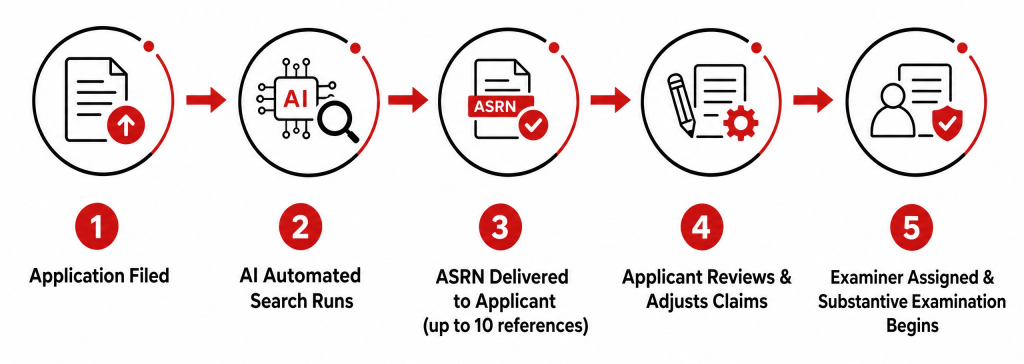
Under ASAP, eligible applications receive an Automated Search Results Notice (ASRN) — a ranked list of up to 10 prior art references identified by the USPTO’s internal AI tool before any examiner is assigned. The tool uses the application’s CPC classification, specification, claims, and abstract to evaluate the disclosure against domestic and international patent databases.

You are not required to respond to the ASRN. But here’s the thing: the examiner will see the same references. The teams that review the ASRN first — and adjust their claim strategy before the first office action — go into prosecution with a significant positioning advantage.

Director Squires has been explicit about the program’s intent. At his March 2026 testimony before the House Judiciary Subcommittee, he described the USPTO’s AI search assistant as delivering a “top ten list of prior art — before the first office action — providing quicker pathways to allowance.” That framing tells you exactly what early participants are gaining.

xlscout_asap_workflow_v2

What Changes When You Know Prior Art Earlier

Early prior art access does three things for your prosecution strategy. First, it lets you define claim scope proactively — before the examiner draws their own boundaries. Second, it compresses the path to allowance by surfacing the most likely rejections before they’re issued. Third, it gives prosecution counsel time to review blocking references and decide whether to distinguish, amend, or abandon early — rather than after multiple rejection rounds.

“Practitioners may consider how early access to prior art could influence drafting approaches, claim scope definition and overall prosecution strategy.”

— Foley & Lardner analysis of ASAP Program, April 2026

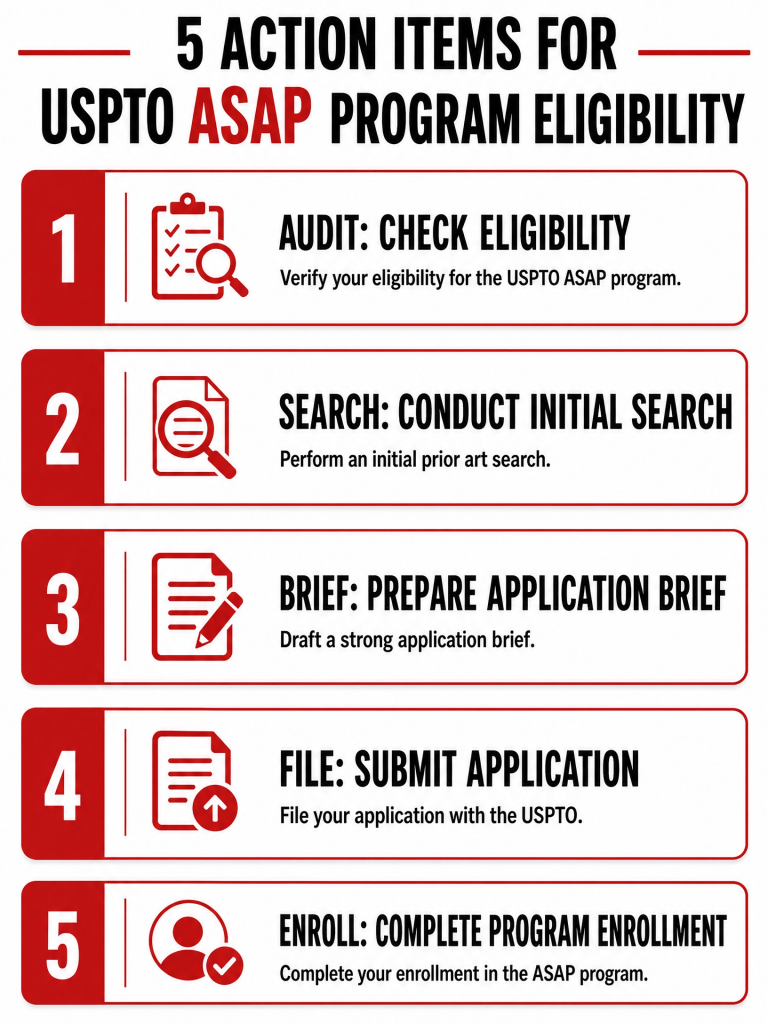
5 Things Your IP Team Should Do Before June 1

xlscout_asap_checklist_v2
  1. Identify eligible applications. Only original, noncontinuing, nonprovisional utility applications filed after October 20, 2025 qualify. Run a quick audit of recent filings.
  2. Run a pre-ASAP novelty check now. Before the automated notice arrives, run your own LLM-based novelty search. Teams that already know the landscape are better positioned to act on the ASRN.
  3. Brief prosecution counsel. Your attorneys need to know how to use ASRN data to adjust claim scope before the first office action — not after.
  4. File Form PTO/SB/470 on the application filing date. The petition must be filed on the same day as the application. You cannot petition retroactively.
  5. Enroll in Patent Center e-Office Action. ASAP requires enrollment in the e-Office Action program. If your team isn’t enrolled, that needs to happen first.

How XLSCOUT's Novelty Checker LLM Fits Into This Window

The USPTO’s ASAP tool covers patent databases. Novelty Checker LLM gives you a broader, semantically-powered search – patents and non-patent literature simultaneously – before you file. Here’s what that means for your prosecution team:

  • Feature-level vulnerability map: see your exposure before the examiner does.

    The output is a ranked prior art list with a color-coded feature-by-feature mapping. Green means direct overlap on that feature, yellow means partial, red means no overlap. Your prosecution team sees exactly where the invention is vulnerable — feature by feature — before the examiner does.

  • Paragraph-level evidence extracted and displayed inline — not just citations.

    For each prior art result, the three most relevant paragraphs are extracted and shown with the specific technical passages that support the match. Not just a citation — the evidence itself.

  • Non-patent literature coverage — what ASAP misses.

    Academic papers, journals, and web sources are covered in dedicated sections. The USPTO's ASAP tool doesn't cover non-patent literature. For biotech, pharma, and deep tech, this is where the strongest prior art often lives.


  • Ready-to-brief executive summary: novelty and obviousness analysis across top 15 results

    An executive summary report covers the top 15 results with novelty and obviousness analysis, risks, and recommendations — ready to brief prosecution counsel before the first office action.

  • Weighted key features: the most critical aspects of your invention get prioritized in the search.

    Key features can be weighted — marking the most critical features of your invention ensures the search and results ranking prioritizes what matters most to your prosecution strategy.

When the USPTO’s ASRN arrives, teams with a prior XLSCOUT analysis cross-reference the two outputs. References appearing in both are confirmed high priority. References only in the ASRN trigger immediate amendment review. References only in XLSCOUT become prosecution differentiation arguments.

Don't wait until June 1. Run your pre-ASAP novelty check with XLSCOUT today.

Why stay behind? Get in touch with us!


Copyrights © 2026 XLSCOUT. All Rights Reserved.