

Introduction
Since the Unified Patent Court opened in June 2023, the pace of European patent litigation has changed materially. As of early 2025, over 880 cases had been filed at the UPC — with the German local divisions in Düsseldorf and Munich accounting for the majority of infringement actions.
A patent holder who obtains a Unitary Patent through the EPO today can seek a preliminary injunction with pan-European effect, potentially covering 18 member states, from a single UPC filing.
German IP teams that receive quarterly landscape reports from their patent analytics providers are operating on a monitoring timeline that no longer matches the enforcement environment they are navigating.
The Numbers Behind the Mismatch
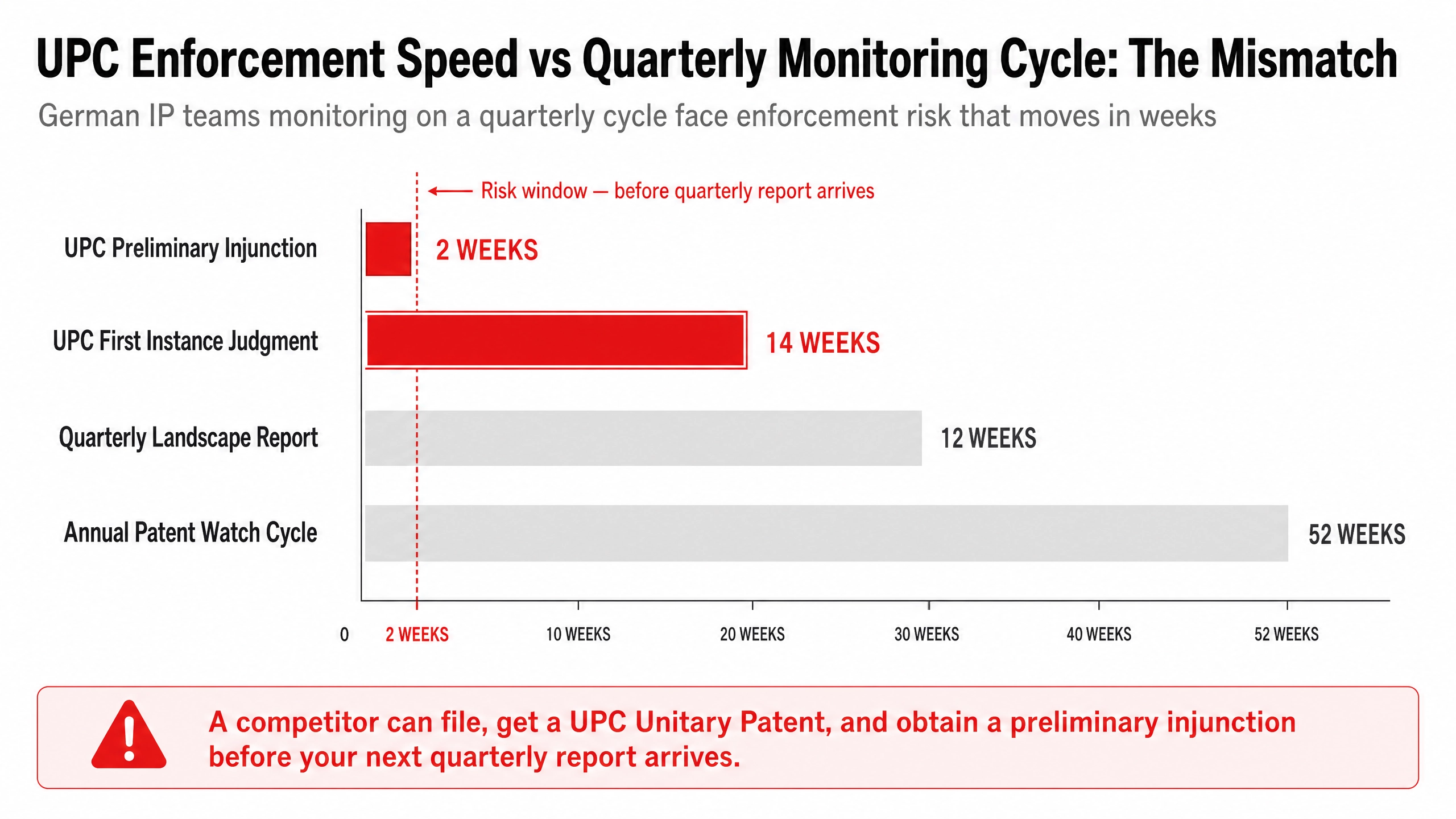
The UPC preliminary injunction process operates in a compressed timeframe relative to traditional national patent litigation. In the German UPC local divisions — which handle the highest caseload in the system — first hearings on preliminary injunctions are typically scheduled within weeks of filing. A Unitary Patent, which a competitor can obtain from a single EPO grant, can move from grant to pan-European preliminary injunction in a timeframe measured in months, not years.
The contrast with traditional patent monitoring cycles is stark. A quarterly landscape engagement means that at least 13 weeks separate each update to a German IP team’s competitive patent picture. In a UPC enforcement environment where enforcement timelines have compressed significantly, that is a monitoring gap large enough for a competitor to file, receive a Unitary Patent grant, and initiate UPC proceedings — all between two consecutive quarterly reports.
Three Monitoring Gaps the UPC Created for German IP Teams
Gap 1: The Unitary Patent blind spot
Many patent monitoring services track national patent publications and EPO grants. The Unitary Patent — a new right type that did not exist before June 2023 — creates enforcement exposure that some monitoring tools have been slower to index. A competitor’s EPO grant that converts to a Unitary Patent requires specific monitoring logic that was not needed before the UPC opened.
Gap 2: Cross-border exposure that bypasses national monitoring
German companies with operations across multiple EU member states now face enforcement risk that can originate from any UPC local or regional division. A preliminary injunction from the UPC’s Nordic-Baltic regional division or the French local division in Paris can affect German operations through supply chain disruption, even without a direct German proceeding.
Gap 3: The filing velocity problem
German technology sectors — automotive, industrial automation, chemicals, medical devices — are among Europe’s most patent-intensive. The volume of relevant new publications per week across these domains is high enough that keyword-based monitoring tools generate alert volumes that German IP teams cannot realistically action. The patent landscape gets noisier, not clearer, under high-volume keyword monitoring.
What Continuous Intelligence Delivers Instead
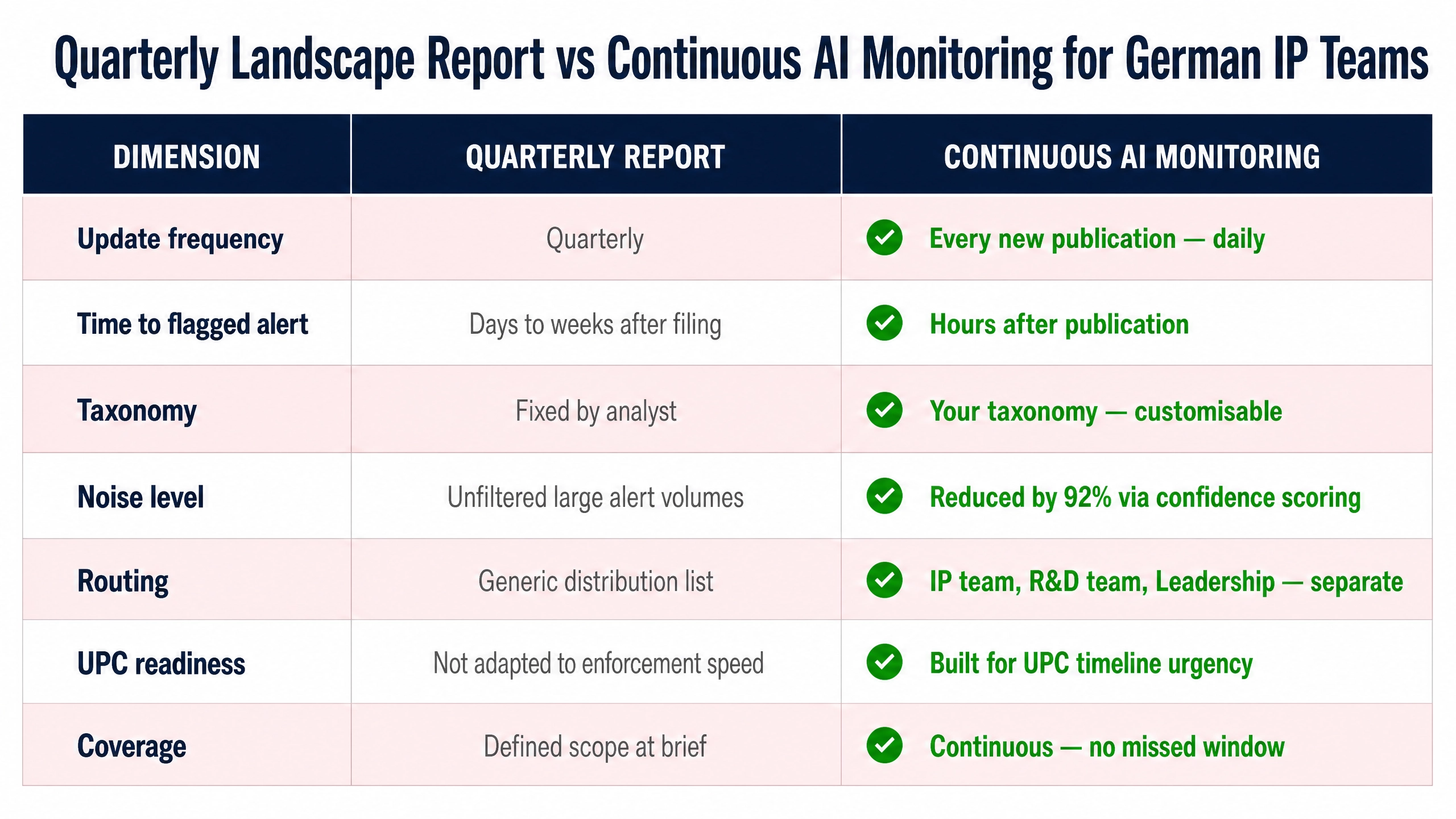
The alternative to quarterly landscape reports is not more frequent reports — it is continuous, routed intelligence that delivers only the signals that matter to the teams that need to act on them. XLSCOUT’s TechScaper LLM monitors new patent publications continuously, auto-tags them to your taxonomy, and routes filtered signals to IP teams, R&D groups, and leadership separately — each receiving only the publications relevant to their specific remit.
The practical difference:
- A quarterly landscape report tells you what happened in the last three months — after a preliminary injunction may already have been filed
- Continuous intelligence flags a competitor’s EPO grant within hours of publication — before it converts to a Unitary Patent
- LLM classification (not keyword matching) reduces alert noise by 92%, so relevant signals surface without requiring a dedicated analyst to filter the inbox
TechScaper LLM for German IP Teams
TechScaper LLM is trained on your taxonomy — the technology classification that reflects your product areas and competitive landscape — not on a generic CPC hierarchy. New patent publications are automatically classified against your taxonomy and confidence-scored, with only high-confidence matches generating alerts to the relevant team.
For German IP teams working in the UPC environment, the watch → decide → act → learn workflow means that new Unitary Patent grants, new EPO publications in competitive technology areas, and new utility model filings at the DPMA are all monitored continuously — with the relevant signals reaching the right team member’s dashboard the same day they publish.
The administrative architecture matters in large German organisations. TechScaper’s Admin and Reader role separation ensures that IP teams, R&D teams, and business unit leads receive appropriately scoped access to the monitoring output — without requiring a centralised analyst to forward and translate signals for each audience.
The Bottom Line for German Patent Counsel
The UPC has made European patent enforcement faster and more powerful. Quarterly landscape reports were a reasonable monitoring approach in a world where national litigation took years and Unitary Patents did not exist. That world ended in 2023. German IP teams that have not updated their monitoring approach to match the new enforcement environment are not just receiving late intelligence — they are receiving intelligence on a cycle that no longer reflects the timeline of the threats they face. Competitive patent monitoring needs to be continuous, semantic, and routed to operate at UPC speed.
XLSCOUT TechScaper LLM delivers continuous patent intelligence auto-tagged to your taxonomy, with 92% noise reduction and role-based routing for German IP, R&D, and leadership teams.