

Introduction
Imagine this. Your R&D team identified a technology direction in October. You commissioned a patent landscape report. The analyst pulled the data in November. The analysis took until December. The report landed in your inbox in January. By February, the landscape report described the state of the art as it existed three months ago — before three of your competitors filed applications that directly addressed the whitespace your team was planning to file into.
This is not a hypothetical. It is the structural flaw in how traditional patent landscape analysis is delivered — and it affects every French R&D team working in fast-moving technical domains, from clean energy and advanced materials to pharmaceutical formulation and aerospace systems.
The Structural Flaw in Traditional Landscape Delivery
A traditional patent landscape engagement has a predictable timeline. Brief: one to two weeks to scope and agree. Data pull: typically two weeks after brief. Analysis: four to six weeks after data pull. Report: delivery of a PDF presenting the landscape as it existed when the data was pulled — typically six to ten weeks after the project started.
In a patent environment where the EPO receives approximately 199,000 new applications per year from French and other European companies, and INPI processes around 17,000 domestic French filings annually, a ten-week window is long enough for hundreds of technically relevant new publications to appear after the analyst pulled the dataset. These publications are invisible in the delivered report — not because the analyst failed, but because the delivery model has a structural lag built into it.
The problem is not the quality of the analysis. It is the patent landscape model itself: a project-based, periodic service that describes the past, delivered too late to reliably inform the present.
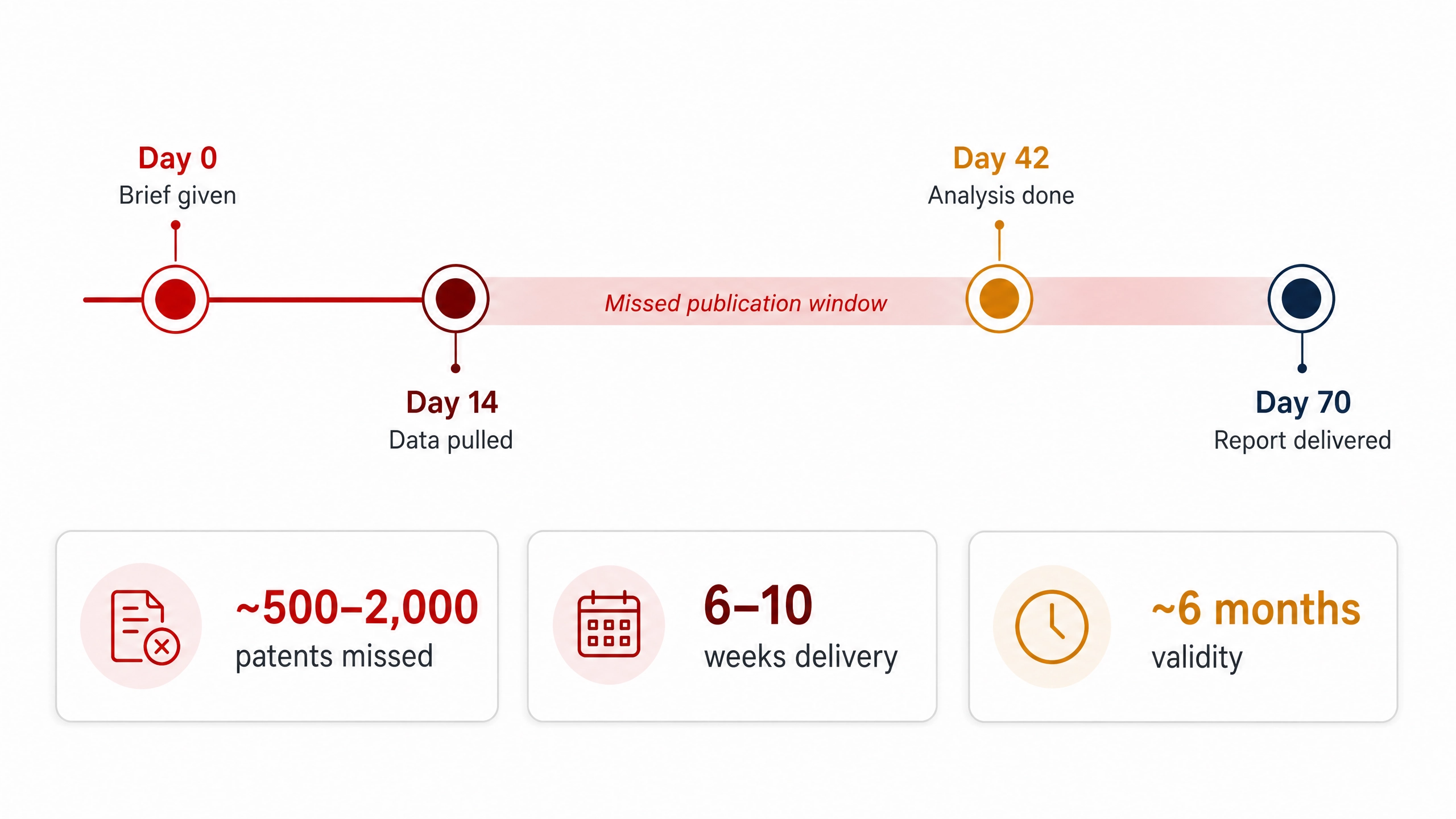
Figure 1: The 10-week landscape delivery gap — what gets published between the data pull and the report delivery, and why it matters for fast-moving French R&D domains
What Gets Lost in the Window
The publications that appear in the ten-week window between data pull and report delivery are not random. They are the most recent — the most likely to reflect current competitive R&D direction. In fast-moving domains, the most recent publications are often the most strategically significant.
For a French pharmaceutical R&D team, a competitor’s continuation application that appears three weeks after the data pull represents a new claim scope that did not exist when the analysis was conducted. For a cleantech team working on offshore wind technology, a Japanese company’s new filing in a whitespace area identified in the landscape report may have already pre-empted the filing opportunity the team was preparing for.
And after delivery, the report ages. A landscape that was accurate in January is materially different by July — new publications, new claim scopes, new competitive entrants. In a domain with active annual filing rates above 500 applications, the number of relevant new publications per six-month period is significant. A team making R&D investment decisions in July based on a January landscape report is making decisions on stale data. The questions that patent landscape analysis is meant to answer — where is the whitespace, where are competitors heading, what is worth filing — have answers that change continuously.
What French R&D Teams Actually Need to Answer
French R&D teams commission landscape reports to answer specific strategic questions: where is the open filing space in this technical domain? Where are our competitors directing their R&D investment, based on their patent filing behaviour? What is the density of existing IP in the sub-domains our team is developing into? These are valid questions. The problem is not the questions — it is that a periodic PDF report is the wrong delivery mechanism for answers that change continuously.
The whitespace identified in a January landscape report may not be whitespace in July. The competitor who appeared to be filing primarily in Domain A in January may have pivoted to Domain B by March. The filing opportunity that looked attractive based on October data may have been pre-empted by a December publication that the report could not see.
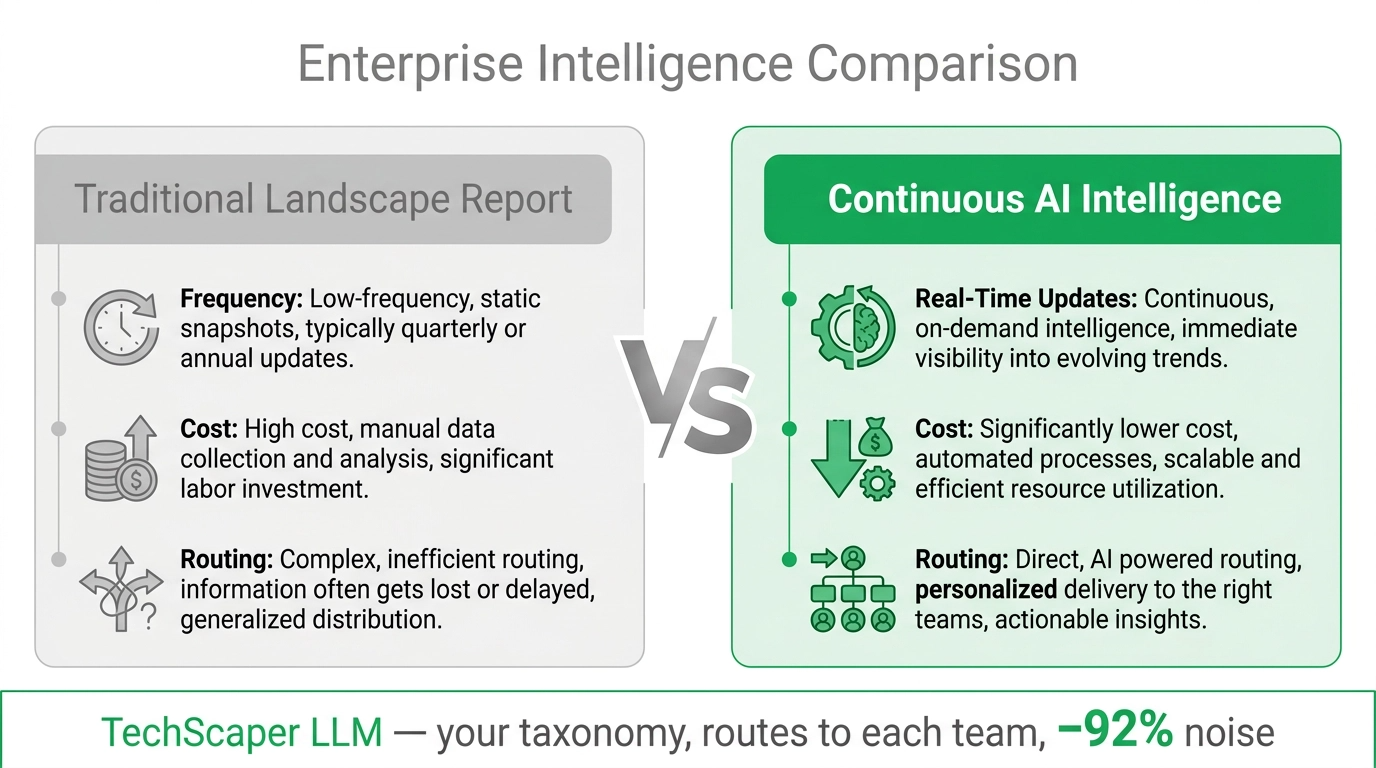
Figure 2: Traditional landscape report vs continuous AI intelligence — what each model delivers for French R&D teams, and where the differences are most consequential
The Continuous Intelligence Alternative
The structural alternative to periodic landscape reports is continuous intelligence — patent monitoring that updates as new publications appear, tagged to the taxonomy of the R&D team’s technology domain, with whitespace scoring that reflects the current state of the landscape rather than the state it was in when the last dataset was pulled.
XLSCOUT’s TechScaper LLM replaces the periodic landscape model with a continuously updating intelligence layer. New patent publications are automatically classified against your taxonomy — the technology classification that reflects your R&D team’s specific domain, not a generic CPC hierarchy — and routed to the team members for whom they are relevant. IP teams receive filing threats and competitive intelligence. R&D teams receive whitespace signals and emerging competitor technology directions. Leadership receives executive digests.
The practical shift: instead of a landscape report that describes the world as it was in October, your R&D team sees the world as it is today — updated within hours of each new relevant publication, without requiring a commissioned engagement or an analyst review cycle.
TechScaper LLM in Practice for French R&D Teams
The onboarding process starts with your taxonomy. French R&D teams in clean energy, aerospace, or pharmaceutical formulation use technical classification systems that are specific to their domain — not the standard CPC classification that patent databases use. TechScaper is trained on your taxonomy, using seed patents that you identify as representative of the technology areas you care about.
From that starting point, TechScaper classifies every new publication that falls within your monitored scope — semantically, not by keyword matching — and routes the relevant signals to the right team members. Alert noise is reduced by 92% relative to keyword-based monitoring, because the LLM distinguishes between patents that are conceptually relevant and patents that merely mention the same terms.
Whitespace heat-maps update continuously as new publications appear, giving R&D teams a current view of technology density and open filing space — not a view that is six months old by the time strategic decisions are made.
Closing the Gap
The landscape report model is not wrong in its ambition. French R&D teams need to understand the competitive patent environment before making technology investment decisions. The ambition is correct. The delivery model — a periodic commissioned project that describes the past — is the constraint. Continuous AI-powered intelligence closes that gap: the answers to the strategic questions your R&D team is asking are updated as the landscape changes, not six weeks after you commissioned someone to describe it.
XLSCOUT TechScaper LLM monitors patents continuously, auto-tags to your R&D taxonomy, reduces monitoring noise by 92%, and delivers current whitespace intelligence to French R&D and IP teams.