Introduction
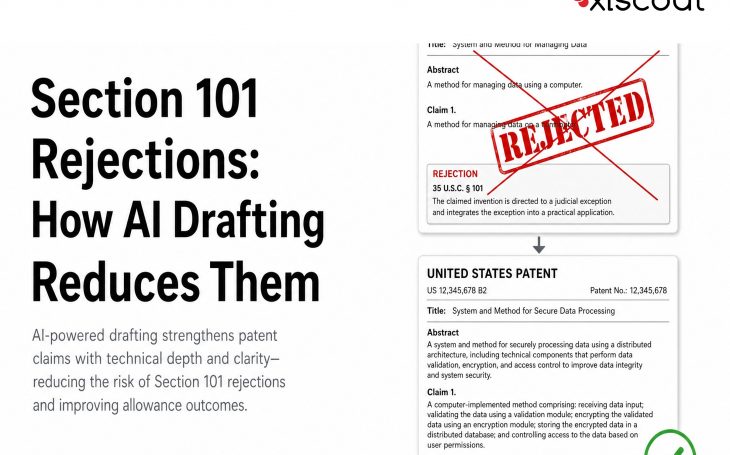
More than a decade after Alice Corp v. CLS Bank (2014), Section 101 rejections remain the most common final rejection for software, AI, and business method patents at the USPTO.
40%+ of software and AI patent applications receive at least one 101 rejection. Years of post-Alice practice guidance have not eliminated the problem — they have made the drafting strategy more precise and the stakes higher.
AI-assisted patent drafting does not change the law. It helps practitioners structure claims from the start — before the first office action — in ways that reduce 101 exposure systematically.
Why Claims Still Fail Section 101
The Alice/Mayo two-step test is clear in principle and difficult in execution. A claim fails Section 101 when it is directed to an abstract idea (step one) and adds nothing significantly more than the abstract idea itself (step two).
The problem is not that attorneys do not understand the test. The problem is that claim language that appears specific and technical to the drafter often reads as abstract to a USPTO examiner applying Alice — because the connection between the claim language and the technical implementation is implicit rather than explicit.
- Abstract idea without technical character: ‘A method of processing data to generate a financial recommendation’ — abstract regardless of the hardware it runs on
- Functional claiming without implementation detail: ‘using machine learning to classify the input’ — tells the examiner nothing about how the classification is technically achieved
- Result-oriented language: claims that describe what is achieved rather than how it is technically achieved fail step two systematically
What AI Drafting Does Differently
Technical problem and technical solution framing
AI drafting tools trained on patent claim data understand the difference between abstract problem framing and technical solution framing.
Rather than ‘a method of improving data processing efficiency,’ AI-assisted drafting generates claim language that specifies the technical problem (a specific bottleneck in a specific system architecture), the technical solution (a specific structural modification or process step), and the technical result (a measurable improvement in a specific technical parameter).
The technical character must be in the claim, not in the specification. AI drafting tools that are aware of 101 framing requirements generate claims where the technical implementation detail is explicit — not assumed.
Specific implementation limitations
‘Using a neural network’ is abstract. ‘Using a convolutional neural network with a defined number of layers and a specific activation function applied to a defined input data structure’ is technical.
XLSCOUT’s Drafting LLM generates claims that include the specific implementation details that make abstract concepts concrete — the layer structure, the data transformation steps, the hardware interaction points that examiners recognise as ‘significantly more’ than the abstract idea.
Computer-readable medium claims structured to avoid abstract method claims
Method claims are the most vulnerable to 101 rejection. CRM claims tied to specific computer-implemented functionality — where the technical implementation of the method is built into the claim structure — are more defensible.
AI drafting tools generate coordinated independent claim sets where the technical character built into the method claim is reflected consistently across the system and CRM claims — closing the abstract idea arguments that arise from inconsistency between claim types.
The Drafting Workflow: From Disclosure to 101-Resistant Draft
The AI-assisted drafting workflow starts with the invention disclosure — a plain-language description of what the invention does and how it technically achieves it.
- Step 1: AI extracts the technical features from the disclosure — the specific structural elements, process steps, and technical parameters
- Step 2: AI generates independent claim language that frames each feature as a technical limitation rather than a functional result
- Step 3: AI flags language that reads as abstract under Alice — giving the drafter specific revisions before submission
- Step 4: AI generates the full specification with technical character framing integrated throughout the background, brief description, and detailed description sections
The attorney reviews and refines the output. The AI provides the first draft with Alice-aware claim structure built in — the attorney applies legal judgment to the strategy, not hours to the keyboard.
Integration with Prior Art Awareness
One of the most important 101 drafting inputs is what the prior art looks like. Claim language that adds specific technical detail beyond the prior art is more likely to survive both 101 and 102/103. XLSCOUT’s Drafting LLM integrates with Novelty Checker LLM — so the drafting process is informed by what the prior art landscape actually contains, not just what the drafter remembers from the last search.
The combination of prior art awareness and 101-conscious claim structure reduces the most common routes to a final rejection — before the first office action ever arrives.