


Introduction
Most enterprise patent portfolios contain far more IP than is actively generating revenue. Licensing teams know the assets exist — but identifying which patents read on which competitor or industry products, at the claim-element level, is a manual process that is too slow and too expensive to run systematically. Patent monetization at scale requires a different approach.
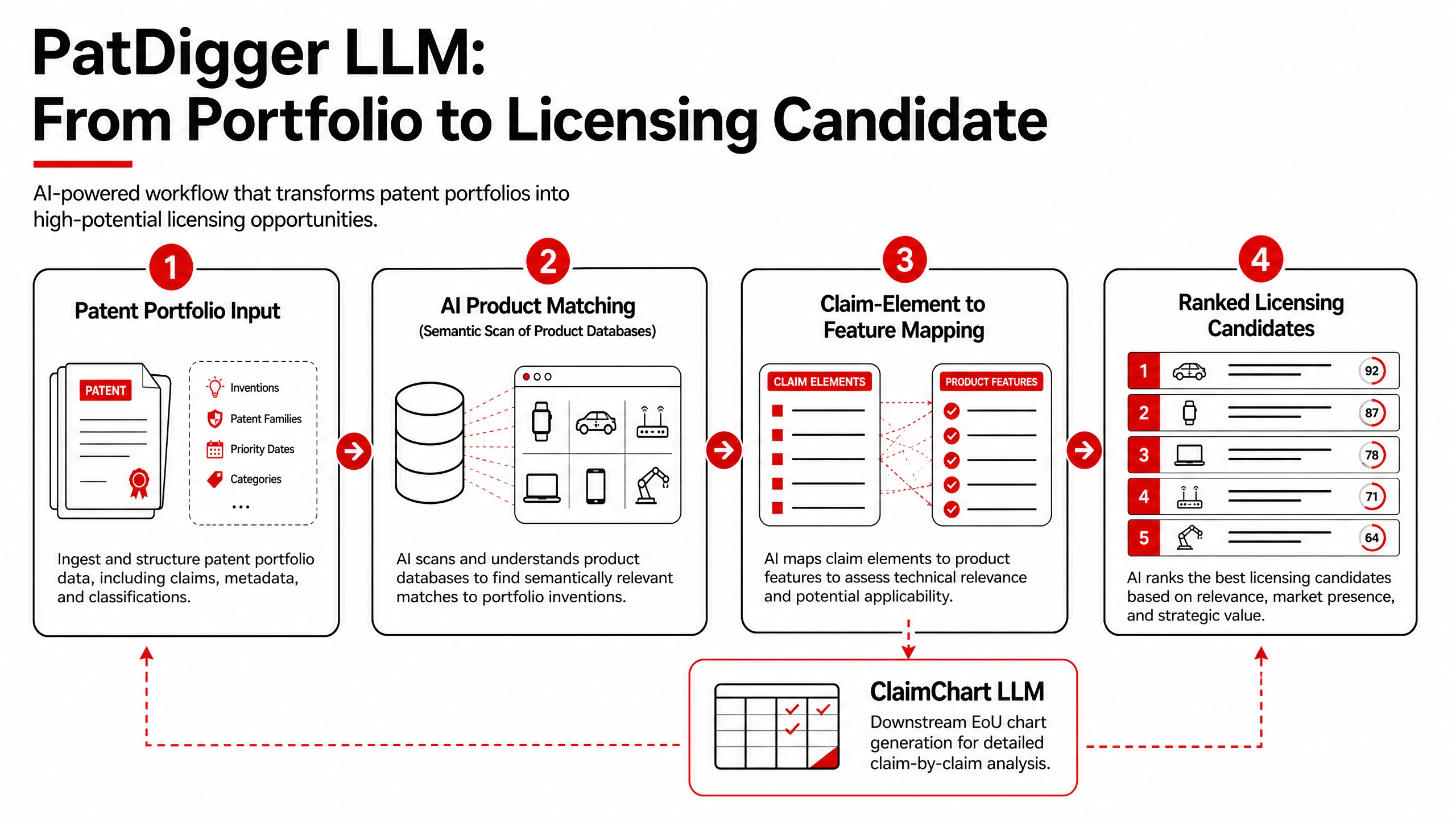
XLSCOUT PatDigger LLM automates the product-to-patent matching process — identifying which products in target industries potentially practice the claims of your portfolio, and surfacing the strongest licensing candidates for attorney prioritization.
What Is Patent Monetization?
Patent monetization is the process of generating revenue from a patent portfolio through licensing, assertion, or sale. Out-licensing — granting third parties the right to use patented technology in exchange for royalties or lump-sum payments — is the most common form.
Effective patent monetization requires:
- Identifying which products in target industries may practice the patented claims
- Mapping specific claim elements to specific product features as evidence of use
- Prioritizing the strongest licensing candidates for attorney-level claim chart preparation
- Tracking market activity to identify new infringing products as they launch
Why Patent Monetization Matters
Enterprise patent portfolios represent billions in R&D investment. The gap between the IP value sitting in a portfolio and the revenue it generates is one of the most persistent inefficiencies in corporate IP management. The barrier is not the quality of the patents — it is the cost and speed of identifying and proving which products infringe which claims. AI can identify licensing opportunities faster than any manual approach.
For university TTOs, NPEs, and corporate IP teams managing large portfolios, the ability to systematically identify out-licensing candidates across entire industries — rather than pursuing single targets opportunistically — is the difference between reactive and proactive IP monetization.
The Limits of Traditional Licensing Identification
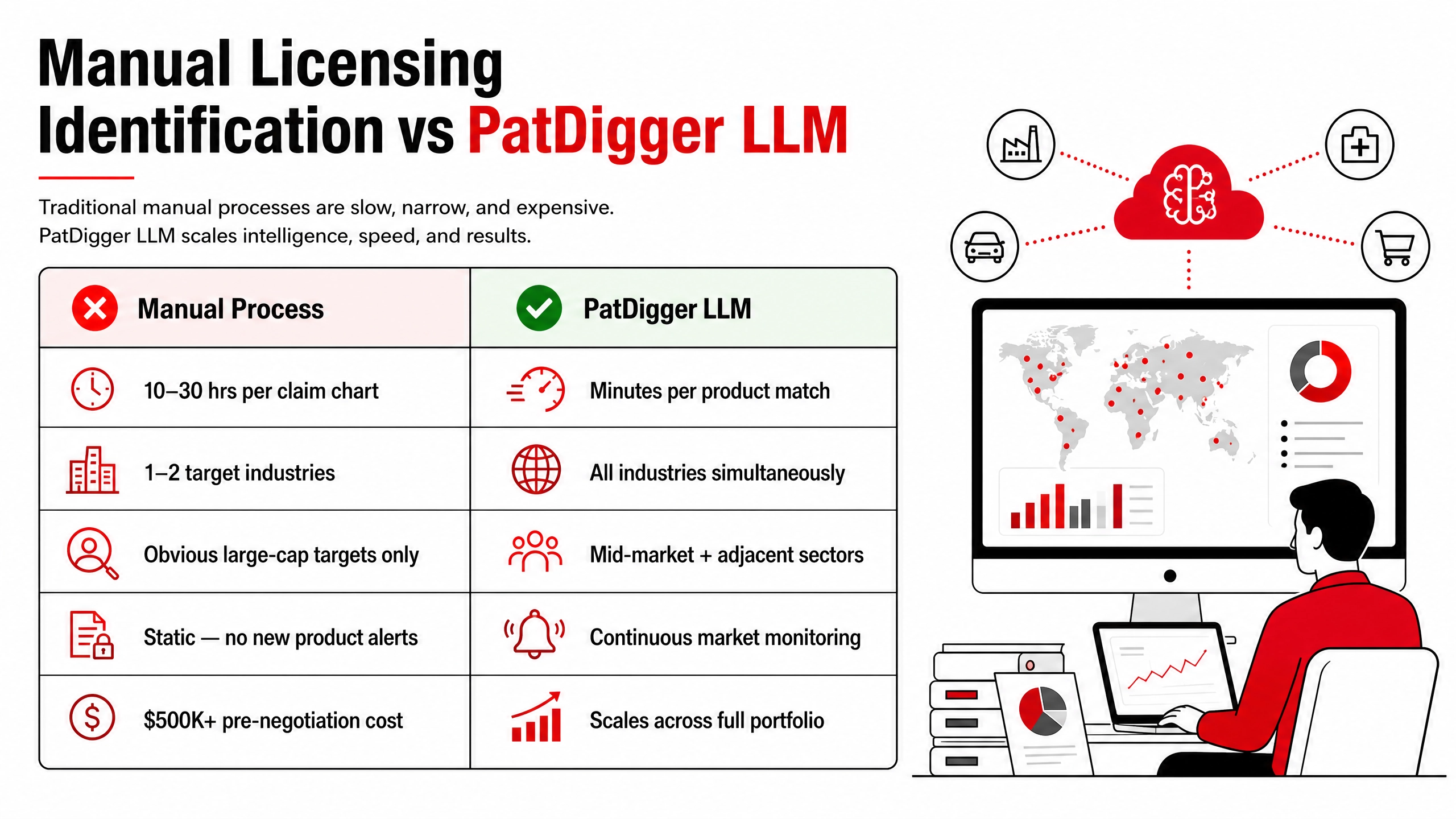
Manual product research does not scale
Identifying which commercial products practice the claims of a patent requires reviewing product specifications, technical documentation, user manuals, and product websites for each potential target. At scale — hundreds of patents across dozens of industries — this manual research is simply not feasible.
Claim chart preparation is a bottleneck
Even after a target product is identified, preparing a claim chart mapping each claim element to specific product features typically takes 10 to 30 hours of attorney or analyst time per patent-product pair. This cost limits how many targets any team can pursue.
Market coverage is incomplete
Manual licensing identification focuses on the best-known companies in obvious industries. Systematic coverage of mid-market companies, regional players, and adjacent industry segments — where licensing exposure often exists — is not practical without AI assistance.
How AI Improves Patent Monetization
AI monetization tools automate the product research phase — scanning product databases, company websites, technical specifications, and market intelligence to identify products that match claim elements. They prioritize results by strength of match, surface multiple potential licensees simultaneously, and feed the strongest candidates directly into claim chart generation workflows.
XLSCOUT PatDigger LLM and Patent Monetization
XLSCOUT PatDigger LLM maps every claim in a patent to potentially overlapping products across industries — identifying licensee candidates automatically and ranking them by strength of claim correspondence.
1. Portfolio to Licensee Matching
PatDigger LLM takes a patent or a portfolio as input and searches across product databases, company profiles, and technical specifications to identify products that potentially practice the asserted claims.
The search operates semantically — finding products that implement the patented technology regardless of whether the product documentation uses the same terminology as the patent claims. This is critical for identifying licensing candidates in industries that use different terminology than the patenting entity.
2. Claim-Element to Product Feature Mapping
For each identified product-patent pairing, PatDigger LLM maps specific claim elements to specific product features — producing structured claim-to-product correspondence that forms the foundation of a claim chart.
This automated mapping compresses what was a 10 to 30 hour manual task into minutes — allowing teams to evaluate 10x more potential licensees in the same time budget.
3. Licensing Candidate Prioritization
Not every product match is equally strong. PatDigger LLM scores each candidate by the strength of the claim-to-product correspondence, the commercial significance of the target, and the breadth of claims potentially practiced.
Teams receive a ranked list of licensing candidates — not a data dump. The highest-priority candidates go directly into attorney-level claim chart preparation using ClaimChart LLM for full Evidence of Use chart generation.
4. Continuous Market Monitoring
Licensing opportunity identification is not a one-time exercise. New products launch continuously. PatDigger LLM monitors for new products entering the defined search scope and alerts teams when new candidates emerge — so licensing programs remain current as markets evolve.
This continuous monitoring capability connects PatDigger LLM to XLSCOUT’s patent landscape monitoring — giving licensing teams both the market intelligence and the patent activity view they need for strategic out-licensing programs.
Why This Matters for IP Monetization Teams
PatSnap offers market intelligence and competitive analytics but does not provide automated claim-to-product mapping at claim-element level. Patlytics portfolio analytics score assets for licensing potential but do not automatically surface specific product targets and evidence of use. PatDigger LLM bridges the gap — from portfolio to identified licensee to claim-structured evidence, in one workflow.
Why XLSCOUT Stands Out
- Automated portfolio-to-licensee matching: identifies target products without manual product research
- Claim-element level mapping: structured correspondence for claim chart preparation
- Continuous market monitoring: new licensing candidates surface as products launch
- Integrated with ClaimChart LLM for direct flow from licensing candidate to Evidence of Use chart — one connected workflow
- Scales across entire portfolios — not single-patent, single-target manual processes
- Connects to out-licensing strategy with the market intelligence to support licensing negotiations and royalty conversations
See How PatDigger LLM Supports Patent Monetization Workflows
If your team is looking to build a systematic out-licensing program rather than pursuing targets opportunistically, PatDigger LLM provides the product matching and claim correspondence that makes monetization at scale practical.