

Introduction
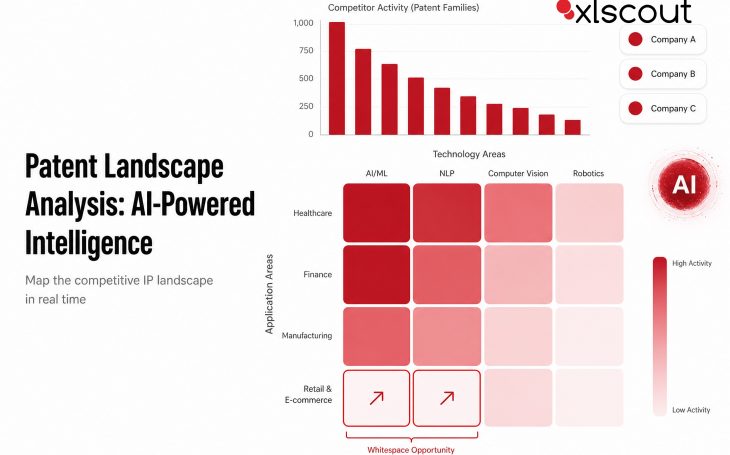
Understanding the patent landscape before making R&D investment decisions is not optional — it is the difference between filing into whitespace and filing into a wall. Yet traditional patent landscape analysis is expensive, slow, and becomes outdated the moment it is delivered. AI is changing both the speed and the operating model.
XLSCOUT TechScaper LLM monitors patents, auto-tags them to your taxonomy, and delivers only the useful signals to each team — reducing monitoring noise by 92% and delivering real-time competitive patent intelligence without requiring a dedicated analyst team.
What Is Patent Landscape Analysis?
Patent landscape analysis is a structured review of patent filings in a defined technology domain — identifying who holds the patents, where the technical density is highest, where whitespace exists, and where competitors are directing their R&D investment. The output is used by R&D strategy teams, IP directors, and innovation managers to make informed filing, investment, and product decisions. A detailed explanation of what goes into a patent landscape report covers the key deliverables.
Effective landscape analysis answers:
- Which companies hold the most patents in this technology domain?
- Where are the technical sub-fields with low patent density (whitespace)?
- Which technology areas are competitors filing into most aggressively?
- Where is R&D investment moving based on patent filing trajectories?
- Which jurisdictions have active enforcement environments in this domain?
Why Patent Landscape Analysis Matters
R&D teams that invest without landscape intelligence risk filing into heavily patented territory where claim scope is narrow, licensing costs are high, and FTO exposure is significant. Competitive patent monitoring gives teams the advance intelligence to redirect development into genuinely open technical territory before competitors establish blocking positions.
For corporate IP teams, landscape intelligence drives continuation strategy, whitespace filing, and portfolio benchmarking against key competitors. For R&D teams, it connects patent intelligence directly to technology investment decisions.
The Limits of Traditional Landscape Analysis
It is a project, not a capability
Traditional landscape analysis is a consulting engagement — commissioned, conducted over six to ten weeks, delivered as a static report, and repeated annually. The landscape changes quarterly. A report that is accurate in January is materially out of date in April.
Alert volumes are unmanageable
Patent monitoring services generate alert volumes that no team can action. Hundreds of weekly alerts, sorted by keyword match, routed to generic distribution lists — teams stop reading. The intelligence exists but cannot be consumed.
Classification is rigid and manual
Keyword-based monitoring classifies patents by word match rather than technical concept. Patents that describe the same invention in different terminology are missed. Patents that match the keywords but are technically irrelevant flood the results.
It does not route to the right team
A competitor filing in automotive radar technology should alert the radar IP team. A filing in EV battery management should route to the battery R&D group. Traditional monitoring tools route every alert to the same inbox — so nobody acts because everybody receives everything.
How AI Improves Patent Landscape Analysis
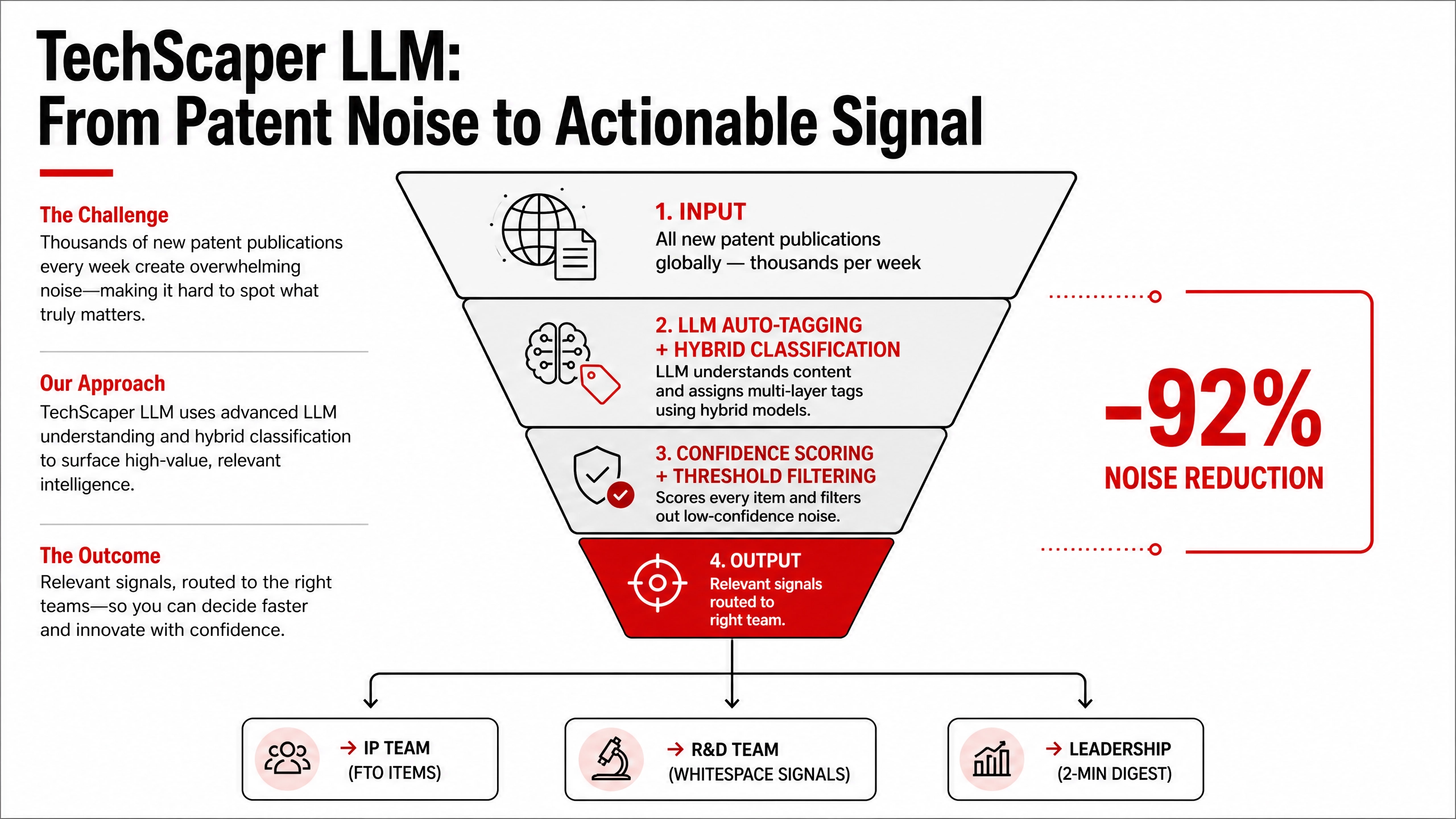
AI landscape tools replace keyword classification with semantic LLM-based tagging — finding relevant patents regardless of terminology, routing signals to the right teams based on defined taxonomy, and reducing noise through confidence scoring. The best tools are continuous rather than periodic, and auto-tag to the organisation’s own taxonomy rather than a generic classification system.
XLSCOUT TechScaper LLM and Competitive Patent Intelligence
XLSCOUT TechScaper LLM monitors patents, auto-tags them to your taxonomy, and delivers only the useful signals to each team. The agentic workflow: watch → decide → act → learn — continuously improving precision through real-time feedback.
1. Define Your Taxonomy and Competitor Watch List
TechScaper is trained on your taxonomy — the technology classification that reflects your product areas, R&D priorities, and competitive landscape. You define the technology nodes and competitor entities. TechScaper maps incoming patent publications to those nodes, not to a generic CPC hierarchy.
Seed patent training ensures the model speaks your language from day one. Upload exemplar patents that define what is relevant in your context, and TechScaper calibrates to your specific technology domain.
2. LLM Auto-Tagging and Hybrid Classification
Every new patent publication in scope is automatically classified by the LLM — going beyond keyword strings and rule-based systems to find conceptually relevant patents in any language and any jurisdiction. Hybrid classification combines retrieval-aided LLM with optional CPC/keyword guardrails for additional precision in narrow technical domains.
On-the-fly taxonomy updates allow new competitor branches to be added without re-running the full classification. When a competitor diversifies into an adjacent area, TechScaper adapts.
3. Confidence-Ranked Alerts and Role-Based Routing
Rather than delivering every matched patent as an equally weighted alert, TechScaper assigns confidence scores and routes signals to the teams they are relevant to. IP teams receive FTO items. R&D teams receive whitespace and trend signals. Leadership receives executive digests — one two-minute summary, daily or weekly.
The result: patent monitoring noise reduced by 92% — only the signals that matter reach the people who need to act on them.
4. Whitespace Discovery and Roadmap Alignment
TechScaper’s heat-maps score technology nodes by density, filing velocity, freshness, and strategic fit — surfacing the open technical sub-fields where R&D investment can achieve broad IP protection. One 90-minute workshop maps the heat-map output directly to the R&D roadmap. Understanding what white space analysis reveals is what turns landscape intelligence into R&D investment decisions.
5. Agentic Workflow: Watch, Decide, Act, Learn
TechScaper’s agentic workflow enables one-click follow-ups: open a review bucket, notify the responsible owner, export to BI platforms. The real-time feedback loop — Retag, Keep, or Mute — improves model precision continuously so the intelligence gets better the longer it is used.
Why This Matters for IP and R&D Teams
PatSnap is a strong landscape analytics platform but requires significant analyst time to interpret results — there is no auto-routing, no continuous LLM tagging, and the interface has a steep learning curve. Orbit/Questel is strong for European patent intelligence but lacks the AI auto-tagging capability. Derwent Innovation is enterprise-priced and analyst-dependent. TechScaper LLM delivers continuously updated, auto-tagged competitive intelligence without requiring a dedicated analyst team.
Why XLSCOUT Stands Out
- Noise ↓92%: confidence-ranked alerts reduce alert volume to only actionable signals
- LLM auto-tagging: beyond keyword strings and manual rules
- Your taxonomy, not ours: classification reflects your IP and R&D structure
- Seed patent training: starts accurate, improves continuously with Retag/Keep/Mute feedback
- Whitespace heat-maps: density, velocity, freshness, and strategic fit scoring
- Agentic workflow: watch → decide → act → learn in one interface
See How TechScaper LLM Supports Competitive Patent Intelligence
If your team wants to move from periodic landscape reports to continuous competitive patent intelligence, TechScaper LLM makes that operational.