

Introduction
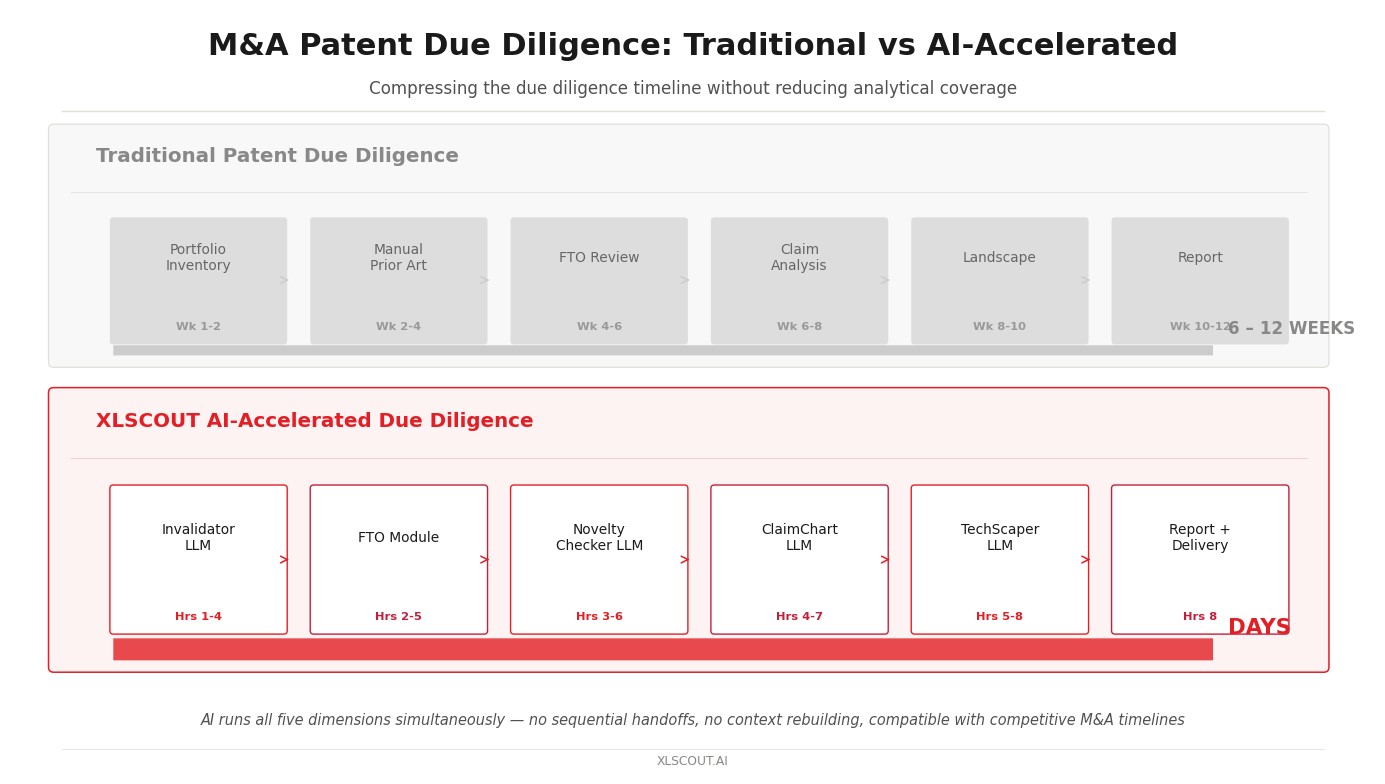
Patent portfolios are among the most complex and highest-stakes assets in any M&A transaction. They drive valuations, create indemnification obligations, and — if poorly assessed — generate post-closing litigation that erases deal value. Traditional patent due diligence takes six to twelve weeks and requires armies of IP counsel. AI compresses that timeline to days without reducing analytical depth.
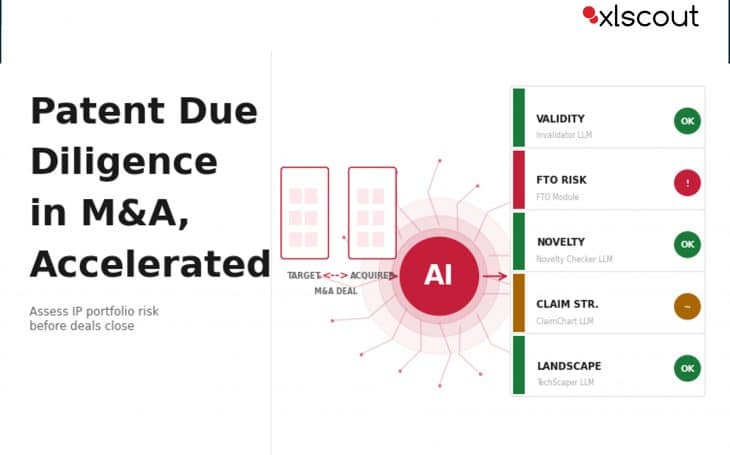
XLSCOUT provides AI modules that cover every dimension of patent due diligence — validity assessment, FTO analysis, claim strength evaluation, novelty confirmation, and portfolio gap identification — giving M&A teams the IP intelligence they need to close deals with confidence.
What Is Patent Due Diligence in M&A?
Patent due diligence is the systematic assessment of a target company’s patent portfolio before an acquisition, merger, or investment closes. It identifies the risk profile of the IP assets: which patents are likely valid and enforceable, which are vulnerable to challenge, which create FTO exposure in the target’s markets, and which represent genuine strategic value versus maintenance cost.
M&A patent due diligence typically covers:
- Portfolio inventory and claim strength assessment
- Validity risk: identifying prior art that could invalidate key patents
- Freedom-to-operate: assessing whether the target’s products infringe third-party patents
- Portfolio gap analysis: identifying whitespace and continuation opportunities
- Competitive benchmarking: how the target’s IP compares to key competitors
- Encumbrances: licensing agreements, covenants not to sue, and pledge obligations
Why AI Patent Due Diligence Matters
Deal timelines do not accommodate traditional due diligence schedules. When a competitive auction process gives bidders four weeks to assess an acquisition target, a traditional six-to-twelve-week IP due diligence process is incompatible with competitive deal execution. The choice is between closing on incomplete IP information or losing the deal.
AI changes the timeline without changing the analytical standard. The $4.19 billion in US patent infringement verdicts across 72 cases in 2024 includes numerous situations where inadequate IP due diligence at deal inception created post-closing liability that could have been identified and priced — or avoided — with better pre-close analysis.
The Limits of Traditional M&A Patent Due Diligence
Timeline is incompatible with competitive processes
Traditional patent due diligence — manual prior art searches, outside counsel claim reviews, and landscape analysis — takes six to twelve weeks per significant portfolio. In competitive M&A processes, that timeline means either conducting incomplete due diligence under time pressure or declining to bid on tight-timeline deals.
Coverage is selective, not comprehensive
Manual due diligence focuses on the target’s most prominent patents — the ones most likely to be asserted or challenged. The long tail of the portfolio — hundreds or thousands of assets — receives superficial coverage or none at all. Material risks hidden in secondary assets are missed.
FTO analysis is shallow
Without AI-powered product-to-patent mapping, FTO assessment during due diligence is typically limited to the target’s primary products and the most obvious third-party patents. The infringement exposure that actually materialises post-close is often in the less obvious areas — secondary products, adjacent markets, supply chain components.
Cost scales with portfolio size
Traditional due diligence cost is approximately linear with portfolio size — more patents means proportionally more attorney hours. For large portfolio transactions, that cost can run to seven figures in legal fees before any deal certainty.
How AI Improves M&A Patent Due Diligence
AI due diligence tools automate the most time-consuming components — prior art searches, claim-element mapping, product-to-patent matching, and portfolio scoring — allowing attorney review to focus on the highest-risk assets rather than conducting manual analysis of every patent in the portfolio.
XLSCOUT Modules for M&A Patent Due Diligence
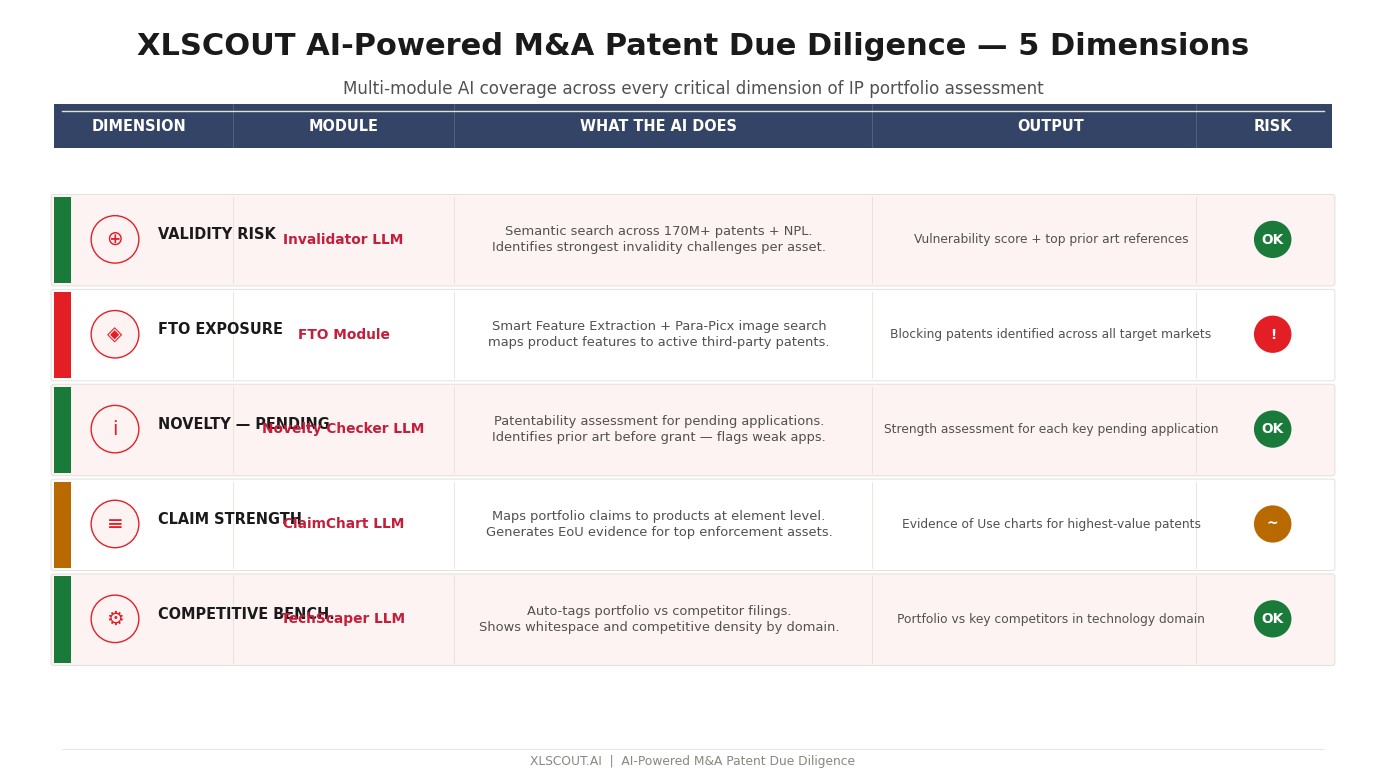
XLSCOUT provides specialized AI modules that address each dimension of patent due diligence — deployed together as an integrated due diligence workflow.
1. Validity Assessment with Invalidator LLM
For every patent in the target portfolio that represents significant deal value, Invalidator LLM conducts a semantic prior art search across 170M+ patents and NPL — identifying the strongest validity challenges and scoring each patent’s invalidation risk. High-risk patents can be identified for deeper attorney review. Low-risk patents can be processed at volume.
This converts a six-week manual validity review into a days-long AI-assisted analysis, with human attorney review focused on the assets that matter most.
2. FTO Analysis with FTO Module
The FTO Module assesses whether the target’s products are clear to operate in their current and planned markets — identifying active third-party patents that may create infringement exposure post-close. Smart Feature Extraction maps product features to patent claims automatically, and Para-Picx™ adds image-based search for hardware products that text-only analysis cannot adequately cover.
3. Novelty Validation with Novelty Checker LLM
For portfolios containing recently filed applications not yet examined, Novelty Checker LLM provides patentability assessment — identifying prior art that may prevent key pending applications from maturing into granted patents. This is critical for transactions where deal value is partly priced on pending application count or breadth.
4. Claim Strength Analysis with ClaimChart LLM
For the portfolio’s highest-value assets — the patents most likely to support licensing or enforcement post-close — ClaimChart LLM maps claim elements to accused products and generates structured Evidence of Use tables. This provides the deal team with a realistic view of the enforcement value of key portfolio assets, not just their formal grant status.
5. Portfolio Benchmarking with TechScaper LLM
TechScaper LLM benchmarks the target portfolio against key competitors in the relevant technology domain — showing where the portfolio is strong, where it has gaps, and what the competitive patent landscape looks like for the business the acquirer is buying. A patent portfolio that looks strong in isolation may look thin against the competitor landscape.
Why This Matters for M&A and Investment Teams
PatSnap provides competitive analytics for landscape benchmarking but requires significant analyst time to produce actionable due diligence outputs — it is not a due diligence platform. Patlytics portfolio classification is useful for ongoing portfolio management but is not structured around the M&A due diligence workflow and begins at $800 per user per month. Clarivate Derwent is enterprise-priced with steep learning curves. XLSCOUT’s modular AI approach delivers due diligence coverage at deal speed without requiring an enterprise-scale deployment.
Why XLSCOUT Stands Out
- Compresses patent due diligence from weeks to days — compatible with competitive M&A timelines
- Multi-module coverage: validity, FTO, novelty, claim strength, and portfolio benchmarking in one platform
- ParaEmbed semantic search: 90% more accurate than free tools — higher analytical standard, not just faster
- Para-Picx image search: covers hardware and mechanical portfolios that text-only analysis misses
- Scales to large portfolios: volume processing without proportional attorney cost increase
- SOC2 Type II and GDPR compliant: enterprise security for sensitive transaction data
See How XLSCOUT Supports M&A Patent Due Diligence
If your team is looking to conduct patent due diligence at deal speed without sacrificing analytical coverage, XLSCOUT’s AI modules provide the multi-dimensional assessment that M&A transactions require.