Introduction
85% of US patent applications receive at least one office action. For the average IP practice, office action response is not an occasional task — it is a constant workflow that determines prosecution outcomes, shapes claim scope, and drives billable hours.
An OA response that takes three weeks instead of two days is not just a workflow inefficiency. It is a billable hours question for law firms and a prosecution timeline question for in-house teams managing deadline pressure across dozens of matters.
AI does not replace attorney judgment in office action response. It compresses the time between receiving the OA and having a verified first draft ready for review — concentrating attorney time on the decisions that require it.
What AI Actually Does in OA Response
Before describing the workflow, it is worth being specific about what AI does and what it does not do — because the misconceptions in both directions create resistance.
- What AI does: analyses the examiner’s rejection basis, identifies the specific prior art cited, maps the cited references to the rejected claim elements, generates claim amendment options, and drafts response language for each rejection basis
- What AI does not do: determine the prosecution strategy, decide whether to amend or argue, evaluate the commercial importance of specific claim scope, or sign the response
The attorney does all of the strategy and judgment. The AI does all of the information processing and first-draft generation.
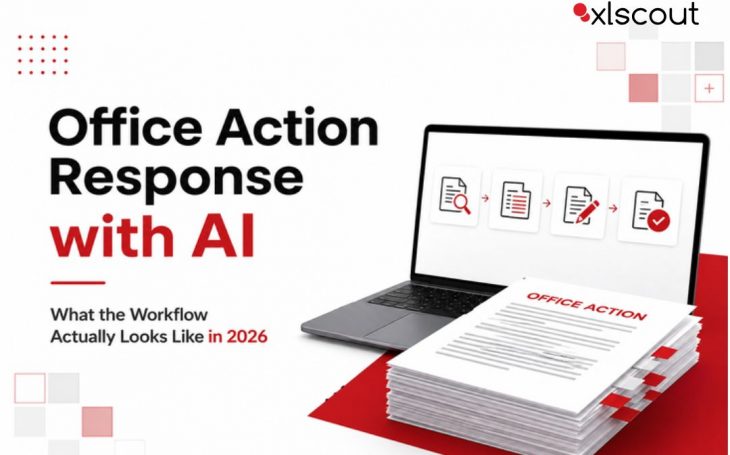
The AI Office Action Response Workflow
Step 1: OA analysis
XLSCOUT’s Drafting LLM reads the office action and extracts the structured information the attorney needs to begin response strategy:
- Rejection type: §102 anticipation, §103 obviousness, §101 subject matter eligibility, §112 definiteness
- Cited references: each cited reference identified and mapped to the claim limitation it is cited against
- Claims affected: independent and dependent claims subject to rejection, and the specific limitations at issue
- Examiner’s argument: the specific mapping the examiner has drawn between the cited reference and the rejected claim limitation
This analysis — which an attorney typically does manually before they can begin drafting — is available immediately. The attorney starts with a structured picture of the rejection, not a raw OA document.
Step 2: Prior art evaluation
For §102 and §103 rejections, the attorney needs to evaluate whether the cited references actually teach the rejected claim limitations. AI supports this by running a targeted prior art search around the specific claim limitations at issue — surfacing references that distinguish the invention from the cited prior art.
The output is a set of distinguishing references and technical arguments that the attorney can use to support an argument traversal — or to inform a claim amendment strategy if traversal is not viable.
Step 3: Claim amendment generation
If amendment is the chosen strategy, AI generates amendment options — claim language that addresses the rejection while preserving as much commercial scope as possible.
Drafting LLM generates multiple amendment variants for each independent claim, ranked by scope preservation. The attorney selects the amendment strategy that balances prosecution risk against commercial claim value — a judgment call that AI informs but does not make.
The attorney’s most important prosecution decision — how much claim scope to give up — is supported by AI-generated options, not left to a blank page and a time-pressured drafting session.
Step 4: Response draft
Once the claim amendment strategy is determined, AI generates the full response document:
- Preliminary statements: acknowledgment of the OA, attorney information, entry of amendments
- Response to §103 rejection: argument traversal addressing the examiner’s motivation-to-combine analysis, or support for the amendment if amending
- Claim amendments: marked-up version of the claims with the selected amendments
- Remarks: the technical argument distinguishing the amended claims from the cited prior art
The attorney reviews, revises, and approves the response. The AI-generated draft is the starting point — not the final output.
What the Attorney Reviews
The attorney’s review in an AI-assisted OA response workflow is qualitatively different from writing from scratch:
- Strategy review: is amend-or-argue the right call for this claim and this rejection?
- Scope assessment: does the proposed amendment preserve the claim scope that matters commercially?
- Technical accuracy: does the AI-generated argument accurately represent the technical distinction between the invention and the cited reference?
- Legal sufficiency: is the response legally complete and formatted for filing?
AI-assisted OA response reduces first-draft time by an estimated 60-70% based on IP practitioners using AI tools in 2025. The attorney’s time is shifted from keyboard to judgment — the work that actually requires legal expertise.
Consistency Across a Docket
For large dockets — law firms managing hundreds of prosecution matters, in-house teams with dozens of co-pending applications — OA response consistency is a quality issue as much as an efficiency issue.
AI-assisted drafting applies consistent argument frameworks and claim amendment conventions across every matter in the docket. The arguments for one application do not inadvertently contradict the arguments for a related application in the same family.