

Introduction
R&D managers and IP counsel face a real choice when a new invention needs a prior art search.
Traditional patent search firms offer expert analysts, curated results, and legal-quality reports — at $1,500 to $5,000 per search with a two-to-three week turnaround. XLSCOUT’s Novelty Checker LLM offers semantic AI search across 170 million patents and non-patent literature in minutes.
The question is not which is better. The question is which is right for which situation — and how the strongest IP teams use both.
What a Traditional Patent Search Firm Delivers
The traditional search process involves expert analysts — often former patent examiners or technology specialists — conducting a methodical search across multiple databases. What they deliver:
- Expert-curated result set, typically 10–30 references with analyst commentary on relevance
- Novelty and FTO opinion from a qualified patent professional
- Search methodology documentation suitable for the prosecution file history
- Non-patent literature manually reviewed by a human with domain expertise
- Certified search reports for use in prosecution and due diligence
The strengths are real: analyst judgment, domain expertise, and legal defensibility. The limitations are equally real: cost, time, and scale. A technology company with 200 invention disclosures per year cannot afford $5,000 searches for all of them.
What XLSCOUT’s Novelty Checker LLM Delivers
Automated Novelty Report With Detailed Key Feature Mappings
Novelty Checker LLM generates a complete novelty report mapping the invention’s key features against prior art — showing which features are directly anticipated, partially covered, or appear to be novel. The report is structured for review by patent counsel, not just R&D teams.
Reinforcement and ParaEmbed Based Analysis
XLSCOUT’s proprietary ParaEmbed technology finds semantically equivalent prior art — patents and papers describing the same technical concept in different words. This captures the prior art that keyword searches systematically miss, particularly across international patent databases and non-English prior art.
Contextual Mapping of Invention Disclosure With Prior Art Results
The output maps the invention disclosure directly to the most relevant passages in the prior art — not just citation numbers, but the specific paragraphs that anticipate or partially address each key feature. Prosecution counsel can build arguments against specific passages from day one.
Connected Technology and Competitor Dashboard
Beyond the novelty analysis, Novelty Checker LLM surfaces the competitive patent landscape — showing which companies are active in the same technology space and providing competitive context alongside the prior art results.
Non-Patent Literature Coverage
Academic papers, conference proceedings, technical reports, and web sources are searched in dedicated NPL sections alongside patent results. For biotech, pharma, and deep-tech inventions, NPL is often where the most relevant prior art lives — and patent-only searches systematically miss it.
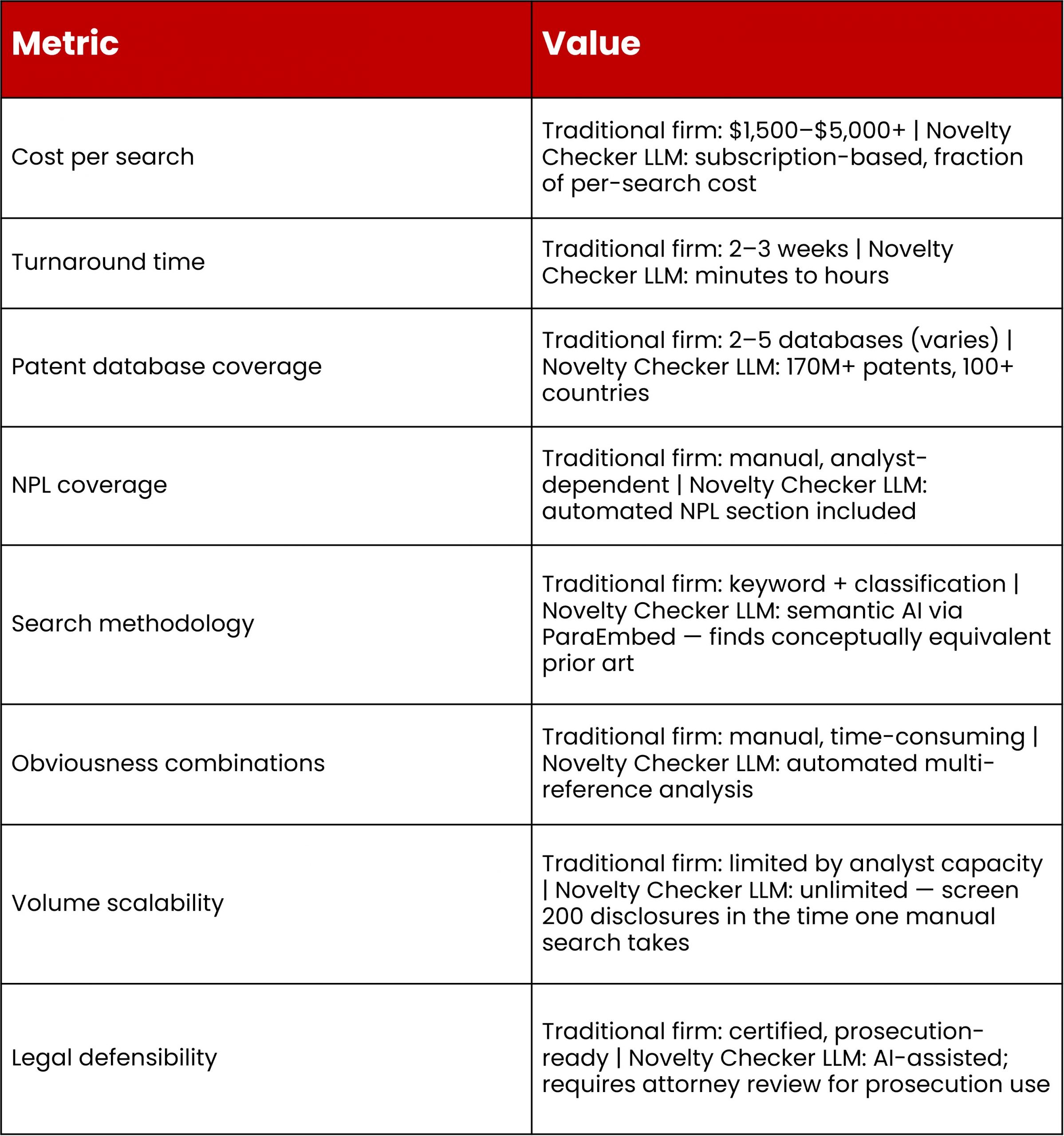
Head-to-Head Comparison
When to Use Novelty Checker LLM First
Novelty Checker LLM delivers the most value in situations where speed, volume, and early-stage insight matter more than a certified legal opinion:
- High-volume invention harvesting — screening 50 to 200 disclosures per quarter to identify the 20% worth routing to outside counsel for full patentability analysis
- Early-stage R&D decision-making — rapid prior art landscape assessment before committing significant R&D investment to a technical direction
- Pre-attorney filing decisions — helping internal IP teams decide whether to file, abandon, or pivot before incurring outside counsel search fees
- Iterative invention refinement — running multiple rapid searches as the invention evolves to guide which technical direction is most likely to yield strong claims
- Competitive intelligence — using the Connected Technology and Competitor Dashboard to understand which companies are active in the same space alongside the novelty analysis
When to Commission a Traditional Search Firm
- Final pre-filing patentability opinion for prosecution, where the search methodology must be documentable for the prosecution file history
- High-stakes or high-value applications, where the cost of a missed prior art reference outweighs the cost of a thorough manual search
- Complex biotech, pharma, or chemical art, where peer-reviewed NPL is the most relevant prior art and manual review by a domain expert adds irreplaceable value
- Validity opinions for litigation or licensing, where the search must support a formal legal opinion from a registered patent professional
The Hybrid Model — How Leading IP Teams Use Both
The most effective IP departments do not choose between AI and traditional search — they sequence them.
Stage 1 — AI screening with Novelty Checker LLM. All invention disclosures pass through Novelty Checker LLM. Inventions with clear white spaces, strong novelty indicators, and no close prior art are identified quickly.
Stage 2 — Internal prioritisation. The Idea Dashboard and novelty report support an internal go/no-go decision. Weak or crowded inventions are returned to R&D or abandoned. The top 20–30% advance.
Stage 3 — Traditional search on priority filings. Shortlisted inventions receive a full traditional search. With the XLSCOUT prior art landscape already mapped, the analyst’s search is faster and more targeted — often reducing cost and turnaround time.
Stage 4 — Attorney filing with combined analysis. The attorney receives both the XLSCOUT analysis and the traditional search report. This richer briefing leads to stronger claim strategy and a more defensible prosecution history.
The traditional patent search firm is not obsolete. And the AI novelty search tool is not a replacement for expert legal judgment. The teams winning on patent quality use both — in the right sequence, at the right stage, for the right decisions.