

Introduction
Italy is not typically the country that comes to mind when European patent strategy is discussed. Germany, France, the Netherlands — these are the names that dominate conversations about European IP. But Italy is the fifth-largest EPO filer in Europe, with approximately 5,400 applications per year. Italian companies in mechanical engineering, packaging technology, automotive components, pharmaceutical formulation, and industrial automation hold patents that would attract significant licensing interest if those companies had the tools to identify that interest.
The problem is not the quality of Italian IP. The problem is systematic: most Italian and Swiss IP teams are working through service intermediaries and legacy tools that were not designed for the scale or the specificity of what these companies need — and the result is that value goes undiscovered and risk goes undetected.
The Italian Patent Reality
Italian manufacturing is among the most patent-intensive in Europe per capita. The mechanical engineering cluster in Lombardy, Emilia-Romagna’s packaging and food technology sector, the pharmaceutical and fine chemicals base in northern Italy, the automotive component suppliers serving the German and French OEM networks — these are technically sophisticated industries with genuine innovation output.
Italian companies file at the EPO, at UIBM, and increasingly through PCT routes for global protection. Swiss companies — in pharmaceutical, precision engineering, and medtech — are among Europe’s most active patent filers per capita, with a concentrated and high-value IP base in sectors where patent enforcement is commercially significant.
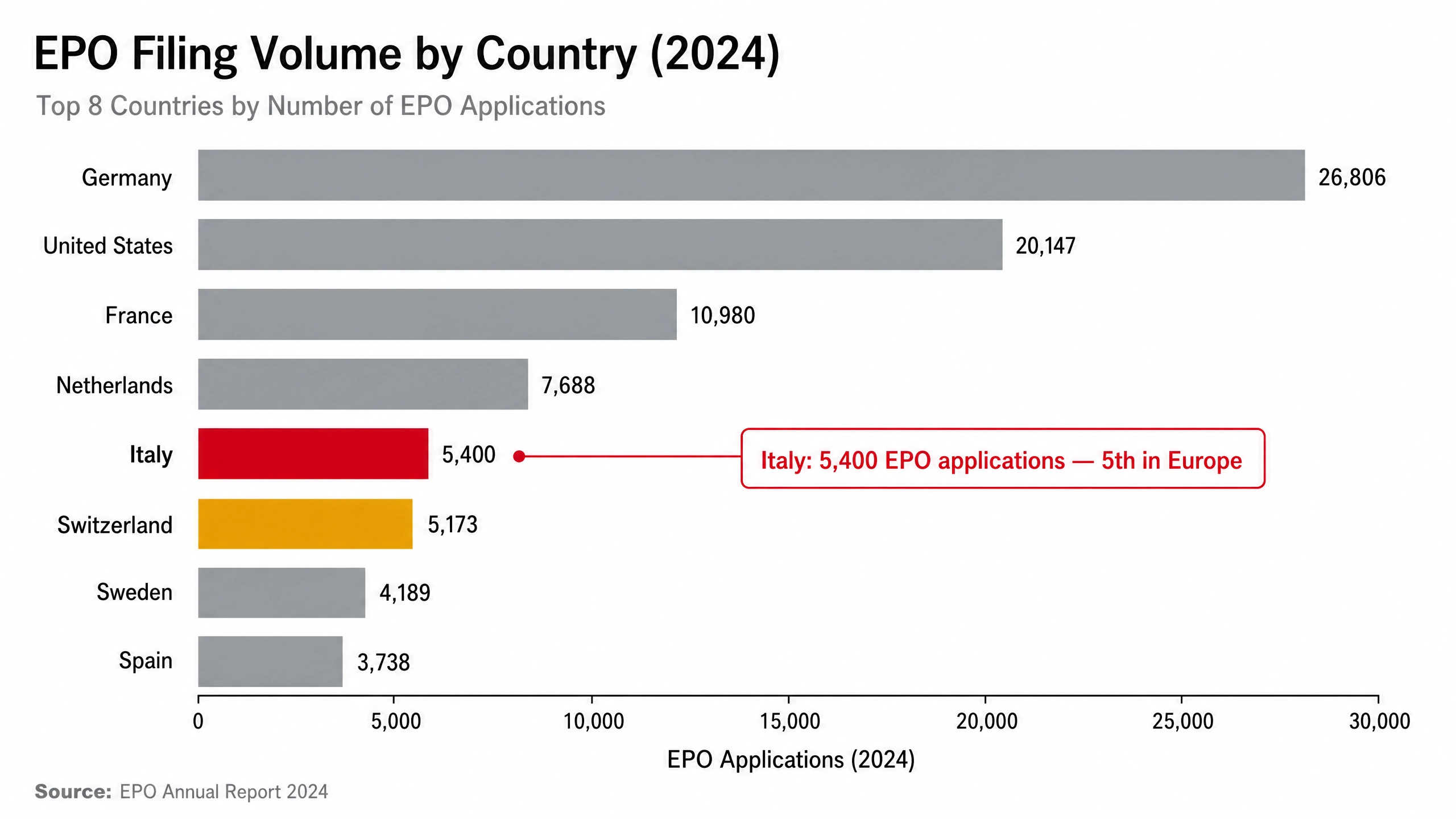
Figure 1: Italy’s position among Europe’s top EPO patent filers (2024 data) — 5th in Europe, ahead of many larger economies in per-capita patent activity
Why the Gap Exists: The Service Intermediary Model
Italy and Switzerland are both heavily served by Questel and Clarivate resellers, and by local IP firm analytics arms, rather than by direct software tool access. This is historically rational: in the pre-AI era, the analytical capability to conduct a comprehensive patent search was embedded in human expertise, and that expertise was accessed through a service engagement.
The service model has a structure that creates specific operational constraints. It requires a minimum engagement scope — no on-demand single-patent searches. It has a turnaround time measured in days or weeks — not hours. It inserts an interpretation layer between the raw patent data and the IP team — the analyst’s understanding of what matters, which may or may not align precisely with the client’s technical context. And it carries a cost structure based on professional service fees rather than software subscriptions.
For Italian and Swiss IP teams, this means that prior art searches, FTO assessments, and competitive monitoring are all throttled by the same constraint: they can only be run when the engagement justifies the cost and the timeline.
Three Workflows That Break Down Under the Service Model
Urgent prosecution support
Patent prosecution involves deadlines. An office action arrives with a three-month response window. The examiner has cited prior art. The attorney needs to understand the landscape around those citations — quickly — to formulate a response strategy. Under the service model, commissioning a new prior art search in this context adds days to a workflow that is already time-pressured. Under a direct AI tool model, the attorney runs the search directly, in the same session as the office action review.
FTO clearance for product launches
Italian manufacturers launching products into the German, French, and EU markets need FTO clearance across EPO, CNIPA, JPO, and KIPO — not just the domestic UIBM database. The cost of commissioning a comprehensive multi-jurisdictional FTO engagement for every product launch is prohibitive for most Italian mid-market companies. The result is that launches proceed without complete clearance — or with clearance that covers only the most obvious risk domains.
Competitive monitoring on a budget
Running a systematic watch on three or four key competitors’ patent filings — to track their technology direction and identify potential licensing conflicts before they become enforcement actions — requires either a paid monitoring service subscription or a commissioned periodic review. For Swiss medtech companies monitoring German and US device manufacturers, neither option is straightforward at the operating budget levels of most IP departments outside the top-tier multinationals.
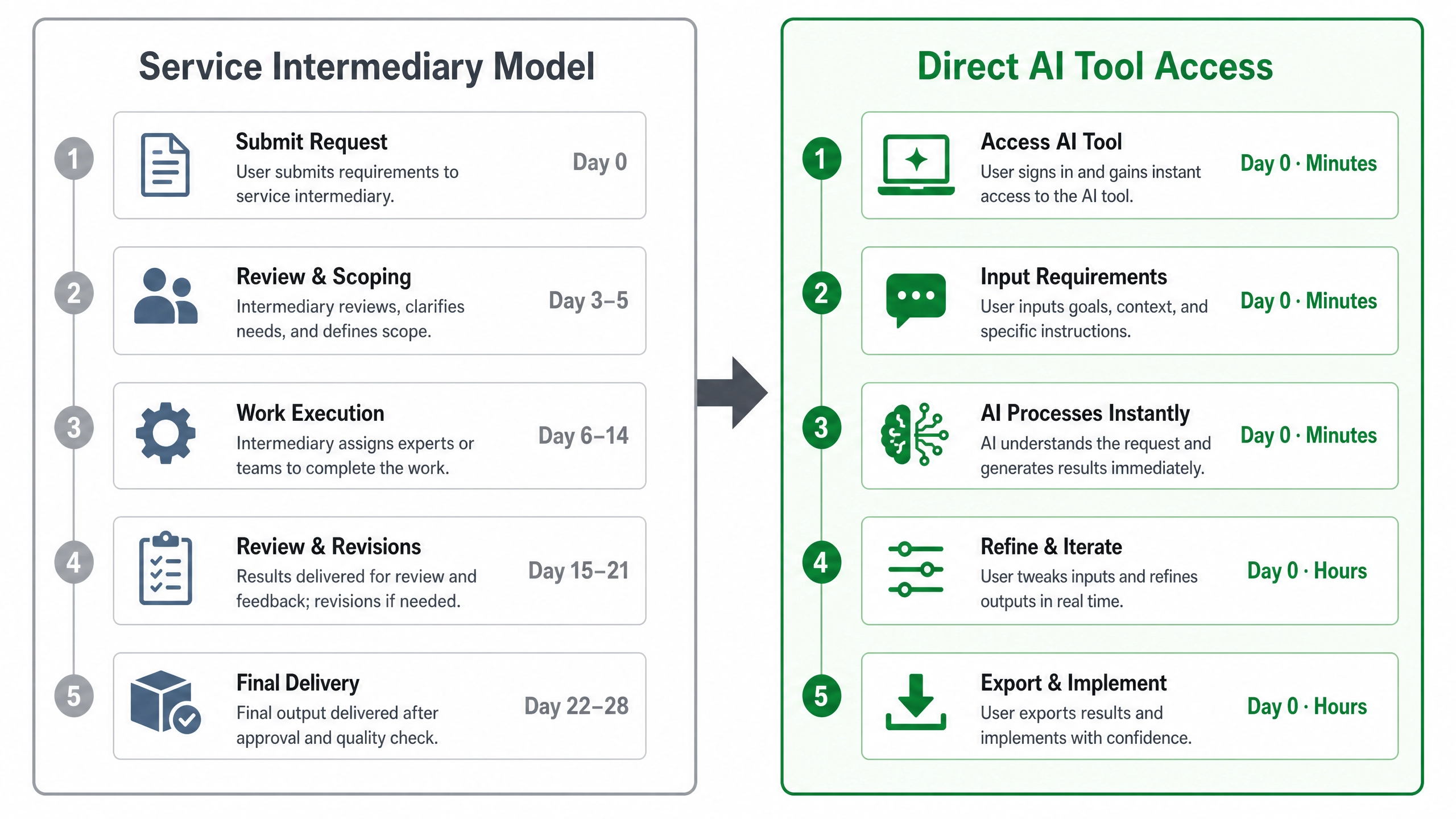
Figure 2: Service intermediary model vs direct AI tool access — what changes for Italian and Swiss IP teams when the intermediary is removed from the workflow
What Direct AI Tool Access Changes
The shift from a service model to a direct AI tool is not just faster — it is structurally different. When an Italian IP attorney can run a comprehensive novelty search directly, covering 170M+ patents across UIBM, EPO, JPO, KIPO, and CNIPA, in the same session as the technical review, the search stops being an event and becomes part of the workflow. The question “is this novel?” gets answered in hours, not weeks — which means it gets asked more often, and earlier in the development cycle.
XLSCOUT’s Novelty Checker LLM operates with ParaEmbed semantic search — finding prior art based on technical meaning rather than keyword matching — which means it finds relevant Italian and Swiss prior art from German, Japanese, or Korean patent language, and vice versa. For Italian manufacturing companies whose most significant competitors file in German or Japanese, this cross-language coverage is not a secondary feature. It is the core of what makes the search complete.
For Swiss IP Teams: The Medtech and Pharma Dimension
Swiss pharmaceutical and medtech IP has specific characteristics. IGE/IPI filings are supplemented by extensive EPO prosecution and US PCT entry. Swiss pharma companies — operating in one of the world’s most IP-intensive industries — need prior art searches that cover not just the patent databases but the NPL corpus: clinical trial publications, regulatory submissions, academic papers, and conference proceedings that can constitute prior art under Swiss and European patent law.
The FTO Module Smart Feature Extraction capability is particularly relevant for Swiss medtech product launches. Rather than requiring a complex technical brief to a service intermediary, the FTO Module extracts the relevant features directly from existing product documentation — specifications, marketing materials, technical data sheets — and runs the clearance analysis from that starting point.
XLSCOUT for Italian and Swiss IP Teams
The practical change is access. Italian and Swiss IP teams that have been commissioning services can now run the same analytical workflows directly — novelty searches, FTO clearance, competitive monitoring, landscape analysis — without minimum engagement requirements, without turnaround weeks, and without the interpretation layer of an intermediary whose technical context may not match their specific domain.
The IP value that Italian manufacturers hold, and the licensing opportunities that Swiss medtech companies have not identified, does not require a new strategy. It requires better tools — ones that are directly accessible, semantically accurate, and fast enough to be used as part of the IP workflow rather than as a commissioned event.
XLSCOUT’s Novelty Checker LLM and FTO Module provide Italian and Swiss IP teams with direct access to comprehensive 170M+ patent prior art search and multi-jurisdictional FTO clearance — on demand, without service intermediaries.