An SOC 2 Type II certified, AI super intelligence platform for innovation and IP: From prior-art searches and AI-assisted ideation to drafting high-quality patents and monetizing innovation!
An SOC 2 Type II certified, AI super intelligence platform for innovation and IP: From prior-art searches and AI-assisted ideation to drafting high-quality patents and monetizing innovation!
A university licenses a breakthrough technology to a startup. Six months later, a third-party patent surfaces that the licensed product appears to infringe. The deal is restructured. Legal costs mount. The startup’s commercialization timeline slips by a year.
This scenario is common. And it is largely preventable.
Technology transfer offices are under resource pressure. They move fast, license as much as possible, and rely on licensees to handle downstream clearance. The result: infringement risk is regularly discovered post-commercialization — exactly when it’s most expensive to fix.
THE TTO GAP
Most infringement issues in university licensing surface after the deal is signed — not during pre-licensing diligence. AI changes the timing.
Why Infringement Detection Has Always Been a Post-Commercialization Problem
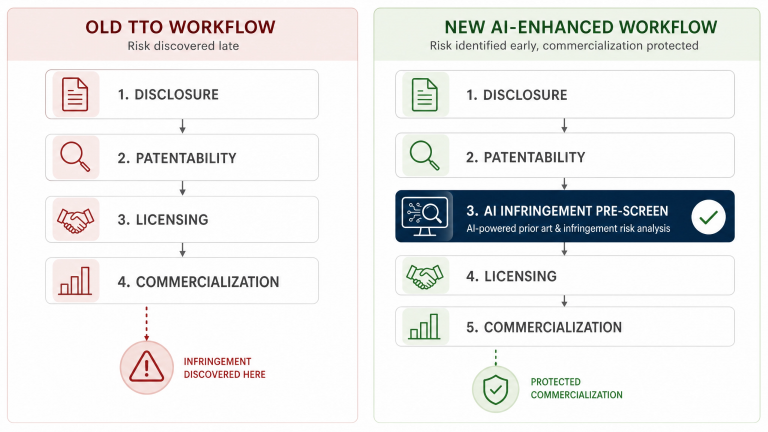
The traditional TTO workflow: invention disclosure → patentability assessment → licensing negotiations → deal → commercialization. Infringement clearance — if it happens at all — is assumed to be the licensee’s responsibility after signing.
The problem: licensees often lack the deep domain expertise to catch blocking patents at the claim level. By the time infringement surfaces, it’s in the middle of a product launch or a follow-on funding round — where restructuring is maximally disruptive.
The Real Cost When Infringement Surfaces After the Deal
Deal restructuring or renegotiation — often requiring outside legal counsel on both sides
Royalty disputes and indemnity claims that strain the university-licensee relationship
Reputational damage with industry partners who expected clean IP from the TTO
Potential litigation exposure for the university if infringement wasn’t disclosed
Commercialization delays that reduce the technology’s market value
What AI-Powered Infringement Checking Looks Like in a TTO Workflow
The shift is straightforward: add an AI infringement pre-screen between patentability assessment and licensing negotiations. It doesn’t replace the licensee’s FTO diligence. It gives the TTO a defensible, documented baseline.
New workflow with AI pre-screen:
Invention disclosure received. TTO documents the core invention claims and target commercial applications.
Patentability assessment. Existing step — prior art search to assess novelty.
AI infringement pre-screen. Map the invention’s expected commercial embodiment against active third-party patents in the target market. Identify blocking risks before licensing terms are set.
Pre-screen review. TTO IP analyst reviews results, flags genuine risks, documents the clearance status.
Decision point: clean or qualified clearance. Clean: proceed to licensing. Risk identified: refine claims, add indemnity terms, or disclose to licensee upfront.
Questions Every TTO Should Ask Before Licensing
Does the invention’s likely commercial embodiment read on any active third-party patents in the target market?
Have the key claims been mapped against the leading competitor patent portfolios in this space?
Is the licensee’s planned product roadmap likely to expand into higher claim-risk territory?
Has freedom-to-operate been assessed for the primary target markets — not just the university’s home jurisdiction?
Are there pending applications that could mature into blocking patents during the commercialization window?
How XLSCOUT's FTO LLM Supports the TTO Pre-Licensing Checkpoint
FTO LLM automates Evidence of Use chart generation and claim mapping — the work that typically requires specialized IP counsel to do manually. For a TTO team processing dozens of disclosures per year with limited headcount, this changes the economics of pre-licensing clearance.
The tool maps an invention’s commercial claims against third-party patent portfolios, generates structured claim charts, and surfaces blocking risks at the claim element level — not just a generic keyword match. A process that would otherwise take weeks of outside counsel time can be completed as part of standard pre-licensing diligence.
XLSCOUT's FTO LLM helps TTO teams run pre-licensing infringement checks in hours, not weeks.