


Introduction
The European Patent Office gives opponents exactly nine months from the date of patent grant to file an opposition.
Nine months to build a case strong enough to revoke a patent centrally — across every designated state — at a fraction of the cost of national nullity proceedings in individual countries.
The prior art search is where most opposition campaigns succeed or fail. Weak prior art, overlooked non-patent literature, or missed multi-reference obviousness combinations can sink an otherwise valid challenge before it reaches the opposition division.
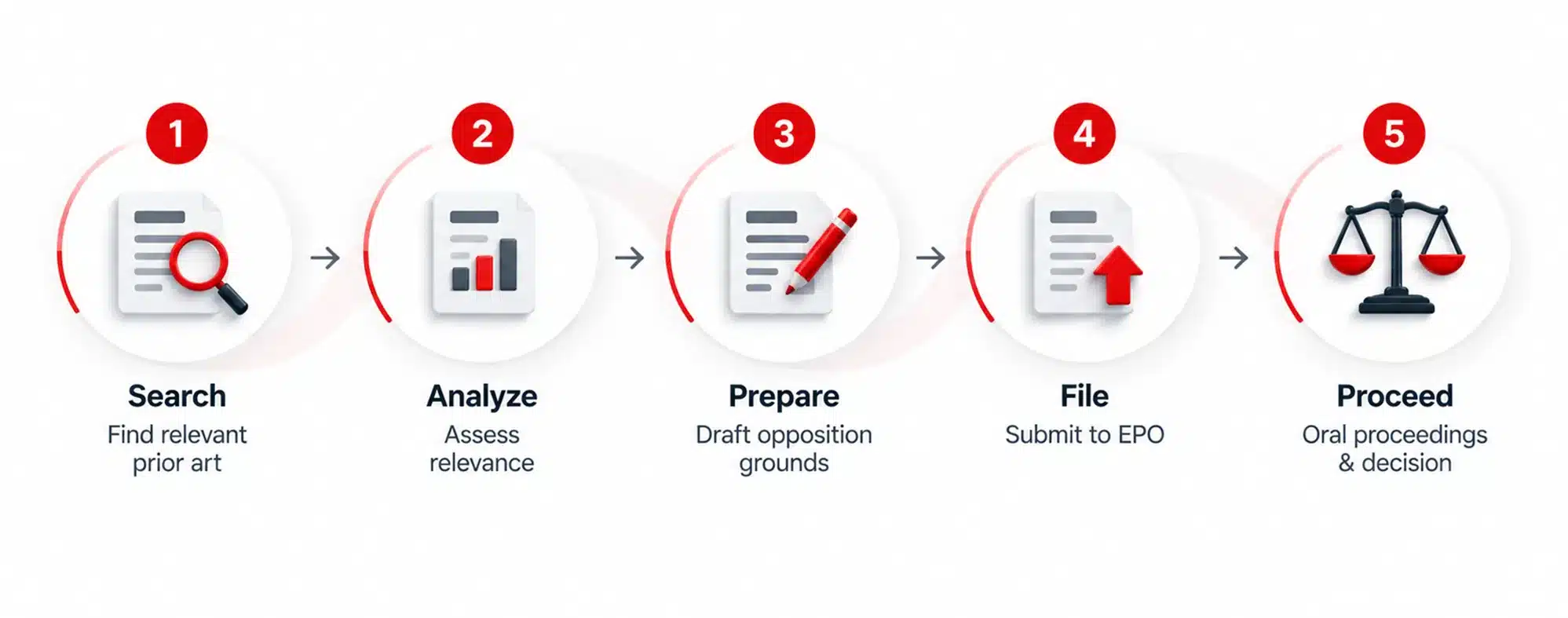
What Is an EPO Opposition – and Why It Matters for European IP Teams
An EPO opposition is a centralised procedure allowing any person to challenge a patent granted by the European Patent Office. Unlike national invalidity routes — nullity actions before the Bundespatentgericht in Germany, revocation proceedings before the Patents Court in the UK, or equivalent proceedings in Italy, Denmark, or other designated states — a successful EPO opposition can revoke or limit a patent across all designated states in a single proceeding.
The costs are substantially lower than pursuing parallel national invalidity proceedings, making EPO opposition the primary early-stage defensive tool for in-house IP teams and patent counsel across Europe.
EPO opposition vs national invalidity routes:
- EPO opposition: filed within 9 months of grant. Central revocation or limitation across all designated states. Lowest cost, most time-constrained.
- Germany — Nullity action (Nichtigkeitsklage) before the Bundespatentgericht: Germany-specific effect, no time limit, requires establishing standing.
- UK — Revocation proceedings before the UK IPO (comptroller), IPEC, or the Patents Court: available to any person, no 9-month limit, UK-specific effect.
- UPC — Revocation action or counterclaim for revocation: available at any time, erga omnes effect across all 18 UPC member states simultaneously. Can be filed alongside or after the EPO opposition window has closed.
The 4 Grounds of EPO Opposition — Where Prior Art Is Decisive
An EPO opposition must be based on at least one of four grounds under the European Patent Convention. Two of them — lack of novelty and lack of inventive step — depend entirely on the quality of the prior art search.
- Lack of novelty (Art. 54 EPC). The invention is not new — a single prior art document discloses all features of the independent claim. One document. Complete anticipation. The prior art search must identify it.
- Lack of inventive step (Art. 56 EPC). Starting from the closest prior art, the skilled person would have arrived at the invention through obvious steps — frequently requiring a multi-reference analysis combining two or more prior art documents.
- Added subject matter (Art. 123(2) EPC). The patent as granted includes subject matter not present in the original application — a structural ground that does not require prior art but requires careful comparison of the granted and originally filed documents.
- Insufficiency of disclosure (Art. 83 EPC). The specification does not describe the invention in sufficient detail for the skilled person to carry it out across the full scope of the claims — a description-based ground assessed against the patent document itself.
Most successful EPO oppositions are built on grounds (1) and (2). That means the quality of the prior art search — and the multi-reference obviousness analysis — is the decisive factor in the majority of opposition cases.
How XLSCOUT’s Invalidator LLM Supports EPO Opposition Searches
Key Features of Invalidator LLM
90% More Accurate Than Free Patent Search Tools
Invalidator LLM’s semantic AI search consistently outperforms free databases such as Espacenet or Google Patents, which rely on keyword matching. Semantic understanding captures conceptually equivalent prior art that keyword searches miss entirely — the prior art that an EPO examiner would identify but a keyword-only search would not.
8X More Accurate Than Paid Alternatives
Independent benchmarking shows Invalidator LLM identifies prior art at eight times the accuracy of leading paid patent search platforms. For EPO opposition, where the 9-month window leaves no room for a second search, this accuracy advantage is directly consequential.
74% of Prior Art Citations in Invalidity Cases Identified
74% of prior art citations that experts find manually in invalidity proceedings are identified by Invalidator LLM — making it a reliable foundation for EPO opposition searches, not merely a screening tool. Teams using Invalidator LLM for opposition work report reduced reliance on follow-up manual searches.
Comprehensive Global Patent and NPL Coverage
The search covers 170 million patents across 100+ jurisdictions alongside non-patent literature — academic papers, technical standards, conference proceedings. EPO examiners and opposition divisions weigh NPL heavily, particularly in opposition proceedings in pharma, biotech, telecommunications, and deep-tech cases. A search that omits NPL leaves the strongest art undiscovered in many technology fields.
Detailed Claim to Prior Art Mapping
Each prior art result is mapped to individual claim elements of the opposed patent — showing exactly which claim limitations are directly anticipated, which are partially addressed, and which are not covered by each reference. This claim-element mapping is the format EPO opposition submissions require and what opposition counsel uses to structure the opposition brief.
The Three-Step Invalidator LLM Workflow
- Enter the opposed patent number. Enter the publication number of the patent under opposition. Invalidator LLM automatically retrieves the bibliographic details and sets the prior art cutoff based on the earliest filing date.
- Supervise the AI — review claim elements. Review the claim element breakdown, edit or add technical features, weight the most commercially critical claim limitations for prioritised search results. This is the step that determines the quality of the output.
- Receive the ranked invalidation report. Receive a ranked invalidation report with prior art references mapped to each claim element, multi-reference obviousness combinations identified, and non-patent literature results in dedicated sections.
EPO Opposition vs. UPC Revocation vs. Nullity Action — Choosing the Right Forum
European IP teams operating under the UPC now have more options than ever — and more strategic complexity. Choosing the right forum affects cost, timeline, scope, and the leverage the analysis provides.
When to Choose EPO Opposition
For patents less than nine months old, EPO opposition is almost always the right first choice. The efficiency of central revocation — affecting all designated states in one proceeding — is difficult to match through any alternative route. The cost advantage over parallel national nullity or revocation proceedings is substantial.
When to Choose UPC Revocation
Where the nine-month EPO opposition window has closed, the UPC central division offers the next best alternative for erga omnes effect. A UPC revocation action can be filed at any time and, if successful, revokes the patent across all 18 UPC member states simultaneously. The July 2025 Fujifilm v Kodak Mannheim ruling has also established that UPC proceedings can have long-arm effect extending to the UK.
When to Choose National Nullity or Revocation
Where a patent has opted out of the UPC, national routes — nullity action before the Bundespatentgericht in Germany, revocation before the UK Patents Court or IPO, or equivalent proceedings in Italy or Denmark — remain the available forum. National proceedings are country-specific in their effect and require separate proceedings per jurisdiction.
5 Common Mistakes in EPO Opposition Prior Art Searches
- Searching only patent databases. European patent opposition allows non-patent literature as prior art. Academic papers published before the priority date are frequently the most damaging references in pharma and biotech oppositions — and keyword-only searches in patent databases will not find them.
- Relying on keyword-only search methodology. The same invention described using different technical terminology across different national patent offices requires semantic search to surface. Keyword searches systematically miss this cross-lingual and cross-jurisdictional prior art.
- Ignoring JPO and CNIPA databases. Japanese and Chinese patent databases contain substantial prior art in electronics, semiconductor, automotive, and industrial technology. Both JPO and CNIPA databases are searched by Invalidator LLM as part of the 100+ country coverage.
- Failing to identify multi-reference obviousness combinations. Identifying which combination of two or three prior art references together addresses an independent claim for a lack of inventive step attack is time-consuming and often overlooked. Invalidator LLM flags these multi-reference combinations automatically.
- Starting the search too late. With a 9-month window and EPO filing formalities to complete, opposition teams that begin the prior art search in month seven rarely have time to build the strongest possible case. AI-accelerated searching restores strategic time.
The EPO opposition is one of the most powerful and cost-effective tools available to European IP teams. Its effectiveness depends almost entirely on the quality of the prior art found — and the speed at which it is found. Invalidator LLM gives opposition teams the strongest possible prior art foundation, built in hours rather than weeks, so the nine-month window is spent on strategy rather than searching.