


Introduction
Semiconductor patents don’t license like software patents.
A single chip can infringe dozens of patent claims simultaneously — spanning materials, fabrication processes, circuit architecture, and system-level integration. Implementation occurs at multiple levels of the supply chain: chip designers, foundry partners, module manufacturers, and OEM integrators may all be independently licensing targets for the same patent.
The competitive landscape has also shifted fundamentally: international competition in the semiconductor industry has expanded from product competition to comprehensive patent portfolio competition, with Chinese companies now filing US patents at a rate that permanently changed the sector’s IP dynamics. Semiconductor licensing campaigns today require multi-jurisdictional analysis as standard.
What Makes Semiconductor Patent Licensing Different From Other Technology Sectors
Multi-Layer Technology Stack
A semiconductor patent may cover the transistor structure (materials science), the fabrication process (method claims), the circuit architecture (design), the chip package (physical structure), or the system-level integration (how the chip interacts with other components). Each layer represents a separate infringement analysis and a potentially separate set of licensing targets.
Supply Chain Complexity
The same patent may be infringed at multiple points in the semiconductor supply chain: by the fabless chip designer, by the foundry manufacturing the chip, by the module manufacturer integrating it, and by the OEM building the end product containing it. Identifying where to assert — and against whom — requires a supply chain-level analysis that product-level search tools cannot provide.
Long Patent Families With Continuation Chains
Semiconductor patents routinely have 10 to 20 continuation and divisional applications covering incremental claim variations. A comprehensive licensing campaign must assess the entire family, not just the single asserted patent — understanding which family members have the broadest coverage against which products at which supply chain levels.
FRAND-Adjacent Licensing Structures in Standards-Heavy Areas
In standards-heavy semiconductor areas — Wi-Fi (IEEE 802.11), USB (USB Implementers Forum), PCIe (PCI-SIG), DRAM (JEDEC) — semiconductor patents may carry FRAND-like licensing obligations even outside the formal SEP framework. Standard conformance and patent essentiality are increasingly relevant in semiconductor licensing campaigns targeting the connected device market.
US-China Patent Portfolio Competition
Chinese semiconductor companies — including CXMT, YMTC, and HiSilicon affiliates — are filing US patents at accelerating rates. US companies simultaneously face Chinese patent assertions in the domestic Chinese market. A US semiconductor licensing campaign against a Chinese target should anticipate cross-assertions in the Chinese market, where Chinese courts have become increasingly willing to grant injunctions.
Step 1 — Portfolio Scan: Which Patents Have the Highest Licensing Potential?
Portfolio-Level Ranking by Claim Breadth and Product Coverage
PatDigger LLM runs portfolio-level analysis that answers the question every semiconductor licensing team needs to start with: which of our patents actually map to products in the current market? For a 200-patent semiconductor portfolio, this delivers a ranked list of licensing targets in hours — not the months that manual portfolio review previously required.
Identify Potential Licensees Across the Full Supply Chain
PatDigger LLM identifies which companies’ products — chip designers, foundry partners, module manufacturers, and OEM integrators — most closely overlap with the portfolio’s claims. Unlike product-level search tools that identify only the end OEM brand, PatDigger can identify infringement at each level of the semiconductor supply chain.
Identify Specific Overlapping Products With Technical Precision
Beyond the target company, PatDigger LLM identifies the specific products within each company’s lineup that most closely read on the patent claims — chip model numbers, process nodes, product families. For semiconductor licensing, this specificity is the difference between a credible assertion and a speculative one.
Three Target Identification Modes for Semiconductor Campaigns
PatDigger LLM supports three target identification modes for semiconductor licensing:
- AI-recommended companies and products — the system identifies up to five target companies and their most relevant products based on the patent’s technology space. For semiconductor campaigns, this typically surfaces leading fabless designers, foundry partners, or system integrators in the relevant chip category.
- User-defined companies with AI-recommended products — the licensing team specifies target companies (known OEMs, identified competitors) and PatDigger identifies their specific overlapping products and product lines within those companies.
- Deep Research mode — no ceiling on the number of companies identified, covering the full semiconductor supply chain simultaneously. Adds a likelihood-of-infringement classification — high, medium, or low — to every result, enabling the licensing team to prioritise outreach immediately.
Step 2 — Claim Mapping Against Semiconductor Product Documentation
Mapping Against All Available Semiconductor Product Sources
ClaimChart LLM maps the semiconductor patent’s claim elements against all available product sources: datasheets, application notes, technical white papers, standards conformance declarations, and the target company’s own patent filings describing their chip architecture. Semiconductor EoU analysis requires this breadth — the most detailed technical information about a chip’s architecture is rarely in a simple product brochure.
Visual Evidence Captured: Architecture Diagrams and Block Diagrams
Semiconductor product documentation frequently describes key architectural features in chip diagrams and circuit block diagrams rather than text. XLSCOUT’s image analysis technology identifies text within product images — including chip architecture diagrams — and maps visual disclosures to patent claim elements. Technical features described in graphics rather than text are not missed.
Claim-Element-Level EoU Charts Delivered to Inbox
ClaimChart LLM delivers AI-generated claim charts including: claim-element-level EoU mapping with specific product evidence paragraphs per element, technical documentation citations with direct hyperlinks to source documents, image-based evidence from chip architecture diagrams, AI-generated commentary explaining the technical basis for each claim element mapping, and likelihood-of-infringement classification per product line from Deep Research mode.
Step 3 — Building the EoU Package for Semiconductor Licensing Outreach
Semiconductor licensees expect a higher standard of EoU evidence than most other technology sectors — particularly in established licensing relationships where both parties are sophisticated IP practitioners. A credible semiconductor licensing approach requires claim-element-level mapping tied to specific, cited product documentation, not just a general similarity assertion.
The AI-generated claim chart from ClaimChart LLM provides this standard of evidence for multiple licensee targets simultaneously. What previously required two to four weeks of specialist analyst and attorney time per licensee can now be generated in parallel — enabling semiconductor licensing campaigns to approach 50 to 100 target licensees with the same timeline previously needed for 5 to 10.
The US-China Dimension: Why Multi-Jurisdictional Coverage Is Now Standard
PatDigger LLM covers 170M+ patents from 100+ jurisdictions — including CNIPA (China National Intellectual Property Administration), JPO (Japan Patent Office), and KIPO (Korean Intellectual Property Office) alongside USPTO and EPO.
For semiconductor licensing campaigns with US-China exposure, multi-jurisdictional patent database coverage enables:
- Assessment of the Chinese patent landscape before initiating US outreach
- Identification of cross-assertion risk before the first licensing letter is sent
- Understanding of which Chinese-filed patents could be used in reciprocal assertions in the Chinese market
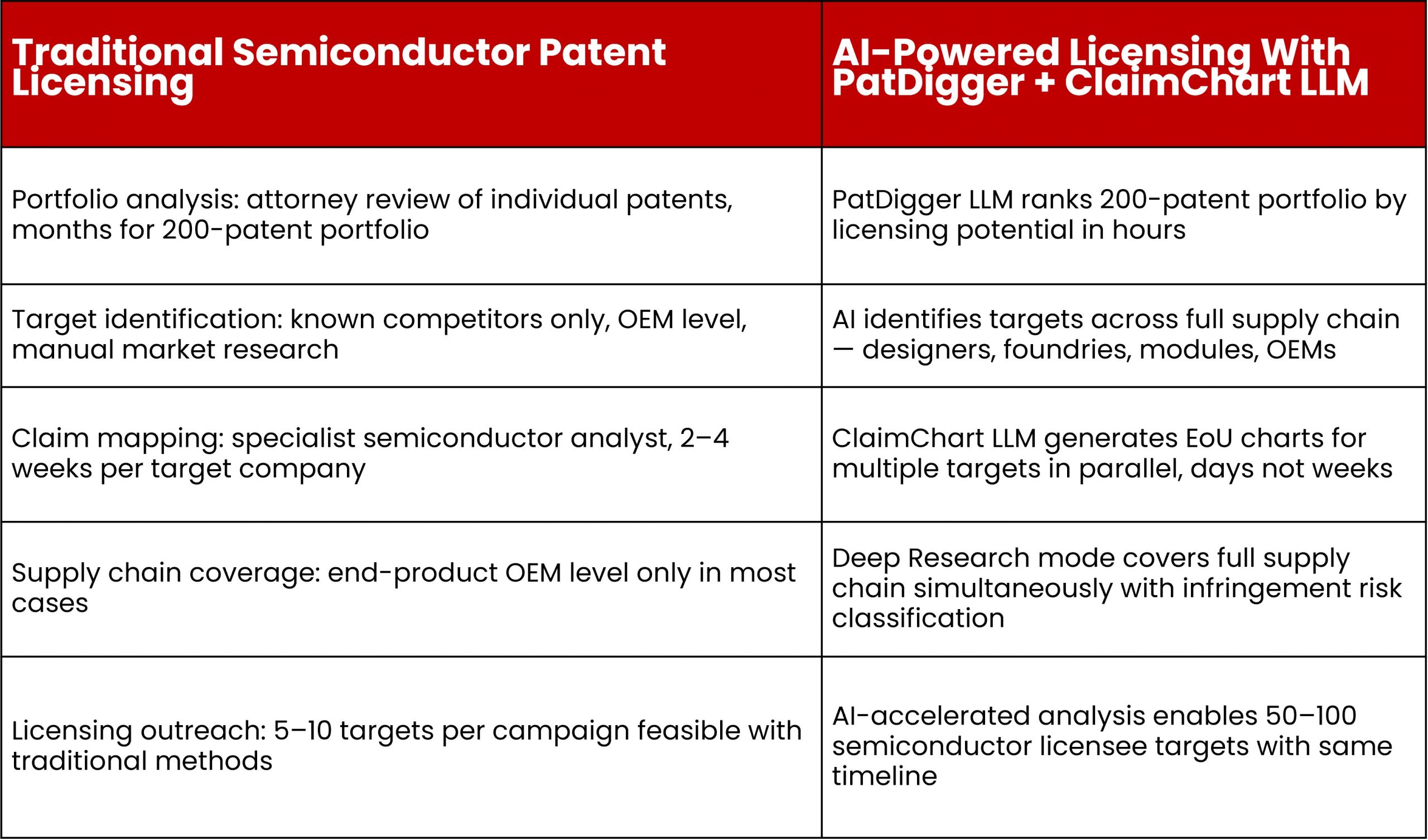
Semiconductor patent licensing rewards both technical precision and analytical scale. AI delivers both — claim-element-level mapping at chip architecture detail, across supply chains that span dozens of companies and hundreds of products across multiple jurisdictions.
The licensing teams building these AI-powered analysis capabilities now are defining the commercial IP landscape for the semiconductor sector’s next decade.