


Introduction
On November 28, 2025, the USPTO rescinded large portions of the Biden-era AI patent guidance. The separate eligibility track for AI-assisted inventions was removed. AI systems are now treated as tools — no different from any other technology — and examined under standard Alice/Mayo two-step analysis.
The same month, Director Squires stated that Section 101 should not be “a blunt instrument to exclude entire technological fields.”
The result is a narrower but cleaner path to AI patent eligibility — built around the Alice/Mayo framework as reinforced by the Federal Circuit’s 2025 ruling in Recentive Analytics v. Fox Corp., the first Alice analysis specifically applied to a machine learning patent.
What the November 2025 Guidance Reset Actually Changed
No Separate AI Eligibility Track
AI inventions are now examined under standard Alice/Mayo two-step analysis. The special guidance that had created a distinct framework for AI-assisted inventions — including the February 2024 AI inventorship guidance and associated examination procedures — has been rescinded. For patent applicants, this is clarifying: there is one framework, applied consistently.
“Close Calls Are Not Rejections”
Director Squires reinstated the long-standing USPTO principle that examiners should not reject a claim under Section 101 unless the rejection is clearly supported. Borderline cases should not receive 101 rejections. This principle had eroded during the previous administration and its reinstatement is meaningful for applicants with AI inventions that have a genuine technical advance.
August 2025 Memo: Tightened Mental Process Definition
The August 2025 Deputy Commissioner memo tightened the definition of “mental process” as an abstract idea. AI model operations — training, inference, and prediction — do not qualify as mental processes that can be practically performed in a human mind. This is a significant protection for AI patent applicants: a claim directed to an AI system’s operations cannot be rejected as directed to a “mental process” abstract idea.
The Recentive Analytics v. Fox Corp. Ruling — The Line the Federal Circuit Drew
In 2025, the Federal Circuit applied Alice doctrine to a machine learning patent for the first time in Recentive Analytics v. Fox Corp. The ruling established the framework that USPTO examiners and courts now apply to AI patent claims.
The court found that applying known machine learning techniques to a new domain — without specifying what is novel about the ML method itself — is an abstract idea without “something more.”
Key distinction from Recentive Analytics v. Fox Corp. (2025):
- Claiming the OUTCOME of an ML system (better accuracy, faster scheduling, improved predictions) is NOT the same as claiming a novel ML architecture, training method, or system that achieves a specific technical improvement.
- “Applying known ML techniques to a new domain” = abstract idea without something more.
- The inventive concept must be in the HOW — the specific technical mechanism — not the WHAT — the application domain or the result achieved.
4 Claim Patterns That Now Trigger Section 101 Rejections in AI Patents
Pattern 1 — Domain Application Without Technical Advance
“A system for improving scheduling accuracy using machine learning.” This claim describes applying ML to a domain without specifying what is novel about the ML method. Recentive confirms this is the paradigm of an abstract idea without something more.
Pattern 2 — Outcome-Claiming Without Mechanism
“A method for predicting X by applying neural networks to dataset Y.” The claim describes the prediction outcome without specifying the technical mechanism that achieves it. Courts and examiners cannot find the inventive concept in the result — it must be in the method.
Pattern 3 — Generic ML Implementation
Software patents where the ML component is an off-the-shelf framework — TensorFlow, PyTorch, scikit-learn — applied to a new problem domain. The application domain may be new, but the implementation is generic. Without a novel architectural choice, training procedure, or system interaction, this pattern fails.
Pattern 4 — Data Novelty Presented as Method Novelty
Inventions where the novelty is the dataset or training data, not the ML methodology. Claiming a unique dataset as the inventive contribution — rather than a novel ML method that processes data in a technically innovative way — does not satisfy the “something more” requirement.
4 Claim Patterns That Survive Alice After Recentive
Pattern 1 — Novel ML Architectures
Claims reciting a specific, novel neural network architecture — not just “a neural network” but a specific architectural advance with demonstrable technical improvements over prior ML approaches. The architecture must be described in sufficient detail that the claim cannot be characterised as simply “using ML.”
Pattern 2 — Technical Problem Solved by AI
Claims where the AI method solves a problem that was previously technically unsolvable, and where the technical problem is articulated in the specification as a technical limitation of prior approaches — not merely a business inconvenience that AI happens to address more efficiently.
Pattern 3 — Architecture-Anchored Mechanism Claims
Claims tied to specific data structures, specific training procedures, specific inference mechanisms — concrete technical implementation, not functional description of what the AI system does. These claims survive because the inventive concept is in the technical “how,” not the application-domain “what.”
Pattern 4 — Measurable Technical Gains From the Novel AI Method
Claims demonstrating specific, measurable technical improvements — reduced latency, improved throughput, lower memory usage — that flow from the specific AI architecture, not from applying AI generically. The technical gain must be causally linked to the specific inventive method.
How XLSCOUT’s Tools Support Post-Recentive AI Patent Filing
Map the Prior ML Landscape Before Filing
The most common Section 101 vulnerability in AI patent applications is a specification that does not clearly distinguish the claimed ML method from prior art approaches. If the examiner finds similar ML techniques in prior art, the “something more” argument at Alice step two weakens significantly.
ParaEmbed AI Search Across Prior ML Literature
Novelty Checker LLM’s ParaEmbed technology finds conceptually similar prior ML methods based on technical meaning — identifying prior ML architectures, training methods, and model types that use different terminology but describe technically equivalent approaches. Before filing, teams know which prior ML methods their claims must be distinguished from.
Feature-Level Prior Art Differentiation Map
The novelty report maps each of the ML invention’s key technical features against the closest prior art — showing which aspects have prior art coverage and which appear genuinely novel. The features with no prior art overlap are precisely where the “something more” argument lives — and where the specification must be built to ensure Alice step two compliance.
Drafting LLM — Structure Claims for Section 101 Compliance
Independent Claim Anchored to the Technical Mechanism
Drafting LLM generates approximately 20 claims in the first pass. The independent claim is structured around the specific technical mechanism — the novel ML architecture, training method, or system interaction identified in the Novelty Checker differentiation map — not the outcome description that Recentive makes vulnerable to Section 101 rejection.
Specification Structured for Alice Step Two
The specification’s description of the technical problem is critical for post-Recentive prosecution. Drafting LLM structures specification sections to articulate the specific technical limitation in prior ML approaches that the invention overcomes — the language Alice step two analysis requires. This is both Section 101 compliance and, under the 2025 inventorship guidance, documentation of the human inventor’s technical contribution.
Chatbot Refinement for Technical Precision
The integrated chatbot drafting assistant allows targeted refinement: “make claim 3 more specific to the training architecture,” “add a method claim corresponding to system claim 1,” “identify which claim elements reflect the specific technical advance.” These instructions produce immediate changes without regenerating the full application.
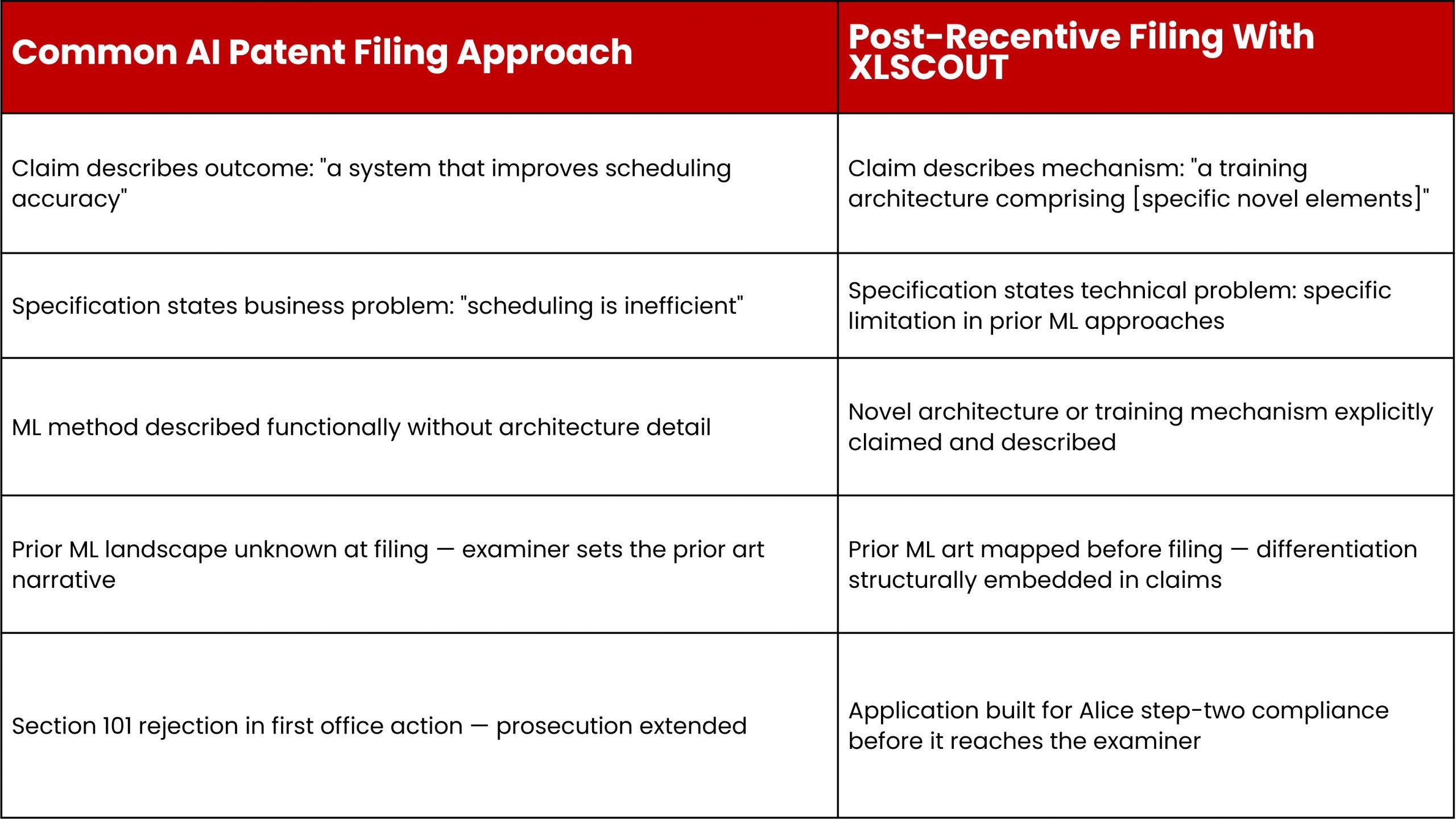
The November 2025 guidance reset narrowed the path but clarified the framework. Teams that understand the Recentive rule — claim the technical mechanism, not the outcome — and use AI drafting tools to implement it will be getting allowances while competitors accumulate Section 101 rejections.