

How to Draft a Patent Application for the EPO Using AI: A Practical Guide for European IP Teams


Introduction
Drafting a patent application for the European Patent Office is not the same discipline as drafting for the USPTO.
The EPO requires a two-part claim format. The problem-solution approach governs inventive step assessment. Article 83 demands the description supports the claims across their full scope. Article 84 requires clarity and conciseness. There is no continuation practice — divisional applications serve a similar purpose, but must be filed while the parent is still pending.
For IP teams filing in Europe — from Germany, Denmark, the UK, or Italy — understanding these EPO-specific requirements is the difference between a patent that grants efficiently and one that becomes tied up in examination for years.
How EPO Patent Drafting Differs From USPTO Practice
European IP teams — and US teams filing EP applications — must adapt their drafting approach to five key EPO requirements:
- Two-part claim format. EPO claims require a preamble (what is known from prior art) and a characterising portion (what is new), joined by “characterised in that.” This two-part format separates the prior art from the inventive contribution — a structural distinction the USPTO does not require.
- Problem-solution approach for inventive step. The EPO examiner assesses inventive step by identifying the closest prior art, defining the technical problem the invention solves relative to it, and asking whether the skilled person would arrive at the claimed solution. The specification must be drafted to support this analysis from the start.
- Article 83 — sufficiency of disclosure. The description must enable the skilled person to carry out the invention across the full scope of the claims. Overbroad claims not supported by the description lead to Article 83 objections that are difficult to overcome in prosecution.
- No continuation practice. Unlike the USPTO, the EPO has no continuation applications. Divisional applications can extend coverage but must be filed while the parent application is still pending. Identifying divisional candidates early — ideally before the parent grant — is a key part of EPO prosecution strategy.
- Language filing options. EPO applications may be filed in English, French, or German. XLSCOUT’s Drafting LLM supports multilingual output, making it suitable for teams filing in multiple languages.
Note: The EPO’s updated 2026 examination guidelines confirm that AI tools may be used in patent drafting, provided all formal and substantive requirements are met. The EPO has specifically flagged that AI-generated content carries hallucination risk — human review of all AI-drafted claims and specifications is required before filing.
The Problem-Solution Approach — Why It Must Inform Drafting From Day One
The EPO’s problem-solution approach is not just an examination methodology — it is a drafting discipline. Specifications drafted without this structure force examiners to construct the analysis themselves, often in a way that is less favourable to the applicant.
The specification must clearly articulate:
- The technical field and the closest prior art, including its technical drawbacks
- The technical problem the invention solves relative to that prior art
- How the claimed solution specifically addresses the identified technical problem
Teams that identify the closest prior art before drafting begins — using a tool like Novelty Checker LLM — enter the drafting process with this framework already established. The two-part claim structure flows naturally from knowing what is in the preamble (the prior art) and what is in the characterising portion (the inventive departure from it).
How XLSCOUT’s Drafting LLM Supports EPO Patent Applications
XLSCOUT’s Drafting LLM generates detailed claims, abstract, background, summary, description, description of drawings, and embodiments within minutes. It is described as the “Faster, Better, and The Most Secure Automated Patent Drafting Platform.”
Complete Application Sections Generated in Minutes
Drafting LLM produces a complete patent application draft from an invention disclosure — including all EPO-required sections. Selecting European drafting style generates two-part claims in the preamble/characterising format the EPO requires, with specification language structured around the problem-solution approach.
Integrated AI Chatbot for Iterative Refinement
An integrated AI chatbot allows patent attorneys to adjust specific claims, expand embodiments, strengthen the problem-solution framework, or add dependent claims — all in real time, without regenerating the entire application. The chatbot retains context throughout the drafting session.
Iterative Refinement to Strengthen the Patent Draft
Each round of chatbot interaction refines the draft further — claim language becomes more precise, the description builds stronger Article 83 support, and the problem-solution narrative becomes more coherent. The iterative model is designed for how patent attorneys actually work, not one-shot generation.
Direct Pipeline From Novelty Checker LLM
The Novelty Checker → Drafting LLM pipeline carries prior art findings directly into the drafting session. The prior art identified in the novelty search populates the preamble of the two-part claims and informs the “closest prior art” section of the description — ensuring the specification accurately reflects the prior art landscape before the application is filed.
Step-by-Step: EPO Application Drafting With Drafting LLM
- Upload or enter the invention disclosure. Drafting LLM accepts text descriptions, uploaded documents, or structured invention disclosure forms — no manual formatting required.
- Select European drafting style. Selecting EPO style applies two-part claim format, problem-solution specification structure, and appropriate Article 83 description depth. Multiple language options are available including English, French, and German.
- Review the generated draft. Drafting LLM produces approximately 20 claims — including independent claims in two-part format, dependent claims with specific embodiments, abstract, and full description sections including background, summary, and preferred embodiments.
- Refine using the chatbot assistant. Use the chatbot to adjust specific claim language, strengthen inventive step arguments, add alternative embodiment descriptions, or generate description of drawings sections.
- Pre-filing review against closest prior art. Before filing, cross-check the characterising portion against the prior art identified in the novelty search to confirm the technical problem is accurately framed and the inventive step argument is structurally sound.
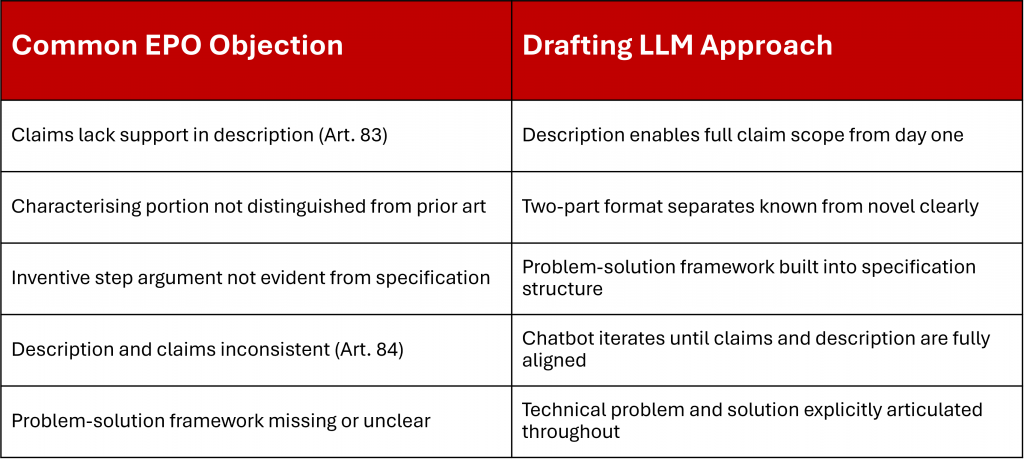
Common EPO Examination Objections That Better Drafting Prevents
The Novelty Checker → Drafting LLM Pipeline for EPO Applications
The most effective EPO drafting workflow combines Novelty Checker LLM and Drafting LLM in sequence. Novelty Checker identifies the closest prior art before drafting begins — defining the technical problem the invention must solve relative to it.
That prior art landscape informs the two-part claim format (what goes in the preamble), the problem-solution specification structure, and the inventive step argument that EPO examiners will apply. Teams that run Novelty Checker before Drafting LLM enter EPO examination with claims already calibrated to the prior art landscape — reducing examination rounds and accelerating the path to grant.
AI-assisted patent drafting is now EPO-permissible. Teams using Drafting LLM are filing stronger applications, reducing prosecution rounds, and spending attorney time on strategy rather than first-draft preparation.
Why stay behind? Get in touch with us!



© 2026 XLSCOUT. All Rights Reserved.