
Introduction
A European patent licensing campaign is not a US campaign with different time zones and currencies.
Patent validation status varies by country — a bundle patent maintained in Germany may have lapsed in Italy. Royalty rate norms differ across European markets. EU competition law places specific constraints on licensing structures that have no direct equivalent in US antitrust law. And the Unitary Patent has changed the target geography entirely: one patent now covers 18 EU member states simultaneously.
AI changes the economics of building a European licensing campaign — but only if the workflow is built for the European context, not adapted from a US model.
What Makes European Patent Licensing Different From US Licensing
Patent Validation Status Varies by Country
Classical European (bundle) patents granted by the EPO must be validated in each designated state separately — and maintained with separate national renewal fees. A portfolio licensing campaign must start with a validation status audit: identifying which patents are actually enforceable in which markets. A patent not maintained in Denmark cannot be enforced there, regardless of its claim scope.
Unitary Patents Cover 18 States Uniformly
Since June 2023, Unitary Patents — granted by the EPO — provide uniform protection across all 18 UPC member states without separate national validation or maintenance. One Unitary Patent creates the same blocking coverage in Germany, France, Italy, Denmark, and 14 others simultaneously. For newer patent portfolios, Unitary Patents simplify the licensing geography considerably.
Royalty Rate Norms Differ Across European Markets
What constitutes a commercially reasonable royalty in Germany differs from conventions in Italy’s manufacturing sector. Danish and UK markets each have their own norms. A single royalty rate applied across European markets may be commercially unsustainable — European licensing campaigns require market-specific rate modelling.
EU Competition Law Constrains Certain Licensing Structures
Article 101 TFEU prohibits agreements that restrict competition. Article 102 prohibits abuse of a dominant position. Patent pools, exclusive licensing arrangements, and certain cross-licensing structures that are permissible under US antitrust law may require careful structuring under EU competition law and the Technology Transfer Block Exemption Regulation (TTBER).
Language Requirements in Target Markets
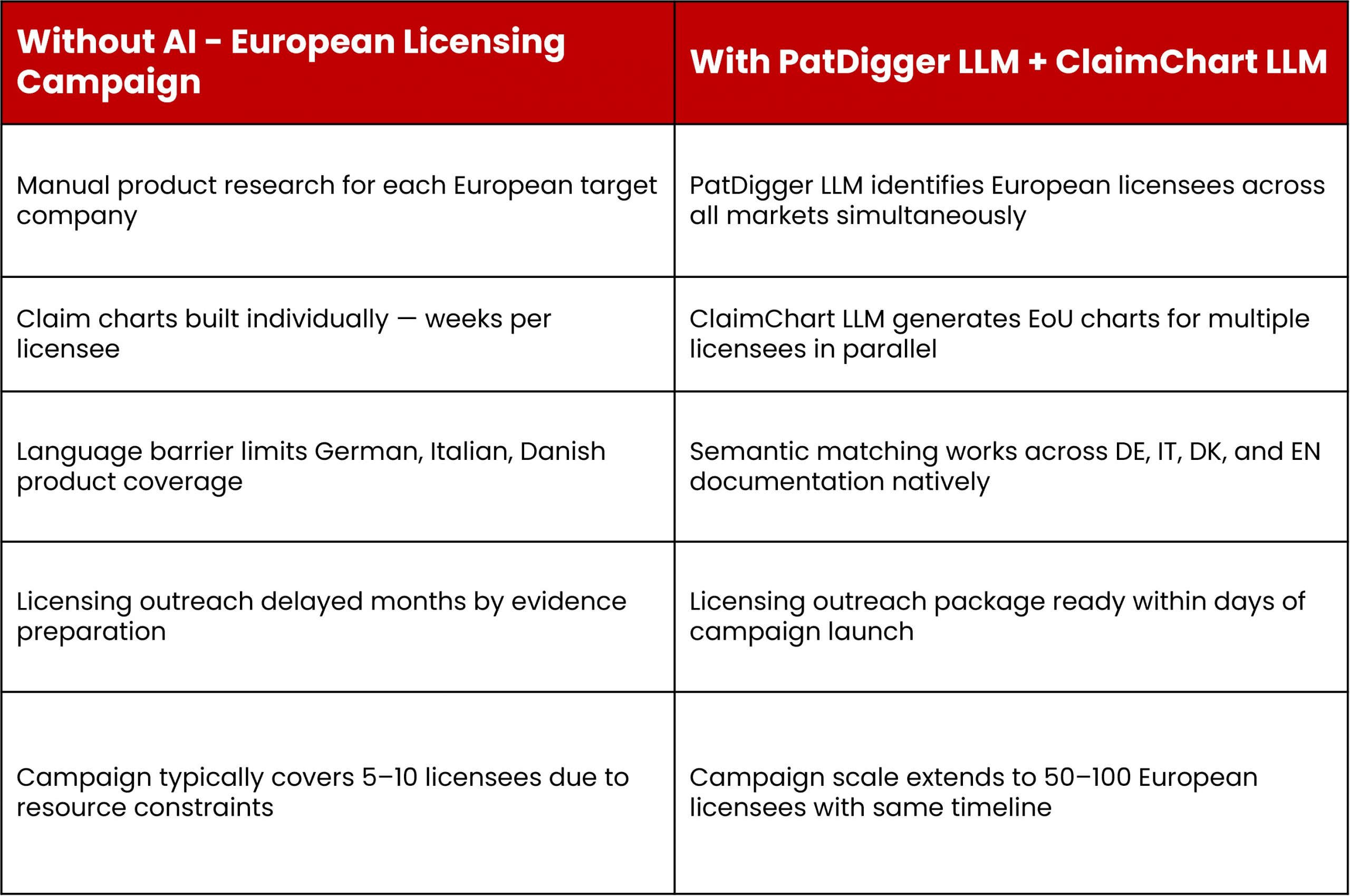
Licensing correspondence directed at German Mittelstand companies, Italian manufacturers, or Danish SMEs is more effective — and sometimes legally expected — in the national language. PatDigger LLM’s semantic matching works across German, Italian, Danish, and English product documentation, enabling multi-language claim mapping without manual translation.
Step 1 — Portfolio Audit: Which Patents Are Enforceable Where?
The first step in any European licensing campaign is a validation status audit. For bundle patents, this means identifying which national validations are maintained, which have lapsed, and which countries represent the commercially relevant target markets.
PatDigger LLM supports this portfolio-level analysis — scanning the patent portfolio and identifying which patents have the broadest claim coverage against products in each target market, ranked by licensing potential.
Enter Patent Portfolio — Identify Potential Licensees — Identify Top Overlapping Products
PatDigger LLM accepts a portfolio of patents and identifies potential licensees — companies whose products overlap with the portfolio’s claims. For European campaigns, this means identifying German Mittelstand manufacturers, UK technology companies, Danish cleantech firms, and Italian engineering companies whose products read on the portfolio’s claims, all ranked by degree of overlap.
AI-Generated Claim Chart Delivered to Inbox
PatDigger LLM delivers AI-generated claim charts mapping patent claims against identified overlapping products — the EoU foundation for licensing negotiations. Claim charts for multiple European licensees can be generated in parallel, enabling large-scale outreach preparation that would previously require months of analyst work.
Step 2 — Identifying European Licensee Targets by Market Segment
European licensing campaigns benefit from market-segment targeting rather than country-by-country approaches. PatDigger LLM identifies licensee targets across each of Europe’s key industrial segments:
- German Mittelstand — mid-sized manufacturers in automotive supply, industrial machinery, medical technology, and electronics. High patent-filing activity, strong IP culture, responsive to licensing outreach backed by clear EoU evidence.
- UK technology sector — fintech, AI, semiconductor design, and pharmaceutical companies. Still active EP(UK) patent filers despite Brexit, with significant R&D investment.
- Danish deep-tech and cleantech — concentrated innovation in wind energy, maritime technology, life sciences, and industrial IoT. Denmark ranks among Europe’s highest patent filers per capita.
- Italian manufacturing and design — mechanical engineering, fashion technology, and food processing equipment. Italy’s manufacturing base creates specific licensing opportunities for mechanical and electromechanical patents.
Step 3 — Claim Mapping Against European Product Documentation
Once PatDigger LLM has identified the target licensees and their overlapping products, ClaimChart LLM generates the EoU charts that form the evidential basis for licensing outreach.
Claim-Element-Level EoU Mapping
For each European target licensee, ClaimChart LLM identifies which specific products most closely read on the patent claims at the individual claim element level — enabling targeted, product-specific licensing outreach rather than broad portfolio assertions that licensees can more easily dismiss.
AI-Generated Claim Charts and EoU Charts
The automated EoU chart includes claim-element-level mapping with supporting evidence paragraphs from product documentation, hyperlinked source references, and AI-generated commentary explaining the technical basis for each mapping — ready for review by licensing counsel before outreach begins.
EU Competition Law Considerations for European Licensing Campaigns
- Article 101 TFEU — prohibits agreements restricting competition. Applies to patent pools, cross-licences, and exclusive licences where parties hold significant market share.
- Article 102 TFEU — prohibits abuse of a dominant position. Relevant where a patent holder holds a dominant technology market position and refuses to license on reasonable terms.
- Technology Transfer Block Exemption Regulation (TTBER) — provides a safe harbour for certain bilateral licensing agreements. Hardcopy licences with price-fixing or market-allocation provisions fall outside the TTBER and require individual assessment.
- SEP holders in Europe — FRAND obligations under ETSI and 3GPP IPR policies create additional constraints beyond the standard EU competition law framework.
European licensing counsel should be engaged early in campaign planning to structure agreements within the TTBER safe harbour and avoid Article 101 or 102 exposure — particularly for campaigns targeting multiple licensees simultaneously in the same market.
European patent licensing rewards preparation. The campaigns that achieve the best licensing outcomes are those that arrive at the first negotiation call with clear EoU evidence, accurate validation status, and market-appropriate outreach — not those that make broad initial assertions and hope for settlement.