Introduction
Not every invention needs a patent. And not every invention that does not need a patent should be left unprotected.
Defensive publication is the third option that most IP teams underuse — the deliberate disclosure of an invention to create prior art that blocks competitors from patenting the same idea, without the cost or timeline of a patent application.
Patent vs Defensive Publication: The Strategic Question
The choice between defensive publication and patent filing is a strategic decision that most IP teams make too quickly or too rarely. The default is usually to file a patent or do nothing — leaving the defensive publication option unused.
Defensive publication makes sense when:
- The invention has limited commercial value as a licensing asset
- The primary goal is blocking competitors rather than generating royalties
- The patent application cost and timeline are not justified by the expected commercial return
- Speed to publication matters more than claim scope
Filing a patent makes sense when:
- The invention covers core product functionality with active commercial value
- Licensing revenue is a realistic objective
- The invention has sufficient novelty for broad independent claims
How AI Helps IP Teams Choose the Right Strategy
XLSCOUT’s Novelty Checker LLM provides the prior art analysis that informs the strategic choice — quickly. By running a semantic prior art search across 170M+ patents and 220M+ NPL sources, the AI identifies whether the invention is genuinely novel, how crowded the surrounding prior art is, and whether broad independent claims are achievable.
The prior art analysis shapes the strategy decision:
- High novelty + commercial value → file a patent application with broad independent claims
- Moderate novelty + limited commercial value → defensive publication — create prior art, block competitors, minimal cost
- Low novelty → neither — already disclosed, no action needed
Running a rapid AI prior art search before every invention disclosure changes the IP strategy conversation from a binary patent/no-patent decision to a three-option framework that allocates resources more precisely.
How AI Drafts Effective Defensive Publications
A defensive publication only creates the prior art it describes. A poorly drafted defensive publication leaves gaps that a competitor can still patent around. An effective defensive publication covers the invention, its obvious variations, and the technical principle underlying both.
XLSCOUT’s Drafting LLM generates defensive publication drafts that cover the technical concept comprehensively — not just the specific implementation the inventor described. The AI identifies the technical principle, the obvious variations, and the boundary of the prior art that needs to be established.
- Comprehensive disclosure: covers the inventive concept and its reasonable variations
- Technical accuracy: matches the level of detail needed to establish prior art
- Boundary definition: describes exactly what territory is being blocked — not more, not less
How AI Protects Innovation Cost-Effectively
The cost comparison is significant. A defensive publication costs a fraction of a patent application — no examiner fees, no prosecution, no maintenance costs — while achieving its primary goal: establishing prior art that prevents competitors from patenting the same invention.
For innovation-intensive R&D teams that generate more invention disclosures than the patent budget can support, AI-powered defensive publication strategy enables a systematic approach:
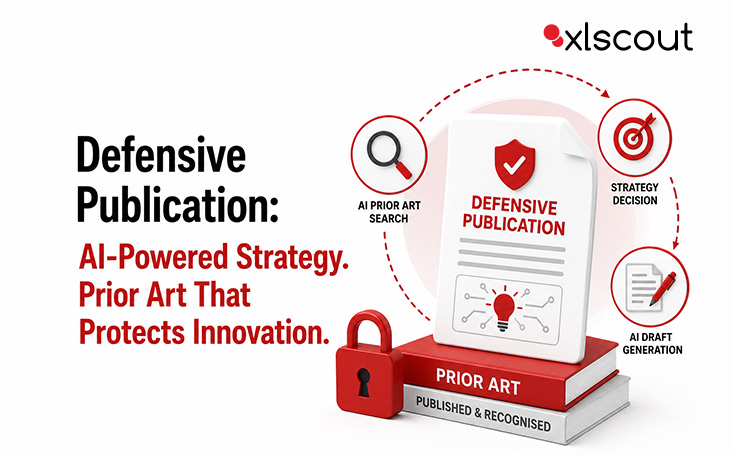
- AI prior art search: rapid novelty assessment for every invention disclosure — in hours
- AI strategy recommendation: patent vs defensive publication based on novelty, commercial value, and prior art density
- AI draft generation: defensive publication document ready for review in the same session
Defensive publications published in recognised databases — including IP.com and technical journal repositories — are legally recognised as prior art in patent examination. AI-generated drafts accelerate the disclosure process without reducing the quality of the prior art created.
XLSCOUT Novelty Checker LLM + Drafting LLM — AI-powered defensive publication strategy: prior art assessment, strategy recommendation, and comprehensive disclosure drafting.