Introduction
A granted patent is not the end of a portfolio strategy. It is the beginning.
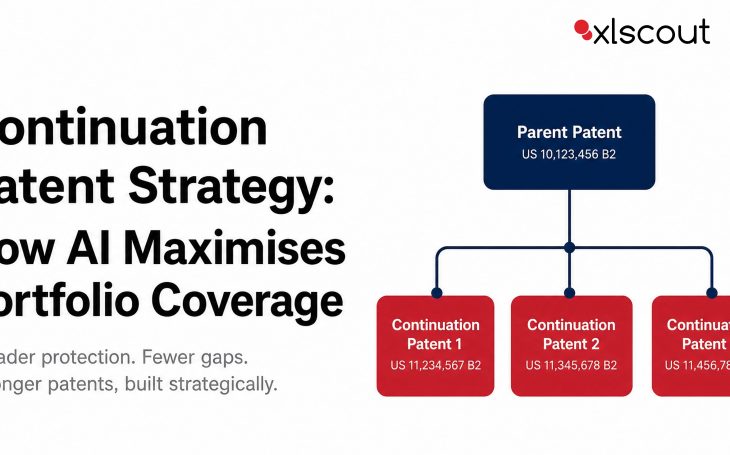
The most defensible IP portfolios are not built from single filings. They are built from patent families — continuations, divisionals, and continuations-in-part that follow technology development and block competitive workarounds.
~120,000 continuation applications are filed per year at the USPTO. Patent families with continuation depth command 3-5× higher licensing rates than single-patent portfolios. Most companies are leaving that value on the table.
What Continuations Do That Most Portfolios Underuse
A continuation application claims priority to a parent patent but presents new or refined claim language. The claims can be narrower, broader (within what the specification supports), or directed to a different aspect of the same invention.
This creates three specific strategic opportunities:
- Blocking competitive workarounds: as competitors design around your granted claims, continuations can follow their design-around attempts with claims that address the workaround directly
- Claiming the full scope of the specification: parent applications often claim only a fraction of what the specification supports — continuation claims capture the rest
- Following technology development: as the invention is commercialised and refined, continuation claims can cover the product as it actually shipped, not just as it was first conceived
The Problem: Identifying Continuation Opportunities at Scale
The strategic logic is clear. The operational challenge is bandwidth.
Systematically reviewing every granted patent in a portfolio for continuation opportunity requires claim analysis, whitespace analysis, and competitive landscape awareness — simultaneously, for every patent that is still within its continuation window.
Most IP teams do not have the bandwidth to do this systematically. So continuation opportunities are identified opportunistically — on the patents that happen to be top of mind, not necessarily the ones with the highest continuation value.
How AI Identifies Continuation Opportunities
Step 1: Parent patent whitespace analysis
XLSCOUT’s Novelty Checker LLM analyses the granted parent patent claims and identifies the whitespace around them — the technical territory that the specification supports but the granted claims do not yet cover. This is the territory available for continuation claiming.
The analysis compares the parent claim scope against the prior art landscape in the same technical domain — identifying what is claimable that has not yet been claimed.
Step 2: Competitive workaround detection
TechScaper LLM continuously monitors competitor patent filings. When a competitor files in a technology area adjacent to your granted claims — the signal that they are exploring a workaround — the monitoring system flags it.
This creates a direct input to continuation strategy: competitor workaround attempts become continuation claim targets.
Step 3: Continuation claim generation
XLSCOUT’s Drafting LLM generates continuation claim language from the identified whitespace and competitive signals. The AI drafts the claims; the attorney reviews the strategy and specification support before filing.
Timing: The Continuation Window
A continuation must be filed while the parent application is still pending — before the parent is granted or abandoned. Once the parent grants, the window is open only for a continuation of a co-pending continuation.
The practical implication: continuation strategy needs to be an ongoing workflow, not an afterthought at grant. AI monitoring that flags the parent status and identifies continuation opportunities before the window closes is what makes systematic continuation strategy operationally feasible.
The Licensing Value of Continuation Depth
Patent families with continuation depth have a structural licensing advantage. When a potential licensee identifies a design-around, the licensor with a continuation portfolio can present claims that address the workaround — without going back to prosecution from scratch.
The licensing negotiation dynamic is different. The licensor with a continuation family has more claim scope, more design-around coverage, and more leverage. The licensor with a single granted patent has exactly one claim set to defend.
PatDigger LLM’s licensing candidate identification is more valuable when applied to continuation families than to single patents — because the claim scope that identifies licensees covers more of what competitors are actually practising.