Introduction
Keyword patent search has a structural flaw. It is called the vocabulary problem.
An invention described as a ‘distributed ledger system’ and an invention described as a ‘decentralised transaction record’ are technically identical. A keyword search for one finds no results for the other. Both describe the same prior art.
This is not a hypothetical. It is the reason that prior art searches conducted by skilled practitioners — using well-constructed Boolean queries across major databases — still miss relevant references. Not because the searcher made an error. Because the relevant reference uses different terminology.
The Vocabulary Problem in Practice
The vocabulary problem is most acute in three situations:
- Cross-jurisdictional search: Japanese, Korean, and Chinese patents describe the same inventive concepts using terminology that has no direct English equivalent — because the technical vocabulary developed independently
- Fast-moving technology areas: terminology for AI, semiconductor design, and clean energy technology evolves faster than keyword lists can track — new terms describe the same concepts that old terms covered
- Domain translation: the same underlying technical principle appears in different fields under different names — what fluid dynamics calls ‘vortex shedding’ and what aerospace calls ‘aeroelastic flutter’ can describe overlapping prior art
Keyword search has no mechanism to resolve these equivalences. It finds what is in the query. It misses everything else — and the searcher has no way of knowing what they missed.
What AI-Based Semantic Search Does Differently
AI-based semantic search does not match keywords. It matches technical meaning.
XLSCOUT’s ParaEmbed model — the engine behind Novelty Checker LLM — is trained on 170M+ patent documents across multiple languages. It encodes the technical meaning of a query into a high-dimensional representation, then finds patent documents whose technical meaning is closest to that representation — regardless of the specific words used.
A query about ‘distributed ledger systems’ finds prior art about ‘decentralised transaction records’ — because the model recognises that both describe the same underlying technical concept.
The Benchmark Data
These are not marketing claims. These are measured outcomes.
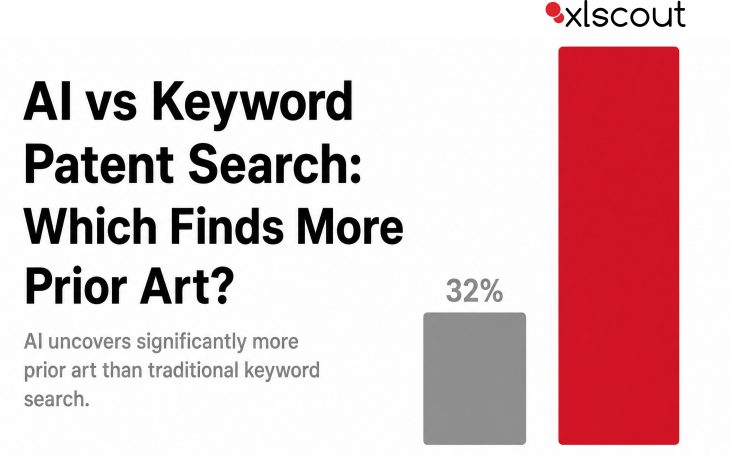
- 90% more accurate than free tools: XLSCOUT’s ParaEmbed model outperforms free database keyword search by 90% in accuracy benchmarks across test sets of known prior art
- 8X more accurate than paid alternatives: in independent benchmark testing against other paid patent search tools, XLSCOUT semantic search delivers 8× better prior art coverage
- 74% of expert-found references in top-10 results: when human expert searchers identified the most relevant prior art for a set of test queries, 74% of those expert-found references appeared in XLSCOUT’s top-10 results
AI patent search market: $747 million in 2025, projected to reach $5.37 billion by 2035. The growth reflects IP teams discovering that the vocabulary problem is not a minor quality gap — it is a structural limitation that compounds at scale.
Where Keyword Search Still Has Value
This is an honest comparison, not a sales pitch. Keyword search retains specific advantages:
- Known-assignee searches: finding all patents from a specific company in a specific technology area — keyword + assignee field search is reliable and fast
- Specific claim language monitoring: watching for specific phrases in competitor patent claims — where exact term matching is the goal
- Examiner-style prior art: examiners search by keyword and CPC classification — understanding what the examiner will find requires understanding what keyword search returns
The practical approach is complementary: AI semantic search for coverage and concept discovery, keyword search for specific assignee or term monitoring.
The Practical Implication for IP Teams
If you are conducting patentability searches that will influence filing decisions, invalidity searches that will influence litigation strategy, or FTO clearance that will influence product launch decisions — the methodology matters.
A prior art search that misses 40-60% of relevant references due to the vocabulary problem is not a complete search. It is a search that found what it was looking for — and missed everything that used different words to describe the same thing.
The question is not whether AI or keyword search is better in the abstract. The question is whether your current prior art search methodology finds the references that exist — in Japanese, Korean, and Chinese patent databases — before the examiner or opposing counsel does.