Introduction
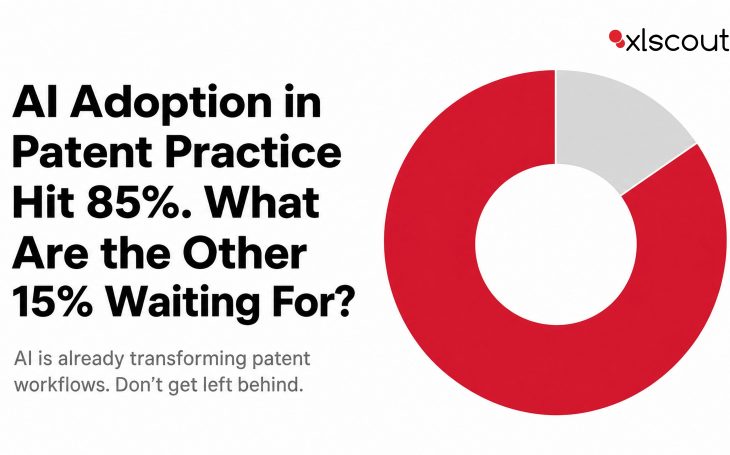
Clarivate’s Centre for IP and Innovation Research tracked something significant in 2025: AI adoption in patent practice jumped from 57% in 2023 to 85% in 2025. That is a 28-percentage-point shift in two years.
The 15% who have not adopted AI are not just operating more slowly. They are operating with a structural disadvantage that compounds with every new filing cycle.
This is not an argument that AI replaces patent attorneys. It is an argument that the 85% who have adopted AI are doing specific things differently — and those differences are measurable.
What the 85% Are Actually Doing Differently
1. Finding prior art their competitors miss
The vocabulary problem is real: the same invention can be described in dozens of different ways across different patent offices and filing languages. Keyword-based prior art search misses the prior art that uses different terminology for the same concept — and that missed prior art is the reference that collapses your patent in prosecution or litigation.
AI-powered semantic search finds prior art by technical meaning, not keyword matching. Teams using AI semantic search are finding references that keyword-only searches systematically miss.
2. Responding to office actions faster
The average USPTO office action response takes 8 to 40 attorney hours manually. Teams using AI to analyse the rejection, map prior art citations, and generate a first-draft response are compressing that to a fraction of the manual time.
The attorney still reviews and approves every response. The difference is that AI does the scaffolding work — leaving attorney judgment for the decisions that actually require it.
3. Monitoring competitive patent activity continuously
Quarterly landscape reports describe the patent world as it existed 10 weeks ago. Teams using continuous AI-powered patent monitoring receive alerts within hours of a competitor filing — in the technology sub-domain that matters to them, filtered to eliminate noise.
−92% monitoring noise. Your taxonomy — not a generic CPC hierarchy. Continuous — not quarterly.
4. Identifying portfolio value they did not know existed
Most patent portfolios carry 20-30% of patents that generate no strategic return — no active product protection, no licensing revenue, just maintenance fees.
AI patent portfolio analysis tools like PatDigger LLM screen existing portfolios for licensing potential — identifying companies whose products may be practising your claims, before any outreach investment.
5. Validating ideas before filing investment
R&D teams using AI-powered novelty checking validate invention concepts in hours rather than weeks. Ideas that would have failed in prosecution are identified early. Filing resources are concentrated on the inventions that stand the best chance of broad claim scope.
The Real Cost of Waiting
The cost of not adopting AI is not just slower workflows. It is compounding prior art risk.
- Prior art that keyword search misses: does not disappear. It surfaces in prosecution, in invalidity proceedings, in litigation.
- Competitive filings that quarterly monitoring misses: create IP positions that are harder to design around after the fact.
- Portfolio dead weight that nobody reviews: costs $1,600-$12,000 per patent per renewal cycle in maintenance fees that earn nothing.
- Licensing revenue that no one has identified: sits in portfolios across every major corporate IP department — unmapped, uncaptured.
The AI patent search market was $747M in 2025 and is projected to reach $5.37 billion by 2035. That growth is not speculative. It reflects an industry-wide recognition that the old methodology has structural limits that compound at scale.
Where to Start
The mistake is thinking you need to change everything at once. The teams who adopted AI fastest started with a single high-frequency workflow and expanded from there.
Prior art search is the highest-frequency IP workflow for most teams. It is also the workflow where AI delivers the most immediate, measurable improvement in both speed and coverage.
XLSCOUT’s Novelty Checker LLM delivers AI-powered semantic prior art search across 170M+ patents and 220M+ non-patent literature sources. 90% more accurate than free tools. 8X more accurate than paid alternatives. Results that include the cross-jurisdictional, cross-language prior art that keyword-only search misses.
The 85% who adopted AI are not using a different methodology from the 15%. They are using better tools to execute the same methodology — faster, more completely, and with less manual effort.
Start with Novelty Checker LLM — AI-powered prior art search across 170M+ patents and 220M+ NPL sources. Results in under 30 minutes.