Introduction
The 5G standard essential patent licensing dispute is not over. As of 2025, more than 200 active SEP cases were ongoing across the US, EU, India, and China.
FRAND rate negotiations that were expected to settle with 5G adoption have instead fragmented into jurisdiction-by-jurisdiction litigation. Meanwhile, 6G filing at 3GPP has already produced 10,000+ early patent applications — adding new layers of complexity to a landscape that is already among the densest and most technically demanding in global IP practice.
95,000+ declared essential patents for 5G standards globally. This is not a landscape that can be navigated manually at scale. It is a volume problem that requires an AI solution.
Why SEP Claim Mapping Is Uniquely Hard
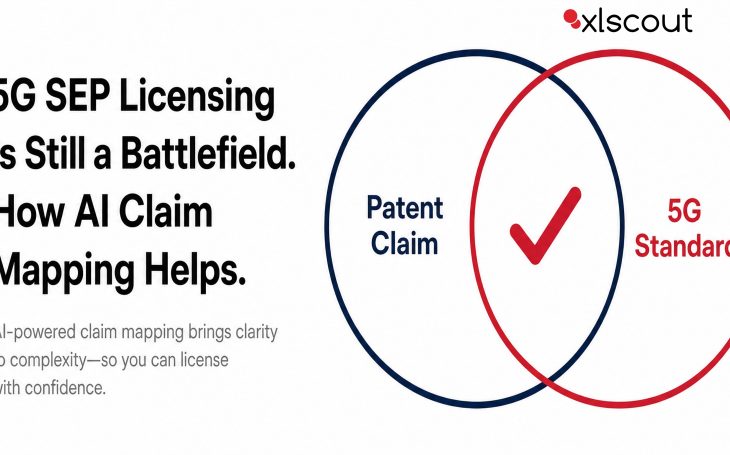
Standard essential patent analysis requires something that conventional patent analysis does not: mapping patent claim language to technical standard specification sections.
The challenge is that the two document types use different terminologies, different levels of abstraction, and different organisational structures. A 3GPP technical specification describes a wireless protocol function in radio engineering terms. A patent claim describes the same function in patent claim language. Identifying that the two describe the same technical feature requires deep domain knowledge — applied across thousands of patent-to-standard mapping pairs.
- Volume: 95,000+ declared essential patents for 5G, across dozens of active standard versions
- Language gap: standard specification terminology and patent claim terminology describe the same features differently
- Multi-party complexity: essentiality claims come from hundreds of different patent holders with different drafting styles
- Jurisdictional variation: the same patent family may have different claim scope across USPTO, EPO, KIPO, and CNIPA versions
How AI Handles the Volume
Automated claim element identification
XLSCOUT’s Standigger LLM identifies the key functional elements in each patent claim and maps them to the relevant sections of the technical standard specification. The terminology translation between patent language and standard language is handled by the AI model, trained on both patent claim corpora and 3GPP/ETSI/IEEE standard documents.
Essentiality scoring
Each patent-to-standard mapping produces an essentiality score — a confidence measure of how closely the patent claim language maps to the standard specification. High-confidence mappings flag strong essentiality candidates. Low-confidence mappings identify where further review is needed.
This scoring enables portfolio prioritisation: rather than treating all 95,000 declared essential patents as equally relevant, IP teams can focus attorney review on the highest-confidence essentiality claims first.
Claim chart generation
XLSCOUT’s ClaimChart LLM generates structured claim charts mapping each patent claim limitation to the relevant standard specification section — with the specific standard text cited as evidence. These charts are formatted for direct use in licensing negotiations, FRAND rate submissions, and court proceedings.
Manual SEP claim charting for a portfolio of 500 patents takes months. AI-generated claim charts are produced in hours — with attorney review focused on the judgment calls, not the document generation.
The 6G Dimension
6G development at 3GPP is moving faster than 5G did at the same stage. Early study items are already generating patent filing activity — and the companies filing 6G patents today are building the SEP portfolios that will define the licensing landscape of the 2030s.
For IP teams advising technology companies in the 6G ecosystem, proactive SEP mapping is not a reactive exercise — it is a strategic one. Filing patents that are likely to be essential to emerging 6G standards, before those standards are finalised, is a fundamentally different strategic problem from mapping essentiality after the fact.
Standigger LLM’s continuous monitoring of 3GPP standard development — alongside TechScaper LLM‘s patent filing intelligence — gives R&D and IP teams the visibility to align filing strategy with standards development in real time.
Licensing and Litigation Applications
AI-generated SEP claim charts serve three specific commercial functions:
- FRAND rate negotiations: charts demonstrate the technical contribution of each patent to the standard — supporting royalty rate arguments
- Counter-assertion: when facing an SEP assertion, AI-powered mapping identifies the asserting party’s patents with weakest essentiality scores — the first targets for challenge
- Portfolio acquisition: AI essentiality screening in M&A due diligence identifies which declared essential patents have genuine essentiality support and which are declaratory