

What Is Patent Landscape Analysis? How AI Makes It Faster, Deeper, and Always Current


Introduction
Patent Landscape Analysis: Patent landscape analysis is a structured examination of a defined patent corpus — typically all patents in a specific technology domain, geographic market, or competitive set — to map filing trends, identify technology concentrations, surface white space opportunities, benchmark competitors, and inform R&D and IP strategy decisions.
Also called a patent landscape study, technology landscape analysis, or IP landscape report, this type of analysis is one of the most requested and most resource-intensive services in IP strategy. It answers the fundamental strategic question every R&D and IP team faces: where are we in the technology filing landscape, where are our competitors, and where is the open territory?
A commissioned patent landscape analysis costs between €10,000 and €40,000 per engagement and takes six to ten weeks to deliver. By the time it reaches the decision-makers who commissioned it, the filing landscape it describes has already changed — new patents have published, competitors have filed, and white spaces have begun to close.
What Does a Patent Landscape Analysis Include?
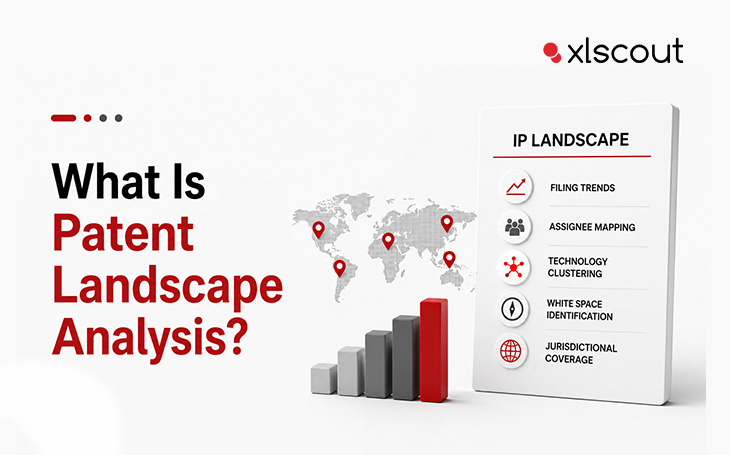
A comprehensive patent landscape analysis covers five analytical dimensions:
1. Filing Trend Analysis
Filing trends map the volume of patent applications and grants in a technology domain over time — identifying whether activity is growing, plateauing, or declining, and at what rate. Accelerating filing rates signal increased R&D investment in the domain. Decelerating rates may signal maturing technology or competitor withdrawal.
2. Assignee Mapping
Assignee mapping identifies which companies and institutions hold the most patents in the domain, which are filing most actively, and whether filing concentration is increasing or dispersing. This answers the competitive positioning question: who controls the IP landscape in our technology area?
3. Technology Sub-Domain Clustering
Technology clustering groups patents by technical concept — going beyond the CPC or IPC classification codes assigned by patent examiners to identify how the actual inventive subject matter is distributed across the domain. This is where AI-based semantic clustering produces significantly different results from keyword or classification-based analysis.
4. White Space Identification
White space analysis identifies technology sub-domains where patent filing density is low relative to commercial relevance — the areas where new filings can still achieve broad claim scope and first-mover advantage. White space is the highest-value output of patent landscape analysis for R&D teams making filing investment decisions.
5. Jurisdictional Coverage Analysis
Jurisdictional analysis maps where patents are being filed globally — identifying whether protection is being sought in all major markets or only in select jurisdictions. Companies filing globally in a technology domain signal high commercialisation intent; jurisdiction-specific filing patterns suggest more targeted market strategies.
Who Uses Patent Landscape Analysis and Why?
Patent landscape analysis serves different purposes for different teams within an organisation:
- R&D leadership: identifies where to direct invention investment to find open territory — filing into white space before competitors claim it
- IP strategy teams: benchmarks portfolio position relative to competitors and identifies continuation filing opportunities in the parent’s specification whitespace
- Corporate development: informs technology acquisition targets and assesses the IP landscape of potential M&A targets
- Licensing teams: identifies where the portfolio has coverage in commercially active domains and where licensing potential is highest
- Regulatory and standards teams: maps SEP landscape in preparation for FRAND negotiations or standards body participation
Companies that use patent landscape analysis to guide R&D filing decisions file into open technology territory earlier than companies that file reactively — and first-mover filing advantage in a white space sub-domain can create 5 to 10 years of exclusivity before competitors establish their own positions.
What Is the Difference Between a Patent Search and a Patent Landscape Analysis?
A patent search answers a specific, narrow question: does prior art exist for this specific invention? It is a point-in-time query against a corpus.
A patent landscape analysis answers a broader strategic question: what does the entire patent environment look like in this technology domain, who is active, where is the density, and where are the gaps? It maps a corpus, not a single invention.
The distinction matters for resource allocation. Patent searches are conducted for individual invention disclosures. Patent landscape analyses are conducted for strategic planning — informing where to invest in R&D, which technology areas to prioritise for continuation filing, and where licensing opportunity exists across the full portfolio.
How Does AI-Powered Patent Landscape Analysis Differ From Traditional Methods?
Traditional patent landscape analysis has three structural limitations that AI directly addresses:
Limitation 1 — Periodic, Not Continuous
A commissioned landscape analysis describes the patent world as it existed when the dataset was pulled — typically six to twelve weeks before delivery. In technology domains where thousands of patents publish each month, this gap between data and delivery means the landscape has already changed before the analysis is read.
AI-powered landscape analysis is continuous. As new patents publish, the landscape map updates automatically. The white space identified in the analysis reflects the current filing environment — not the one that existed two months ago.
Limitation 2 — Keyword, Not Concept-Based
Traditional landscape analysis groups patents by keyword and CPC/IPC classification — technology categories assigned by patent examiners that do not always reflect the actual inventive content. An AI model trained on the full patent corpus clusters patents by technical concept — finding groupings that keyword analysis misses and separating clusters that keyword analysis incorrectly merges.
Limitation 3 — Domestic Database, Not Global Coverage
Most commissioned landscape analyses focus on USPTO and EPO, with selective JPO coverage. For technology areas where the most significant prior art and the most active filing is at the KIPO, CNIPA, and JPO — semiconductor, cleantech, electronics, and telecommunications — this creates a landscape analysis that describes less than half the relevant global patent activity.
XLSCOUT’s TechScaper LLM covers 170M+ patents across all major patent offices — USPTO, EPO, JPO, KIPO, and CNIPA — in all filing languages. The technology domain map is updated continuously as new patents publish, and Talk 2 Patents allows teams to interrogate their specific landscape questions directly from live data rather than waiting for an analyst to run a new query.
What Is Technology White Space in Patent Landscape Analysis?
Patent White Space: Patent white space refers to a technology sub-domain where commercial relevance is high but patent filing density is low — indicating that new patent applications filed in this area can achieve broad claim scope with limited prior art opposition. White space is a first-mover filing opportunity.
White space identification is the highest-value output of a patent landscape analysis because it directly informs R&D investment decisions. A technology team that identifies a white space before competitors is able to file patents with broad independent claims that establish exclusivity in that sub-domain before the prior art landscape becomes crowded.
AI-powered white space analysis evaluates each technology sub-domain across three dimensions: current prior art density, commercial relevance to the company’s product roadmap, and trajectory — whether the space is opening as competitors exit or closing as filing activity accelerates.
How Often Should a Patent Landscape Analysis Be Conducted?
The answer depends on the velocity of the technology domain. For fast-moving sectors including AI, semiconductors, clean energy, and biotechnology — where filing rates are growing at 20-40% annually — a point-in-time landscape analysis conducted annually is structurally inadequate. The landscape the team navigates at month twelve is not the landscape the analysis described at month one.
For these domains, continuous AI-powered landscape monitoring replaces the periodic commissioned report. For more stable technology domains, a quarterly landscape refresh with continuous monitoring for significant competitor filing events provides the right balance of depth and currency.
Global AI-related patent filings grew 28% year-on-year in 2025 (WIPO). In technology domains moving at this speed, a landscape analysis that is six months old is not a quality gap — it is a strategic gap. The white space it identified may already be closed.
What Are the Key Outputs of a Patent Landscape Analysis?
- Technology heat map: visual representation of patent filing density across sub-domains — showing where concentration is highest and where white space exists
- Competitor filing trajectory: filing velocity trends by assignee — identifying who is accelerating, who is decelerating, and who is entering the domain for the first time
- White space opportunity ranking: prioritised list of open filing sub-domains ranked by the combination of scope availability and commercial relevance to the organisation’s R&D roadmap
- Claim scope benchmarking: comparison of the organisation’s claim breadth versus comparable competitor claims in the same technology sub-domain
- Strategic recommendations: specific technology areas to prioritise for new filings, continuation applications, or licensing outreach, based on the landscape data
XLSCOUT TechScaper LLM — continuous AI-powered patent landscape analysis across 170M+ global patents. Technology domain mapping, white space identification, competitor monitoring, and Talk 2 Patents for real-time landscape intelligence.
Why stay behind? Get in touch with us!





© 2026 XLSCOUT. All Rights Reserved.