



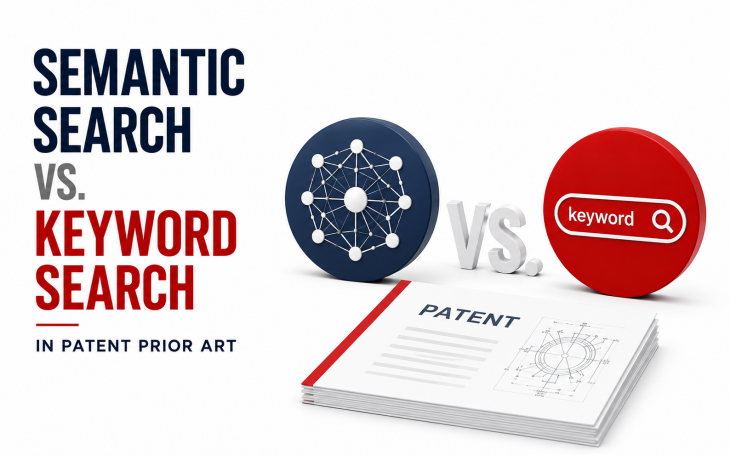
Keyword and Boolean search match exact strings you type. Semantic patent search matches meaning, so it surfaces prior art that uses different words for the same concept. Keyword search still wins for known terms of art and precise number lookups. XLSCOUT’s Novelty Checker LLM combines both across 170M+ patents and 220M+ non-patent literature references.
Dimension | Keyword / Boolean Search | Semantic Patent Search |
Match basis | Exact keyword and string matching | Concept and meaning |
Terminology handling | Manual synonym expansion required | Captures variations automatically |
Cross-language reach | Limited to query language | Spans multiple languages |
Recall on paraphrased art | Low | High |
Query effort | Iterative Boolean construction | Plain-language input |
Best for | Known terms of art, exact numbers, classifications | Broad recall across differing vocabulary |
Both methods have a place in a defensible prior art workflow. The question is not which one to abandon, but when each earns its keep. This article breaks down where keyword and Boolean search hit their limits, what semantic patent search adds, and how XLSCOUT combines both in one search. For the fundamentals of AI-driven search, see our pillar guide on AI Patent Search: How It Works, Benefits & Best Practices.
The Limits of Keyword and Boolean Patent Search
Keyword and Boolean search depend on you naming every term the prior art might use. That assumption breaks in practice. A reference describing “inductive power transfer” stays invisible to a search built around “wireless charging,” even though both describe the same mechanism.
Every synonym, regional spelling, and alternate technical phrasing has to be expanded by hand. Miss one, and you miss the art. Cross-language references compound the problem, since a Boolean query written in English rarely reaches a patent filed in Japanese or German. The result is fragmented recall that depends entirely on the searcher’s vocabulary.
What Semantic Search Adds
Semantic patent search matches on concept, not on string. It reads a claim, disclosure, or plain-language description and returns documents that share the same technical idea, regardless of the words they use.
That shift closes the vocabulary gap. “Solar panels” and “photovoltaic panels” surface as related because the model understands they name the same thing. The same logic links “machine learning” with “trained neural network” across languages and jurisdictions. Semantic patent search also accepts natural language patent search input, so you describe the invention instead of engineering a Boolean string. Broader recall and less query effort follow directly from matching meaning.
Side-by-Side Comparison
The table below expands the keyword vs semantic patent search comparison across the dimensions that decide search quality.
Dimension | Keyword / Boolean Search | Semantic Patent Search |
Match basis | Exact keyword and string matching | Concept and meaning |
Terminology handling | Manual synonym expansion required | Captures variations automatically |
Paraphrased prior art | Frequently missed | Surfaced through concept matching |
Cross-language reach | Limited to query language | Spans multiple languages |
Non-patent literature | Often siloed or excluded | Searched alongside patents |
Query input | Iterative Boolean construction | Plain-language description |
Precision on exact terms | High for known terms of art | High, and broadened by synonyms |
Number and classification lookups | Direct and exact | Better handled by keyword filters |
The AI vs Boolean patent search choice is not binary. Keyword filters still anchor precise lookups, while semantic matching widens recall. The strongest searches use both.
When You Still Need Keyword Search
Semantic matching does not retire keyword search. Some queries call for exact-string precision, and forcing them through a concept model adds noise.
Keep keyword and Boolean search for these cases:
- Known terms of art. When a field uses one settled term, an exact match is faster and cleaner.
- Patent and publication numbers. Direct number lookups need exact matching, not concept inference.
- Classification codes. CPC and IPC filters are string-based by design.
- Assignee and inventor names. Named-entity lookups reward precision over recall.
The takeaway: use keyword search where precision matters most, and semantic search where recall matters most.
How XLSCOUT Combines Both Approaches
XLSCOUT’s Novelty Checker LLM runs semantic patent search and keyword filtering in one workflow. It reads a disclosure or claim set, matches on concept across 170M+ patents from 100+ countries and 220M+ non-patent literature references, then lets you narrow with date, jurisdiction, and classification filters.
Semantic matching drives recall; keyword filters drive precision. Every ranked result still requires review by a qualified patent professional before it informs a filing or opinion. See the Novelty Checker LLM module page for the full workflow.
Run a Side-by-Side Search Comparison
Bring a real disclosure and run it through XLSCOUT’s Novelty Checker LLM. Compare semantic patent search results against your current keyword workflow and see which references each method surfaces, across 170M+ patents and 220M+ non-patent literature references. Book your demo of Novelty Checker LLM and test both approaches on your own technology.
FAQs
Keyword search matches the exact strings you enter. Semantic patent search matches on meaning, so it returns documents that describe the same invention in different words. Keyword search rewards precision on known terms; semantic search rewards recall across varied vocabulary.
Neither is universally better. AI vs Boolean patent search is a question of fit. Semantic search finds paraphrased and cross-language prior art that Boolean queries miss. Boolean search stays faster for exact lookups like patent numbers, classification codes, and settled terms of art.
No. Semantic patent search broadens recall, but keyword filters still handle exact-string tasks better, including number, classification, and named-entity lookups. XLSCOUT’s Novelty Checker LLM runs both together so you do not choose one at the expense of the other.
Natural language patent search lets you describe an invention in plain language instead of building a Boolean string. The model interprets the description and returns concept-matched prior art. It lowers query effort and reduces the risk of missing art through incomplete synonym expansion.
No. Semantic patent search narrows and ranks the field faster than manual methods, but it does not replace professional judgment. A qualified patent professional must review every result before it informs a filing, opinion, or legal argument.
Why stay behind? Get in touch with us!





© 2026 XLSCOUT. All Rights Reserved.