An SOC 2 Type II certified, AI super intelligence platform for innovation and IP: From prior-art searches and AI-assisted ideation to drafting high-quality patents and monetizing innovation!
An SOC 2 Type II certified, AI super intelligence platform for innovation and IP: From prior-art searches and AI-assisted ideation to drafting high-quality patents and monetizing innovation!
Patent invalidity analysis is not one workflow. It is three simultaneous workflows — and the outcome depends on how well they are coordinated
A prior art search that finds the right reference but cannot map it to the asserted claim elements is not useful in litigation. A claim mapping that identifies the right limitations but misses the most relevant reference is not sufficient for an IPR petition. AI coordinates all three in a single structured workflow.
The Three Simultaneous Challenges of Patent Invalidity
Prior art discovery: finding references that anticipate or render obvious the asserted claims across patents and NPL
102/§103 analysis: determining which references anticipate (§102) and which combine to render obvious (§103) — with motivation-to-combine arguments for the latter
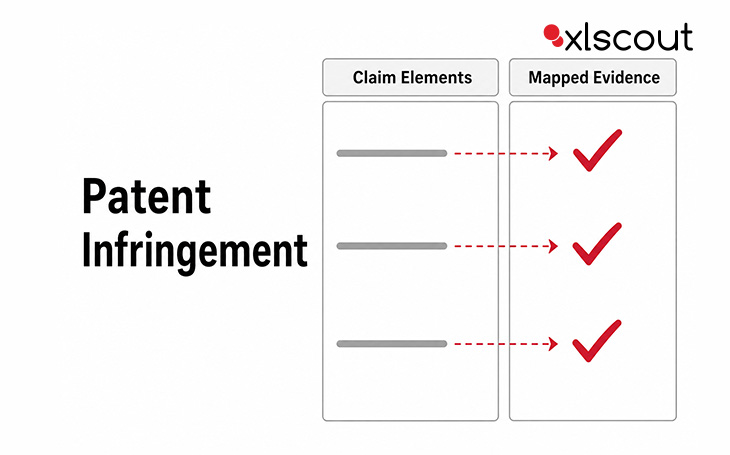
Claim element mapping: demonstrating precisely how each reference addresses each claim limitation
Miss any one of these, and the invalidity analysis is incomplete — regardless of how thorough the other two are.
How AI Structures Prior Art Search
XLSCOUT’s Invalidator LLM starts with the asserted claims and works backwards — extracting claim elements, identifying the technical concepts underlying each limitation, and running a semantic prior art search across 170M+ patents and 220M+ NPL sources.
The prior art search is structured around claim elements, not around keywords:
Claim-element-first: search targets the specific technical concepts in each independent claim limitation
Semantic, not keyword: finds prior art that uses different terminology for the same technical concept
Cross-language: searches Japanese, Korean, Chinese, and English language prior art simultaneously
NPL is relevant prior art in 60%+ of software and electronics invalidity cases. A prior art search that does not cover NPL is structurally incomplete for these technology domains.
How AI Generates §102/§103 Analysis
Once prior art references are identified and ranked, AI analysis evaluates each reference against the §102 and §103 framework:
102 anticipation: does a single reference disclose every element of the claim in an enabling manner?
103 obviousness: does a combination of two or three references render the claim obvious to a person of ordinary skill?
Motivation to combine: why would a person of ordinary skill have combined the references? AI identifies the technical rationale.
Priority date analysis: each reference verified as pre-dating the patent’s effective priority date
The AI generates a structured §102/§103 analysis framework for each top-ranked reference combination — giving attorneys the starting point for the invalidity contentions they will argue, not a raw list of patents to evaluate manually.
How AI Automates Claim Mapping
The AI claim mapping process produces a structured element-by-element analysis for each high-priority reference — showing exactly how each limitation of the asserted independent claim is addressed by the prior art reference.
The automated claim chart format includes:
Claim limitation: each element of the independent claim, parsed and structured
Reference disclosure: the specific passage, figure, or paragraph in the prior art that addresses the limitation
Mapping confidence: AI-scored assessment of how closely the reference language maps to the claim limitation
Gap identification: claim limitations where the reference is weak — signalling where §103 combinations are needed
Invalidator LLM delivers a top-15 ranked reference list, automated claim charts, and an AI-generated summary report — all delivered to the attorney’s inbox. The attorney reviews for legal sufficiency and strategic selection, not for database navigation.
The Complete Invalidity Workflow
The AI invalidity workflow coordinates all three challenges in sequence:
Claim element extraction → automatic parsing of independent and dependent claim limitations
Semantic prior art search → patents and NPL across 170M+ sources, searched simultaneously
Reference ranking → top-15 references ranked by claim element coverage
102/§103 analysis → anticipation and obviousness framework for each top reference
Automated claim charts → element-by-element mapping for attorney review
AI summary report → high-level evaluation delivered to inbox alongside the detailed analysis
XLSCOUT Invalidator LLM — structured AI patent invalidity analysis: prior art search, §102/§103 analysis, and automated claim mapping in one workflow.