Quick Answer
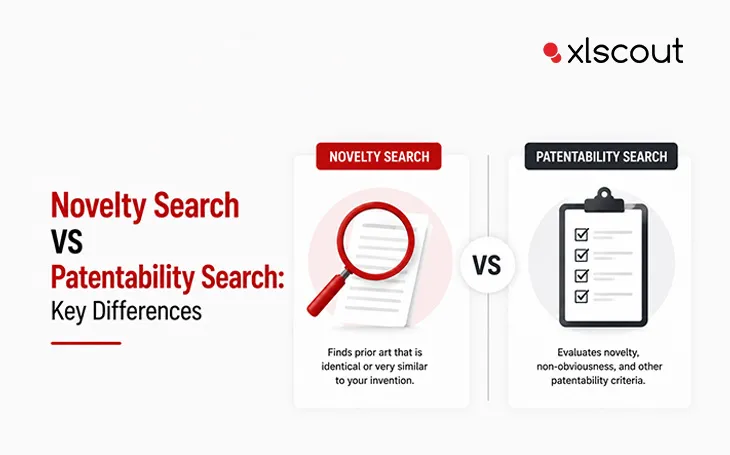
A novelty search asks one question: does prior art already disclose your invention? A patentability search asks a broader one: is your invention both novel and non-obvious enough to earn a patent? Novelty is a subset of patentability. XLSCOUT’s Novelty Checker LLM runs both checks across 170M+ patents and 220M+ non-patent literature references.
R&D teams and first-time inventors hit the same wall early: the terms “novelty search” and “patentability search” get used interchangeably, but they answer different questions. The confusion costs time and money, because running the wrong search at the wrong stage means either over-spending early or under-preparing before a costly filing. This article resolves the distinction, shows which search fits which decision point, and explains how XLSCOUT’s Novelty Checker LLM handles both. For AI-patent-search fundamentals, see our pillar guide, AI Patent Search: How It Works, Benefits & Best Practices.
A novelty search checks whether your invention is new. It scans existing prior art – patents, applications, and published literature for any single reference that already discloses your idea. The question is binary: has this been disclosed before, yes or no?
Novelty searches are narrow by design. They test one leg of patentability the newness requirement without weighing obviousness. That focus makes them fast and cheap, which is why teams run them first, before committing to further IP spend.
A patentability search is broader. It tests both statutory requirements a patent must clear: novelty (is the invention new?) and non-obviousness, also called inventive step (would the invention be obvious to a person skilled in the art?).
A patentability search absorbs the novelty question and adds the harder one. It considers combinations of prior art references, not just single disclosures, because an examiner can reject a claim as obvious by combining two or more existing documents. That makes it the more complete assessment before you commit to filing costs.
The comparison table below lays out where the two searches diverge.
Factor | Novelty Search | Patentability Search |
Question answered | Has this invention been disclosed before? | Is this invention both novel and non-obvious? |
Legal requirement tested | Novelty only | Novelty and non-obviousness (inventive step) |
Scope of prior art | Single references that anticipate the invention | Single references plus combinations that render it obvious |
Depth | Narrow, focused | Broad, comprehensive |
Cost | Lower | Higher |
Typical timing | Early, to validate an idea | Before committing to filing costs |
The core takeaway: every patentability search includes a novelty check, but a novelty search alone does not answer the obviousness question. Choose based on the decision in front of you.
Run a novelty search early. When an idea is still forming, a novelty search validates it cheaply if a single reference already discloses it, you learn that before spending on anything further. It is the low-cost gate at the front of the pipeline.
Run a patentability search before you commit to filing. Filing carries real cost: attorney fees, drafting time, and prosecution. A patentability search tests both novelty and non-obviousness, so you know whether the invention can survive examination before you pay to find out. For inventions that clear both, the next question is often freedom to operate see our FTO guide.
Missed prior art slows prosecution and inflates cost. XLSCOUT’s Novelty Checker LLM addresses both search types in one workflow:
See the Novelty Checker LLM module page for the full workflow.
Validate your idea and test its patentability in one workflow. XLSCOUT’s Novelty Checker LLM runs novelty and patentability checks across 170M+ patents and 220M+ non-patent literature references, then hands the results to your team for expert review. Schedule a demo to run your invention through both checks.
Q1: What is the difference between a novelty search and a patentability search?
A novelty search checks whether a single prior art reference already discloses your invention a yes-or-no newness test. A patentability search is broader: it tests both novelty and non-obviousness, including whether combinations of references make the invention obvious. Every patentability search includes a novelty check, but not the reverse.
Q2: Which search should I do first?
Do the novelty search first. It is faster and cheaper, and it validates the core idea before you spend more. If the invention clears the novelty check, run a patentability search next to test non-obviousness before you commit to filing costs.
Q3: Is a patentability search the same as a freedom-to-operate search?
No. A patentability search asks whether your invention can be patented is it novel and non-obvious? A freedom-to-operate search asks whether making or selling your product would infringe someone else’s active patent rights. They answer different questions at different stages.
Q4: Does a novelty search guarantee my patent will be granted?
No. A novelty search only confirms no single reference anticipates your invention. An examiner can still reject a claim as obvious by combining multiple references, which is why a patentability search and expert review of the results matters before filing.
Why stay behind? Get in touch with us!
© 2026 XLSCOUT. All Rights Reserved.