

Introduction
Let us be clear about what J-PlatPat does well. The Japan Patent Office’s free search portal gives comprehensive access to JPO published applications and granted patents. It handles Boolean keyword search, IPC classification filtering, applicant name search, and basic citation analysis. It is free. It is trusted. And it is the starting point for almost every JPO prior art search conducted in Japan.
The question is not whether J-PlatPat is useful. It is. The question is whether it is sufficient — whether a prior art search conducted only on J-PlatPat constitutes a complete patentability assessment by the standards that modern IP practice requires. For most matters, in most technical domains, the answer in 2026 is no. The gap is not a criticism of J-PlatPat. It is a description of what it was designed to do — and where that design now falls short of what Japanese IP teams need.
What J-PlatPat Gets Right
J-PlatPat’s core strengths are real and should not be understated. Its coverage of JPO-published documents is comprehensive — full-text search across the Japanese patent database, with machine translation for non-Japanese users. Its classification system aligns with F-terms, FI codes, and IPC — the classification frameworks that Japanese patent examiners use, which makes it effective for the kind of technology-space searches that Japanese patent prosecution requires.
For searches that are primarily concerned with Japanese prior art — for domestic prosecution, or for technology domains where Japanese companies are the dominant filers — J-PlatPat remains a highly relevant tool. Its familiarity to Japanese patent engineers, its institutional trust, and its zero cost make it a rational starting point for most searches.
Four Things J-PlatPat Cannot Do
The limitations of J-PlatPat are structural — they reflect the design decisions of a tool built for manual, keyword-based, single-jurisdiction search. They are not gaps that can be patched with better keyword selection or more careful search methodology. They are limitations of the underlying approach.
1. Semantic search — finding concepts rather than keywords
J-PlatPat’s search is fundamentally keyword-based. A search for “gallium nitride semiconductor” will find documents that contain those terms — but will not find documents that describe the same technology using the terms “GaN power device” or “wide-bandgap transistor” or “III-nitride epitaxial layer”, unless those terms are also included in the query. In a technical domain where terminology evolves rapidly — as it does in power semiconductors, advanced materials, and biotechnology — this keyword dependency creates systematic gaps that are invisible to the searcher.
2. Cross-jurisdictional search in a single query
J-PlatPat searches the JPO database. For a Japanese patent application in semiconductors, the most relevant prior art may have been filed first at the USPTO, the EPO, or the KIPO — and may not have a JPO equivalent at all. Running separate searches across multiple jurisdictions and manually merging the results is technically possible but practically burdensome — and it requires the searcher to anticipate which jurisdictions are relevant, which in technical domains with complex competitive landscapes is not straightforward.
3. Non-patent literature coverage
Academic publications, conference proceedings, technical standards, and regulatory submissions can all constitute prior art. J-PlatPat does not index NPL. For Japanese IP teams in pharmaceutical, biotechnology, or materials science — where the most significant prior art is often published in academic journals before it reaches the patent literature — this is a material limitation. An invalidation search or patentability assessment that does not cover NPL is structurally incomplete in these domains.
4. Image-based prior art search
JPO patent specifications use a figure-heavy disclosure convention. Circuit schematics, device cross-sections, mechanical assemblies, and process flow diagrams carry a significant proportion of the technical disclosure in Japanese patents — often more than the claim text alone. J-PlatPat’s text-based search cannot find prior art that is expressed in figures rather than in claim language. For Japanese IP teams in semiconductor, electromechanical, and precision engineering domains, this is the structural gap that matters most.
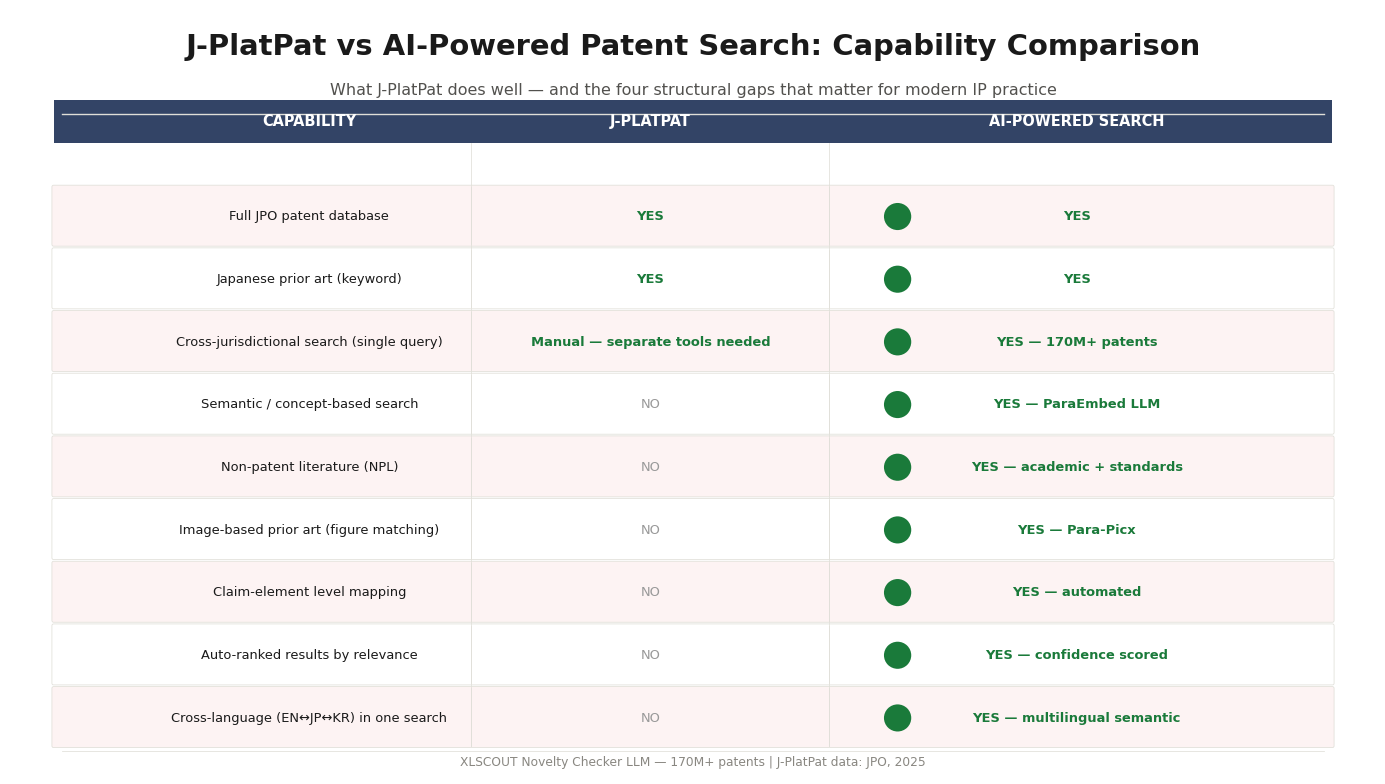
Figure 1: J-PlatPat vs AI-powered patent search — a capability comparison across the dimensions that matter for modern Japanese IP practice
Where the Gap Shows Up in Real Workflows
The limitations of J-PlatPat are not theoretical. They show up in specific, predictable situations that Japanese patent engineers and IP teams encounter regularly.
A patentability search in advanced semiconductor materials that finds no relevant prior art on J-PlatPat may have missed the blocking reference filed at KIPO by a Korean competitor in 2019 — in Korean, with no JPO equivalent. A freedom-to-operate analysis for an electromechanical device that is based solely on text search may have missed the blocking prior art that exists only in a cross-sectional figure in a 2016 JPO application. An invalidity search for a pharmaceutical patent that does not cover NPL has not searched the journal articles that are the most likely source of anticipating prior art.
These are not edge cases. They are the structural gaps that arise when a tool designed for one purpose — comprehensive single-jurisdiction keyword search — is asked to serve as the complete foundation for a patentability analysis that requires a different set of capabilities.
The Figure-Disclosure Gap
For Japanese IP teams in semiconductor, electromechanical, and precision engineering domains, the image-based prior art gap deserves specific attention. JPO applicants have a long tradition of detailed figure-driven disclosure — circuit diagrams that show topology, device cross-sections that show fabrication structure, mechanical assemblies that show component relationships. This technical information is conveyed in the figures, not in the claim text.
A prior art search that reads only the text of patent claims misses the class of prior art that is expressed in figures. For circuits, devices, and mechanical assemblies, this class of prior art is substantial. XLSCOUT’s Para-Picx technology addresses this gap by enabling image-based prior art search — upload a patent figure, a product schematic, or a device cross-section and receive prior art results matched on visual similarity.
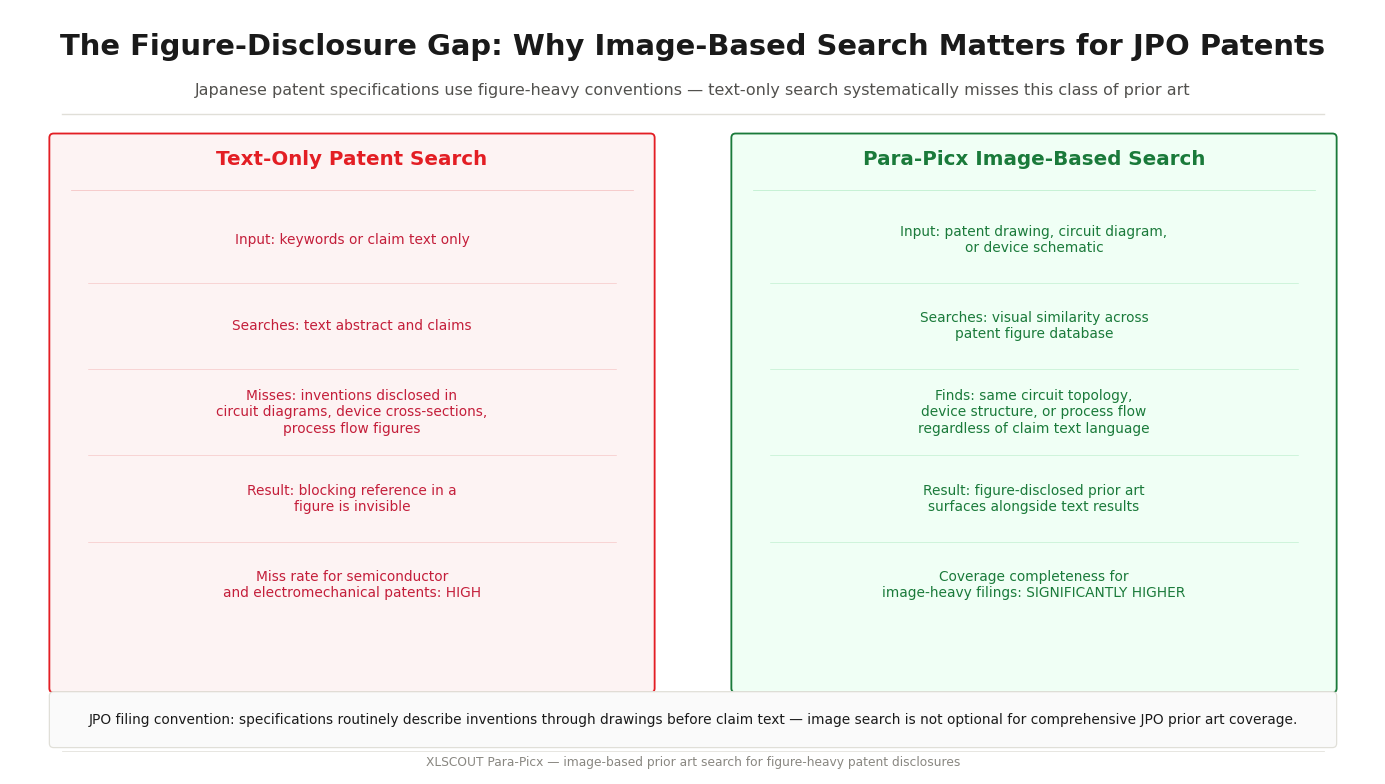
Figure 2: The figure-disclosure gap — why image-based search matters for JPO patents, and what text-only search systematically misses in Japanese patent specifications
What Japanese IP Teams Are Doing Differently
The Japanese IP teams that have moved beyond J-PlatPat as their sole prior art tool are not abandoning it — they are supplementing it with semantic AI search that covers the cross-jurisdictional, NPL, and image-based gaps that J-PlatPat does not address. XLSCOUT’s Novelty Checker LLM searches across 170M+ patents from 100+ jurisdictions — including full JPO coverage — in a single semantic query. ParaEmbed’s cross-language semantic matching finds relevant prior art in Korean, German, and English from a Japanese-language query, and vice versa.
For Japanese companies whose competitors file primarily at USPTO and KIPO, this cross-language semantic coverage is the core improvement over J-PlatPat. For Japanese IP teams working on invalidity and prosecution support in semiconductor and electromechanical domains, Para-Picx adds the image-based search layer that J-PlatPat’s text-only approach cannot provide.
XLSCOUT and Japanese Patent Search
J-PlatPat will remain the starting point for most JPO prior art searches. Its strengths — comprehensive JPO coverage, institutional trust, zero cost — are real and durable. But the prior art search that is built solely on J-PlatPat is missing the cross-jurisdictional semantic coverage, the NPL layer, and the image-based search capability that comprehensive patentability and invalidity analysis requires in 2026. The gap is structural. And it is now addressable without proportional increases in cost or turnaround time.
XLSCOUT Novelty Checker LLM extends J-PlatPat’s JPO coverage with 170M+ cross-jurisdictional semantic search, NPL, and Para-Picx image-based prior art — in a single AI-powered workflow for Japanese IP teams.