

Introduction
In most technology domains, a prior art search returns a manageable universe of relevant references. In dynamic random-access memory architecture, 3D NAND flash process technology, and OLED display thin-film transistor design, the relevant universe is an order of magnitude larger — measured in thousands of closely related patents filed by Samsung, SK Hynix, LG, Micron, Kioxia, and their global competitors across at least three major patent offices in at least three languages. The tools designed for general patent search were not built for this.
Understanding the Density Problem
Patent density in semiconductor technology arises from a specific dynamic. A single product — a DRAM chip, a NAND flash die, an OLED panel — is the subject of hundreds of overlapping patent filings covering every aspect of its design, fabrication, and application. Every process step in DRAM fabrication has been patented from multiple angles by multiple companies. Every architectural variant of NAND flash storage has prior art spread across KIPO, JPO, and USPTO in Korean, Japanese, and English.
The KIPO database reflects this. South Korea processed approximately 246,000 patent applications in 2024 — fifth globally — with semiconductor, display, and telecommunications accounting for a disproportionate share of the high-density technical domains. A prior art search in DRAM architecture is not a search through a sparse landscape with a few relevant references. It is a navigation problem through a dense, multi-language cluster of technically overlapping patents that requires semantic understanding, not just keyword matching.
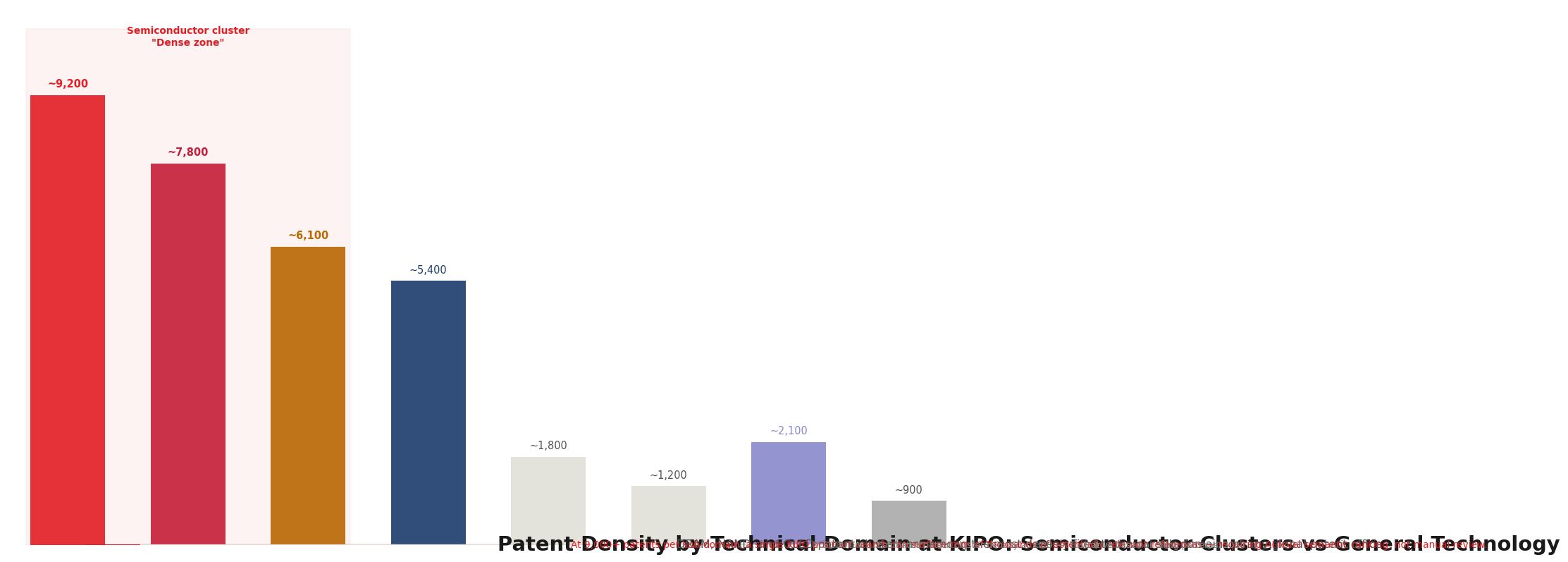
Figure 1: Patent density by technical domain at KIPO — semiconductor clusters vs general technology, illustrating the scale difference that makes general-purpose patent search tools structurally mismatched for Korean semiconductor prior art
What Searching Semiconductor Clusters Actually Requires
A prior art search in DRAM or NAND technology that is limited to keyword matching in a single language will miss a significant proportion of the technically relevant references — not because those references do not exist in the database, but because they are described in different terminology, in a different language, or at a different level of technical abstraction than the search terms anticipate.
What a comprehensive semiconductor prior art search in the Korean context requires:
- Semantic search that finds technical concepts regardless of the specific terminology used in the claim language
- Cross-language coverage that surfaces Korean, Japanese, and English references in a single query — because the most relevant prior art for a KIPO filing in DRAM architecture may be a 2015 JPO filing in Japanese by a Toshiba predecessor entity
- Confidence-ranked results that surface the most technically proximate references first — not a 50,000-document result set that requires days of manual review to navigate
- Claim-element level analysis for the highest-priority references — showing which claim elements are addressed by which prior art document, not just which documents are broadly relevant
The Multi-Language Challenge
Korean semiconductor IP teams occupy a unique position in global patent search. Their most commercially significant competitors — Samsung, SK Hynix, and LG in the domestic market; Micron, Intel, and Broadcom internationally; Kioxia, Sony, and Renesas in Japan; TSMC, MediaTek, and NANYA internationally — file in Korean, English, and Japanese across KIPO, USPTO, EPO, and JPO.
A prior art search for a KIPO application in 3D NAND architecture that searches only Korean-language KIPO filings is systematically incomplete. The Japanese prior art for the same technology — which may predate the KIPO filing by several years, and which may be the most technically proximate reference — is invisible to a Korean-only keyword search. The same applies in the other direction: Korean-language KIPO filings may be the blocking reference for a JPO or USPTO application, and an English-only search at those offices will not find them.
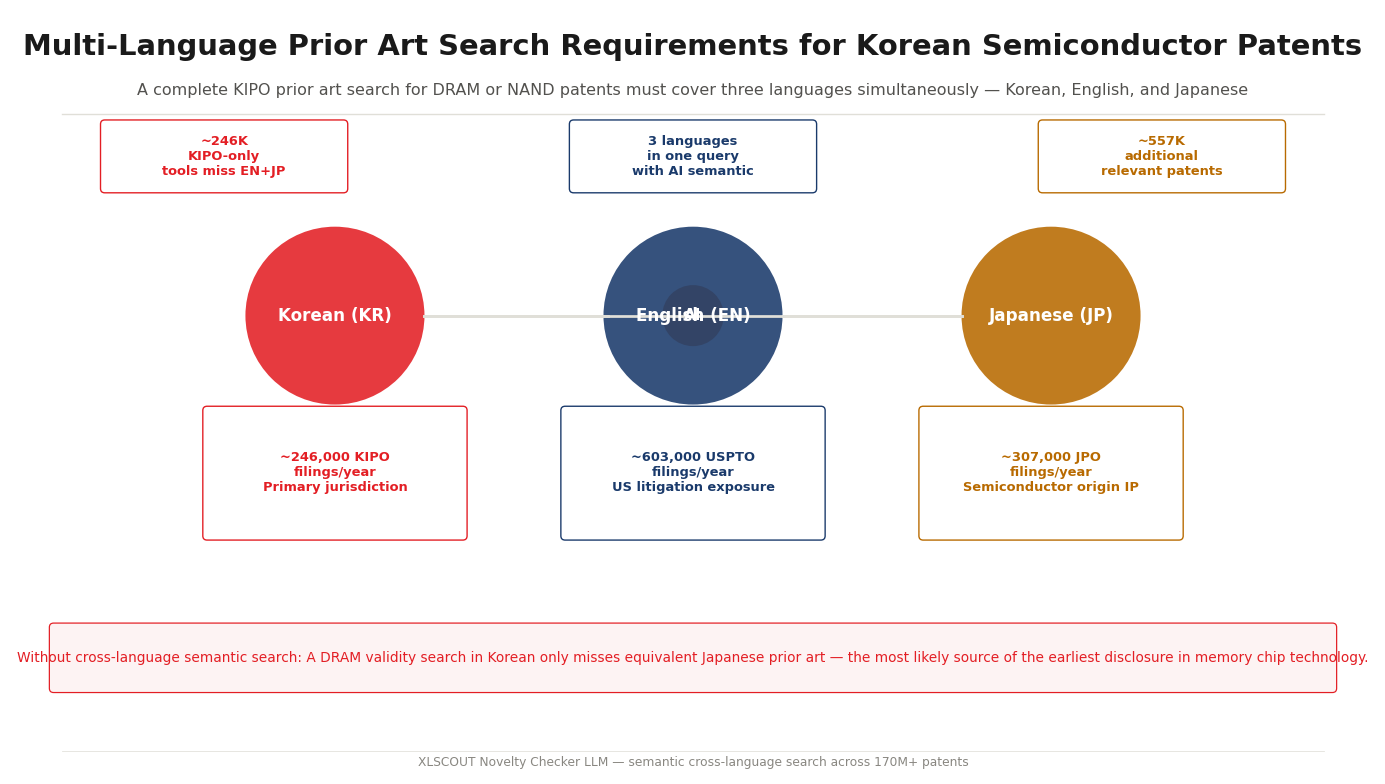
Figure 2: Multi-language prior art search requirements for Korean semiconductor patents — why a complete search must operate across Korean, Japanese, and English simultaneously
What Breaks with General Patent Search Tools
- General-purpose patent search tools were designed for the average patent search use case — moderate technical complexity, manageable result volumes, primarily English-language prior art. Semiconductor cluster searches are not average. They are extreme in three dimensions simultaneously: volume, language diversity, and technical granularity.
- At 9,000+ related patents in a DRAM architecture sub-domain, keyword matching produces result sets that no team can manually review in a reasonable timeframe. The most relevant references are buried in the noise. Confidence ranking — which requires semantic understanding of which references are most technically proximate to the specific query — is not something keyword tools provide.
- The cost of this mismatch is not always visible. A prior art search that returns 200 references in a well-known technology area looks complete. But if the 201st reference — the one not returned because it was filed in Japanese by a company whose name was not in the keyword filter — is the anticipating reference for the application under examination, the incompleteness of the search only becomes apparent at examination or, worse, in litigation.
Claim-Level Analysis for Semiconductor Patents
For Korean semiconductor IP teams conducting invalidity analysis or freedom-to-operate assessments on high-value patents, the density of the prior art landscape creates a specific workflow need: the ability to map prior art references to specific claim elements automatically, not manually.
XLSCOUT’s ClaimChart LLM automates the claim-element level mapping — taking the most relevant prior art references identified by Novelty Checker LLM and producing structured claim charts that show which references address which claim limitations. For Korean semiconductor IP teams conducting invalidity analysis against asserted KIPO, JPO, or USPTO patents, this automated mapping compresses what was previously a multi-week manual analysis into a structured output that attorneys can verify and use directly.
XLSCOUT for Korean Semiconductor IP Teams
XLSCOUT’s Novelty Checker LLM addresses the density, language, and semantic complexity of Korean semiconductor prior art search in a single workflow. ParaEmbed semantic search operates across 170M+ patents in Korean, Japanese, and English simultaneously — finding the most technically proximate references regardless of which language they are filed in, and ranking them by relevance to the specific inventive concept under examination.
The practical improvement for Korean semiconductor IP teams is not marginal. Semantic cross-language search in a domain with this degree of filing density and multi-language complexity is not a quality-of-life improvement. It is the difference between a structurally complete search and a structurally incomplete one.
XLSCOUT Novelty Checker LLM and ClaimChart LLM deliver semantic cross-language prior art search and automated claim-element mapping for Korean semiconductor IP teams — designed for the density and complexity of KIPO, JPO, and USPTO semiconductor patent clusters.