



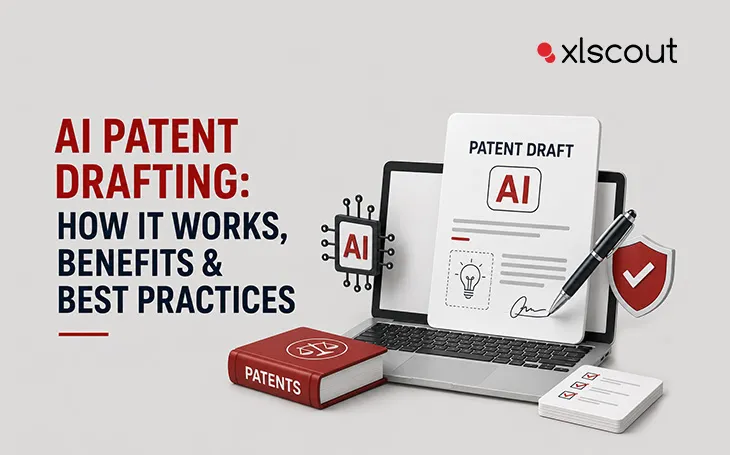
AI patent drafting tools now generate first-pass claims, abstracts, descriptions, and drawings from an invention disclosure, cutting the most time-intensive stage of the patent lifecycle. These drafts are built for attorney review, not blind filing. XLSCOUT’s Drafting LLM produces comprehensive draft applications across jurisdictions including the US and JP, giving practitioners a reviewable starting point instead of a blank page.
Drafting consumes more attorney hours than any other stage of the patent lifecycle. A single application demands claim construction, an abstract, a detailed description, and drawings, each drafted by hand from an invention disclosure. AI patent drafting tools now generate all four as a first pass for review. LLM and Gen AI adoption across IP workflows accelerated through 2025 and 2026, and drafting is where the time savings land hardest. For the fundamentals of AI-driven patent work, see our pillar guide on AI Patent Search: How It Works, Benefits & Best Practices.
The Traditional Patent Drafting Bottleneck
Manual drafting is slow by design. An attorney reads the disclosure, interviews the inventor, constructs independent and dependent claims, writes the specification, and coordinates drawings before a single review cycle begins. Each application can absorb 15 to 30 hours of skilled time.
That time cost compounds into backlog risk. When drafting volume outpaces capacity, filings slip, priority dates come under pressure, and teams either add headcount or push deadlines. The bottleneck is not skill. It is the sheer hours manual drafting demands per application.
How AI Patent Drafting Tools Work
Automated patent drafting software reads an invention disclosure and generates the structural components of an application. The output is a first draft for attorney review, not a filing.
Claims Generation
Patent claims drafting AI takes a disclosure and produces a structured claim set: independent claims defining the core invention, dependent claims adding specificity. The tool proposes claim scope and hierarchy from the disclosed technical features. An attorney then refines scope, catches gaps, and sets strategy.
Abstracts, Descriptions & Drawings
Beyond claims, an AI patent application generator drafts the abstract, the detailed description, and drawing sets. It maps disclosed features into the specification’s required sections and produces figures tied to the description. This gives the attorney a complete draft skeleton to edit rather than write from scratch.
Multi-Jurisdiction Drafting (US, JP and Beyond)
Claim formatting requirements differ by jurisdiction. US applications favor a particular independent-dependent structure and specification conventions. Japanese Patent Office filings apply their own claim formatting and description norms. Filing the same invention across offices means reworking structure for each.
AI patent drafting tools adapt output to jurisdiction-specific requirements. A single disclosure can generate a US-formatted draft and a JP-formatted draft, each following that office’s claim conventions. This removes the manual reformatting step that slows multi-jurisdiction filing programs.
Where Human Review Still Matters
AI generates structure. It does not exercise legal judgment. Three decisions stay with the attorney.
- Strategic claim scope. How broad to claim, where to add fallback positions, and how to position around known prior art are strategic calls that depend on business objectives an AI cannot infer from a disclosure.
- Legal sufficiency. Whether claims satisfy enablement, written description, and definiteness requirements requires legal analysis a qualified professional must perform.
- Inventor interviews. The disclosure is rarely complete. Attorneys surface unstated variations and design-arounds through direct conversation with inventors, and that context reshapes the claims.
Every AI-generated draft requires review by a qualified patent professional before filing. This is a structural boundary in the workflow, not an optional check.
Inside XLSCOUT’s Drafting LLM
Drafting one application by hand can absorb 15 to 30 attorney hours before the first review cycle. XLSCOUT’s Drafting LLM compresses the first-draft stage by generating comprehensive patent applications from an invention disclosure.
Drafting LLM produces the full set of components:
- Claims. Structured independent and dependent claim sets derived from the disclosed features.
- Abstract. A specification-compliant abstract summarizing the invention.
- Description. A detailed description mapping disclosed features into the required specification sections.
- Drawings. Figure sets tied to the description.
Drafting LLM generates these across multiple jurisdictions, including the US and JP, adapting claim formatting to each office’s conventions. The output is built for attorney review, never blind filing. A qualified patent professional reviews and refines every draft before it informs a filing. Drafting LLM removes the blank page. It does not remove the attorney.
Explore the workflow on our Drafting LLM module page.
Generate a First-Draft Claim Set with Drafting LLM
Bring a real invention disclosure and run it through XLSCOUT’s Drafting LLM. Watch it generate a first-pass claim set, abstract, description, and drawings across the US, JP, and beyond, then review the output against your current drafting process. Book a demo of Drafting LLM and see a first draft generated from your own disclosure.
FAQs
AI patent drafting tools generate a complete first draft, including claims, abstract, description, and drawings, from an invention disclosure. XLSCOUT’s Drafting LLM produces all four components across jurisdictions. The draft is a reviewable starting point, not a file-ready application. A qualified patent professional must review and refine it before filing.
Yes. AI patent drafting tools adapt claim formatting to jurisdiction-specific requirements. XLSCOUT’s Drafting LLM generates drafts across multiple jurisdictions, including the US and JP, following each office’s claim conventions and specification norms. This removes the manual reformatting step in multi-jurisdiction filing programs.
No. AI-drafted claims, descriptions, and abstracts are first drafts, not filing-ready documents. Strategic claim scope, legal sufficiency under enablement and written description requirements, and inventor input all require a qualified patent professional. Every AI-generated draft needs expert review before it informs a filing.
Manual drafting can absorb 15 to 30 attorney hours per application before review. AI patent drafting tools generate the first-draft claims, abstract, description, and drawings in a fraction of that time, shifting attorney hours from drafting from scratch to reviewing and refining. Actual savings depend on invention complexity and jurisdiction count.
Why stay behind? Get in touch with us!




© 2026 XLSCOUT. All Rights Reserved.