

Europe’s Green Tech Patent Race: How AI Tracks the IPC, Identifies White Space, and Guides Clean Energy IP Strategy


Introduction
The European Green Deal committed €1 trillion to clean energy transition over the decade to 2030. The patent filing activity that commitment has generated is visible in every major cleantech technology class: solar photovoltaics, offshore wind, green hydrogen, battery chemistry, EV powertrain, and smart grid management have all experienced 30-40% increases in European patent filing rates since 2020.
The IPC Y02 family — the patent classification system for climate change mitigation technologies — is now one of the most crowded and fastest-growing patent spaces in European practice. And the competition is not only European. Chinese clean energy companies, led by CATL, BYD, and LONGi Green Energy, are filing at the EPO at rates that are adding thousands of new prior art references per quarter to domains where European R&D teams are simultaneously trying to protect their own innovations.
European cleantech patent strategy in 2026 requires continuous whitespace intelligence — not annual landscape reports. The window between ‘open sub-domain’ and ‘competitor has filed’ is measured in months, not years, in IPC Y02 technology classes.
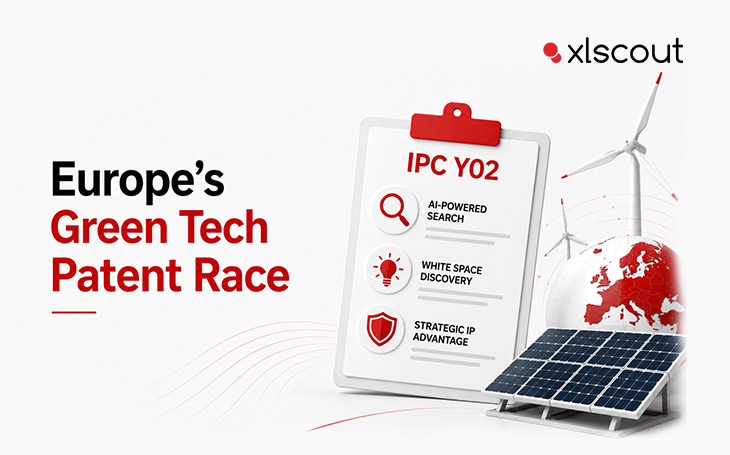
The IPC Y02 Landscape: What the Filings Show
IPC Y02 covers four main technology clusters relevant to the European Green Deal: Y02E (energy generation and distribution), Y02T (transportation), Y02B (buildings and construction), and Y02P (production processes). Each cluster contains dozens of sub-classifications, and the filing density across sub-classifications varies significantly.
TechScaper LLM maps IPC Y02 subclasses with a continuous whitespace heat-map — showing filing density across every relevant technology sub-domain, updated as new patents publish. The heat-map reveals three things critical for European green tech patent strategy: where prior art density is highest (avoid or be highly specific), where density is low but rising (file quickly before the window closes), and where density is low and stable (the genuine white space with open filing opportunity).
For European cleantech R&D teams — whether in solar cell development, battery electrolyte chemistry, hydrogen electrolysis, or EV charging protocols — the IPC Y02 whitespace map is the strategic planning input that tells them where patent protection is achievable and where it is already foreclosed.
The Chinese Prior Art Problem in European Cleantech
China is now the world’s largest filer in battery technology, solar technology, and many smart grid sub-domains — filing more patents at the CNIPA annually than all European countries combined in these areas. For European companies developing clean energy technology, the most relevant prior art for their inventions is increasingly in Chinese patent documents, filed at the CNIPA in Simplified Chinese.
CNIPA also includes utility models — a separate category of IP protection that confers patent-like rights on less complex inventions. Utility models are valid prior art in EPO proceedings and are routinely cited by EPO examiners in cleantech examination reports. Most European patent search tools do not effectively index CNIPA utility models — creating a structural blind spot in European cleantech prior art searches.
XLSCOUT covers CNIPA’s full corpus — 1.8 million applications per year, including both invention patents and utility models — in Chinese, with cross-language semantic search from English-language queries. For European cleantech teams, a Novelty Checker LLM search finds the Chinese solar cell manufacturing patent, the CATL battery chemistry utility model, and the BYD charging protocol application that ESPACENET and most European search tools never surface.
CNIPA processes 1.8 million patent applications per year — more than three times the USPTO volume. In cleantech technology classes, CNIPA is the world’s largest prior art corpus. A European green tech patent search that does not cover CNIPA is searching less than half the relevant global prior art.
Whitespace Identification Before the Window Closes
The commercial value of whitespace identification in European cleantech is a function of timing. A whitespace that is open today may be substantially closed in 12 months if Chinese, American, or Korean companies are accelerating their filing in that sub-domain. The value of identifying a whitespace is highest when it can still be acted on — when there is time to direct R&D investment, develop the invention, search the current prior art, and file before competitors claim the territory.
TechScaper LLM’s agentic monitoring alerts European cleantech teams when a previously open sub-domain begins attracting accelerated filing activity. The alert arrives when the window is narrowing — in time to respond — not after the sub-domain is already crowded.
From whitespace to invention: XLSCOUT’s Ideacue 10X generates AI-powered invention directions from the identified whitespace — providing R&D teams with technically grounded innovation suggestions for the open territory, informed by what the adjacent prior art landscape already covers. For European green tech R&D teams, Ideacue bridges the gap between ‘this sub-domain is open’ and ‘here are the specific technical directions worth pursuing’.
Green Tech Patent Strategy by Sector
Battery and Energy Storage
Battery technology is the most competitive IPC Y02E sub-domain globally. CATL, Panasonic, Samsung SDI, and LG Energy Solution have built patent portfolios that cover most commercially significant battery chemistries. European teams — Northvolt, BMW, and Volkswagen’s battery division — need whitespace maps that show which battery chemistry sub-domains, electrolyte formulations, and cell manufacturing approaches remain open for patent protection.
Solar and Wind
European solar and wind IP teams face prior art primarily from Chinese manufacturers in solar and from Danish and German manufacturers in wind. TechScaper LLM’s technology landscape monitoring provides real-time visibility into competitor filing patterns — identifying when Chinese solar manufacturers are entering new efficiency improvement sub-domains and when European wind technology companies are accelerating rotor design filing.
Green Hydrogen
Green hydrogen is the European cleantech domain with the most open whitespace in 2026. Electrolysis efficiency, membrane design, and hydrogen storage technology are all areas where prior art density is significantly lower than in battery or solar domains. For European research institutes and industrial companies investing in green hydrogen R&D, the whitespace opportunity is real — but requires continuous monitoring to identify the specific sub-domains where claims can still achieve broad scope.
From Landscape Intelligence to Filed Patent
The AI-powered European green tech patent strategy workflow connects whitespace intelligence directly to the filing pipeline:
- TechScaper LLM: continuous IPC Y02 landscape monitoring, Chinese cleantech prior art coverage, whitespace heat-maps updated in real time
- Ideacue 10X: invention directions for identified whitespace — technically grounded, prior-art-informed suggestions for R&D investment
- Novelty Checker LLM: validate new invention concepts against current prior art before development investment is committed
- Drafting LLM: generate claim language for green tech innovations — structured to address the EPO’s requirements for technical character in cleantech claims
European green tech patent strategy is not a one-time landscape engagement. It is a continuous intelligence and filing workflow — one that must run at the pace of IPC Y02 filing activity, not at the pace of commissioned landscape report cycles.
XLSCOUT TechScaper LLM + Novelty Checker LLM + Ideacue 10X — AI-powered European green tech patent strategy: IPC Y02 whitespace mapping, CNIPA cleantech prior art, invention direction generation, and continuous competitor monitoring.
Why stay behind? Get in touch with us!





© 2026 XLSCOUT. All Rights Reserved.