

European Pharma IP: How AI Manages Prior Art, Patent Opposition, and SPC Strategy for Life Sciences Teams


Introduction
A European pharmaceutical patent does not expire when the 20-year term ends. Supplementary protection certificates extend patent protection for marketed drugs by up to five years — commercially critical for products that require years of regulatory approval before reaching patients. Managing SPC strategy across 40+ EPO member states, each with its own national SPC granting authority, while simultaneously defending the underlying patent against EPO opposition proceedings, is one of the most complex IP workflows in European legal practice.
Layer on the increasing rate of biosimilar challenges — the first biosimilar competitor triggers an immediate invalidity proceeding against every patent protecting the reference product — and the picture becomes clearer: European pharma IP teams are managing portfolio lifecycles measured in decades, under continuous validity challenge, across dozens of jurisdictions simultaneously.
EPO opposition window: 9 months from grant. Miss the window to file opposition, and it closes permanently for that proceeding. For pharmaceutical companies defending blocking patents, the prior art mobilisation that would form the basis of an opposition counterclaim must begin before the opposition is filed — which means before the 9-month window closes.
The EPO Opposition Challenge
EPO opposition is a powerful tool — available to any third party within 9 months of a patent grant, it can revoke or significantly limit a patent across all EPO-designated states. For pharmaceutical companies whose products are blocked by competitor patents, opposition is often the most cost-effective route to challenging the block.
For patent holders defending against opposition, the prior art mobilisation pressure is intense. The opponent has had months to prepare their prior art case. The patent holder must respond with prior art arguments, claim amendments if needed, and a complete invalidity analysis of the opponent’s cited references — all within the EPO’s examination timeline.
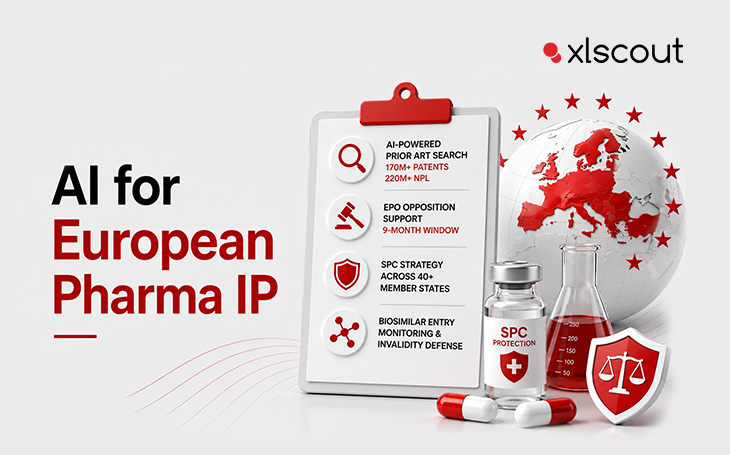
XLSCOUT’s Invalidator LLM provides the rapid prior art assessment that EPO opposition proceedings require. The claim-element-first search covers 170M+ patents and 220M+ NPL — academic publications, clinical trial registrations, and regulatory submissions that are directly relevant prior art for pharmaceutical patent opposition. Top-15 references are ranked by claim element coverage and delivered with automated claim charts and §102/§103 analysis framework within hours.
For pharmaceutical companies considering filing an EPO opposition — whether offensive against a competitor blocking patent or defensive as a counter-assertion — Invalidator LLM provides the prior art assessment that determines whether an opposition has merit before the 9-month window closes.
Non-Patent Literature: The Critical Prior Art for Pharma
In pharmaceutical patent prosecution and invalidity proceedings, non-patent literature is not supplementary prior art. It is often the primary prior art. Clinical publications, pharmacological studies, conference abstracts, and regulatory submissions frequently predate patent applications by years — and constitute the most relevant prior art for novelty and obviousness challenges against drug and biologic claims.
Standard European prior art search tools, including ESPACENET, do not index NPL. A pharmaceutical patent opposition built on patent prior art alone is systematically missing the most relevant and most persuasive category of evidence — the clinical and scientific literature that the EPO’s own Technical Boards of Appeal frequently cite as decisive prior art.
XLSCOUT’s 220M+ NPL corpus covers clinical trial registrations, pharmacological journals, drug regulatory filings, and conference proceedings. For European pharma prior art search, NPL and patents are searched simultaneously in a single query — giving pharma IP teams the complete prior art picture that EPO proceedings actually require.
SPC Strategy Across 40+ Member States
Supplementary protection certificates are national rights — granted by each EU member state’s national patent office on the basis of the EU marketing authorisation for the drug product. Managing SPC applications across 40+ EPO member states involves coordinating different filing deadlines, different national requirements, and different durations based on the regulatory approval timeline in each jurisdiction.
The SPC strategy challenge is fundamentally a portfolio lifecycle management problem — which patents cover which products, in which jurisdictions, for how long, and with what exposure to invalidity challenge. XLSCOUT’s PatDigger LLM supports pharmaceutical portfolio lifecycle management by mapping patent claims against approved product formulations, identifying the patents with the broadest SPC potential, and flagging those with prior art exposure that might be challenged alongside the SPC application.
European pharma patent strategy AI must cover the full SPC lifecycle — from identifying the right patents to protect with SPC, through monitoring biosimilar market entry signals, to rapid invalidity assessment when a biosimilar manufacturer initiates the first challenge. AI handles the analytical work at each stage; the attorney applies legal strategy to the output.
Biosimilar Entry: The Invalidity Challenge Timeline
When a biosimilar manufacturer files for regulatory approval of a reference biologic, the first legal challenge that follows is typically an invalidity proceeding against the blocking patents. For the reference product holder, the timeline is compressed: the biosimilar application can be confidential until regulatory approval is imminent, leaving limited time for prior art preparation before the invalidity proceedings begin.
Teams that have already run AI-powered invalidity assessments on their core biologic patents — as part of ongoing portfolio management, not in response to a biosimilar threat — know their exposure before the challenge arrives. Teams that have not face the invalidity proceedings with weeks to prepare what takes months to do manually.
Invalidator LLM’s portfolio-wide invalidity assessment identifies the patents with the highest prior art exposure — the ones most vulnerable to biosimilar invalidity proceedings — so that the portfolio can be strengthened through continuation filing, prosecution history correction, or licensing strategy adjustment before the challenge arrives.
The AI-Powered European Pharma Patent Lifecycle
The complete AI-powered European pharma patent lifecycle workflow covers five stages:
- Pre-filing: Novelty Checker LLM searches 170M+ patents and 220M+ NPL — clinical literature, academic publications, and regulatory filings — before any application is drafted
- Prosecution: Drafting LLM generates specification language and claim sets informed by the pre-filing prior art landscape. Office action responses begin with an AI-drafted first response for attorney review.
- Opposition window: Invalidator LLM runs within the 9-month window for any competitor patent whose grant triggers opposition consideration — providing the prior art foundation for the opposition decision
- SPC management: PatDigger LLM maps which patents support SPC applications for which approved products, identifying the patents with the broadest SPC potential and the highest exposure to challenge
- Biosimilar defence: Invalidator LLM provides rapid prior art assessment for the blocking patents at risk — hours after the biosimilar regulatory filing becomes public, not weeks
This lifecycle workflow does not replace the pharma patent attorney’s legal judgment. It eliminates the information gaps the prior art that was missed, the invalidity exposure that was not assessed, the continuation opportunity that was not identified that compound over a 20-year pharmaceutical patent lifecycle into significant commercial risk.
XLSCOUT Novelty Checker LLM + Invalidator LLM + PatDigger LLM — AI-powered European pharma patent strategy: NPL-inclusive prior art, rapid EPO opposition response, SPC lifecycle management, and biosimilar entry monitoring.
Why stay behind? Get in touch with us!





© 2026 XLSCOUT. All Rights Reserved.