

Introduction
A semiconductor product designed by a Taiwan fabless company, fabricated at TSMC, using components from Korean and Japanese suppliers, targeting consumer electronics markets in Japan, Korea, the United States, and China. This is not a hypothetical supply chain. It describes a significant proportion of global semiconductor products shipped today.
The IP clearance requirements for this product — before it ships — cover four of the world’s five largest patent offices: JPO (Japan, 307,000 applications per year), KIPO (Korea, 246,000 per year), TIPO (Taiwan, 70,000 per year), and CNIPA (China, 1.8 million per year). The relevant prior art exists in Japanese, Korean, Traditional Chinese, and Simplified Chinese. The blocking patents could have been filed by a Japanese conglomerate, a Korean semiconductor giant, a Chinese state-owned enterprise, or a US company that filed PCT and entered the national phase in all four jurisdictions.
Most APAC IP teams handle this by running four separate searches, in four separate tools, and asking an analyst to merge the results. This is where clearance falls apart.
The Four-Office Problem in Detail
Each of the four major APAC patent offices has different characteristics — different filing conventions, different language requirements, different technical domain concentrations — that affect how prior art search needs to be conducted. Running the same keyword search across four separate database interfaces does not account for these differences. It produces four result sets in four different formats that require an analyst to deduplicate, translate, and synthesise into a unified assessment.
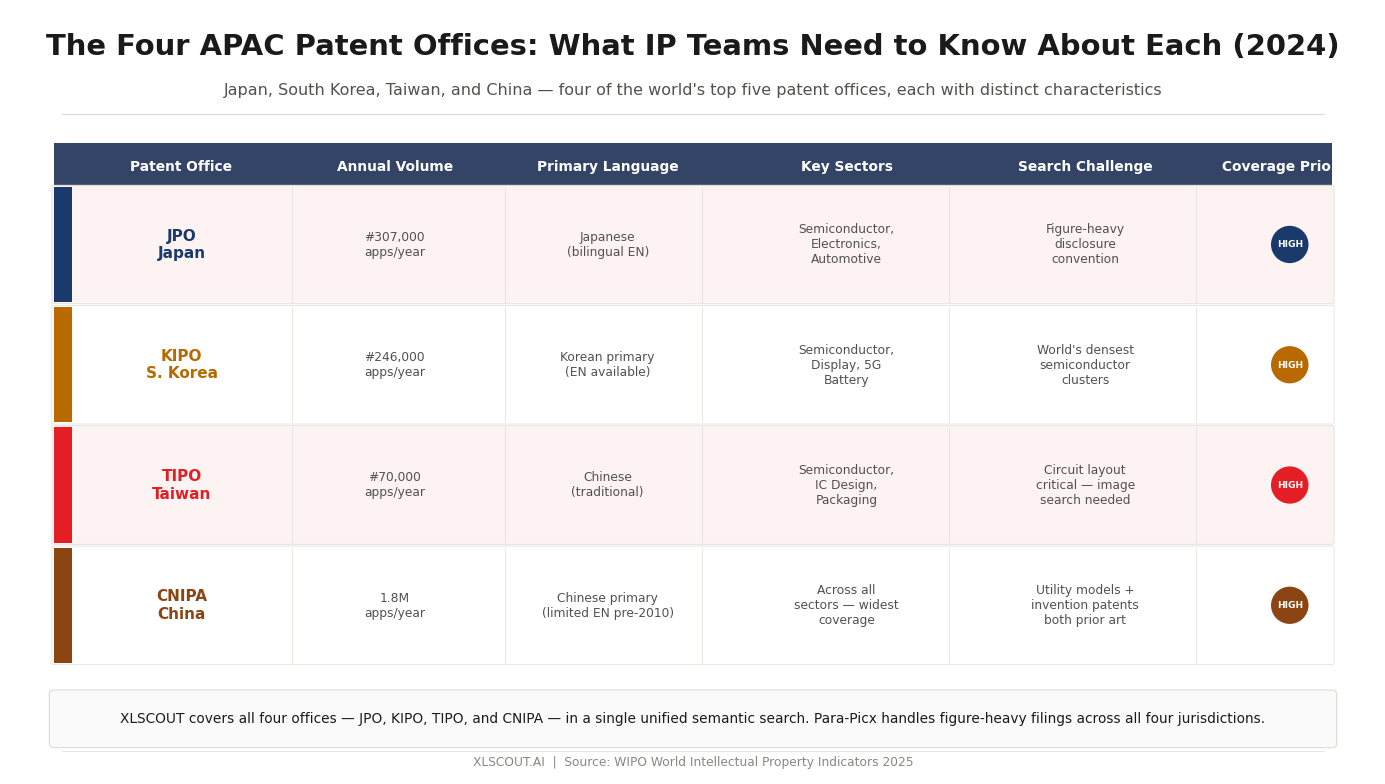
Figure 1: The four APAC patent offices — JPO, KIPO, TIPO, and CNIPA compared across volume, language, key sectors, and search challenges for APAC IP teams
What Breaks at Each Seam
The JPO-KIPO seam
Japanese and Korean semiconductor companies file at both JPO and KIPO — often with the same underlying technology disclosed in Japanese at JPO and Korean at KIPO, with material differences in claim scope between the two jurisdictions. A search that covers JPO but not KIPO may find the patent family but miss the Korean claim variant that has broader scope. A search that covers KIPO but not JPO may miss the earlier filing that establishes priority. The relevant prior art picture for any technology with both Japanese and Korean competitive filers requires both jurisdictions — simultaneously, not sequentially.
The TIPO-CNIPA seam
Taiwan and Chinese patent filings often cover the same technology — but TIPO filings are in Traditional Chinese, while CNIPA filings are in Simplified Chinese, and the technical terminology has evolved differently in the two patent systems. A keyword search optimised for TIPO terminology will not reliably find the CNIPA equivalent. A search optimised for CNIPA terminology may miss the TIPO filing that was the earliest disclosure. Semantic cross-language search that spans both systems is not a luxury — it is the only way to find the blocking reference that exists at one office but not the other.
The language seam within CNIPA
CNIPA’s historical corpus — pre-2010 filings in sectors like telecommunications, industrial electronics, and manufacturing technology — has Chinese-language abstracts with limited or no English translation in most global databases. A global prior art search that does not specifically address this historical Chinese-language corpus is systematically missing the earlier Chinese prior art that may predate the international patent families that appear in English-language searches.
The Internal Routing Challenge
The clearance problem is compounded by the organisational structure of most APAC-facing IP operations. An MNC with significant APAC exposure typically has:
- A Japan IP team in Tokyo — conducting JPO prosecution and managing Japanese licensing relationships
- A Korea IP team in Seoul — focused on KIPO matters and Korean supply chain exposure
- A legal team in Singapore or Hong Kong — responsible for regional strategy and cross-border clearance coordination
- A product management team in Taipei or Shenzhen — responsible for the actual product launch decision
These four groups are working with different patent search tools, different databases, different workflows, and different alert systems — and when the clearance question arrives (“is this product clear to ship into Japan, Korea, Taiwan, and China?”), assembling the answer requires manual coordination across all four.
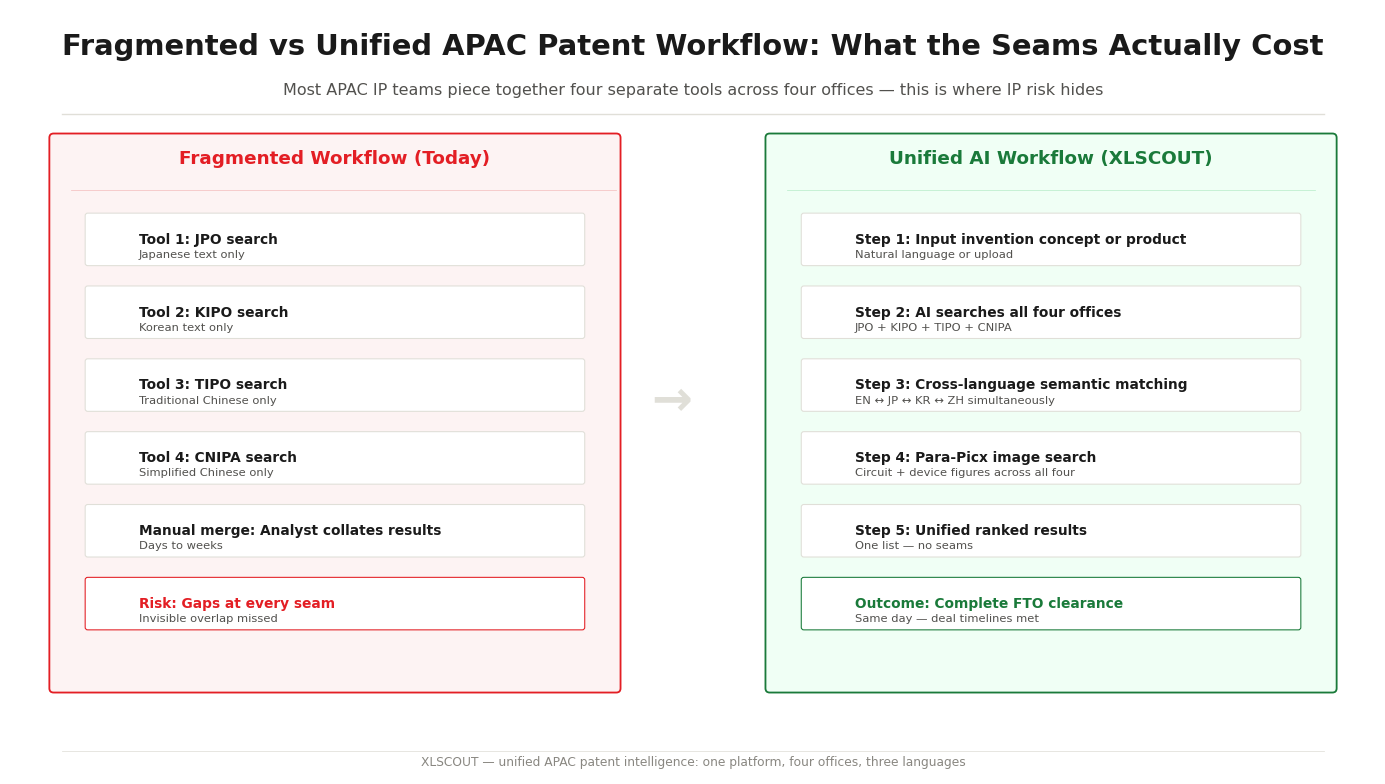
Figure 2: Fragmented vs unified APAC patent workflow — what changes when four separate search tools are replaced by a single AI platform covering all four offices
What Unified APAC Patent Intelligence Looks Like
The alternative to four separate searches is a single AI-powered search that covers JPO, KIPO, TIPO, and CNIPA in one semantic query — in Japanese, Korean, Traditional Chinese, and Simplified Chinese simultaneously — with results ranked by relevance to the specific product feature being cleared, not by publication date or CPC classification.
XLSCOUT’s unified workflow covers all four APAC offices through Novelty Checker LLM‘s 170M+ patent corpus with ParaEmbed cross-language semantic search. Para-Picx adds image-based FTO clearance for the semiconductor and hardware-intensive products where circuit topology and device structure are the primary disclosure in Japanese and Korean patent specifications.
TechScaper LLM extends the unified coverage to continuous monitoring — tracking new publications across all four offices simultaneously, tagged to the product taxonomy of the company’s technology portfolio, with role-based routing that delivers signals to the Japan IP team, the Korea IP team, the Singapore legal team, and the product team in Taipei — each receiving the signals relevant to their specific scope, not a single undifferentiated feed that nobody has time to filter.
The Commercial Case for Unified Clearance
A product launch that is delayed by IP clearance issues costs more than the clearance would have. A product that ships without complete clearance creates IP exposure that is discovered — and enforced — after the product is in market. In APAC, where enforcement activity in semiconductor, telecommunications, and consumer electronics has been increasing across Japan, Korea, and China, the risk profile of shipping without complete multi-office clearance is not theoretical.
The fragmented four-tool workflow is not just inefficient. It is structurally incomplete — it misses the blocking references that live at the seams between jurisdictions, and it surfaces them too late for the product team to act. Unified AI-powered APAC patent intelligence eliminates the seams.
XLSCOUT’s unified APAC workflow covers JPO, KIPO, TIPO, and CNIPA in a single semantic search — with Para-Picx image-based clearance, continuous patent monitoring via TechScaper LLM, and role-based routing for APAC IP, legal, and product teams.