

Introduction
Denmark and Sweden have built some of the world’s most significant IP positions in offshore wind energy, advanced pharmaceuticals, enterprise telecommunications, and automotive systems. Vestas holds over 1,500 active patents. Ørsted is accelerating its IP position in offshore wind and hydrogen as its core technology platform. Ericsson files approximately 2,800 patents per year across 5G and 6G radio access systems. AstraZeneca’s Gothenburg R&D base generates significant biopharmaceutical IP.
These are not companies that can afford to miss a competitor filing. And yet the patent monitoring tools most Nordic IP teams are using were not designed for technical domains with this filing velocity or this semantic complexity.
The Scale of Nordic Patent Activity
DKPTO receives approximately 7,000 patent applications per year. PRV in Sweden processes around 8,500 domestic filings annually. But these numbers substantially understate the relevant patent activity for Danish and Swedish IP teams, because the most strategically significant filings — by their competitors, by global technology leaders, and by standards development organisations — are filed at the EPO, the JPO, and the USPTO, not at the domestic Nordic offices.
For a Danish IP team monitoring competitive offshore wind technology, the relevant publications include filings by Siemens Gamesa (Germany/Spain), General Electric (US), Mingyang Smart Energy (China), and Goldwind (China). For a Swedish telecommunications IP team monitoring Ericsson’s competitive landscape, the relevant publications span 3GPP standard-essential patent filings from Nokia, Huawei, Qualcomm, and Samsung across EPO, JPO, KIPO, and USPTO.
The monitoring scope for Nordic IP teams in these domains is genuinely global — and genuinely high-volume.
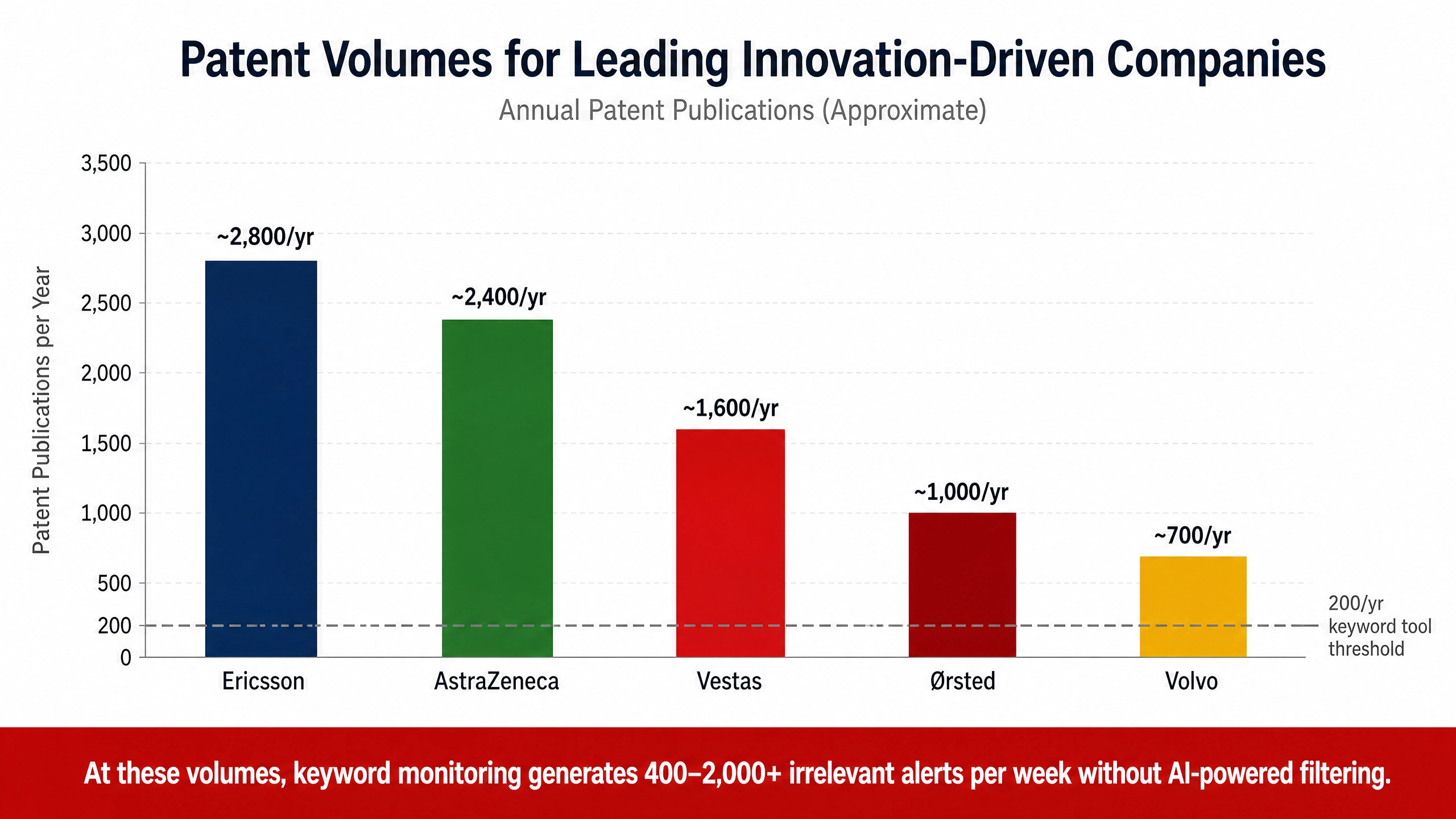
Figure 1: Nordic cleantech and telecom patent filing — selected companies and estimated annual volumes, illustrating the scale of relevant IP activity that Nordic monitoring tools must track
Why Filing Velocity Breaks Keyword Monitoring
Keyword-based patent monitoring tools work by matching publications against a predefined list of search terms. For technology domains with stable, well-defined terminology — traditional mechanical engineering, for example — this approach is workable, if imperfect. For rapidly evolving technical domains, it breaks down in a specific and predictable way.
New technical concepts emerge and are named in the patent literature before they appear in the predefined keyword list. Patent filings describe the same inventive concept using different terminology across different jurisdictions and different filers. Semantic equivalents — “offshore wind substation” and “marine electrical collection system” — do not share keywords but describe the same class of technology. A keyword monitor that is not updated continuously will systematically miss the new filings that use the latest terminology.
At the filing velocities of Ericsson, Nokia, Samsung, and their 5G and 6G competitors, this systematic miss is not marginal. An IP team monitoring 5G standard-essential patent filings by keyword is likely missing 40 to 60 percent of relevant publications — not because the tools are malfunctioning, but because the keyword matching approach was not designed for semantic complexity at this filing speed.
The Semantic Complexity Problem
Cleantech and advanced telecommunications patents are written by engineers for patent examiners, in technical language that evolves rapidly. A 2024 offshore wind patent may describe the same floating platform concept that a 2018 marine energy patent described — using entirely different terminology because the field has developed its own vocabulary since 2018. A keyword search designed in 2022 will not find the 2024 filing.
For Nordic IP teams in these domains, the consequence is not just missed alerts. It is a systematically incomplete picture of the competitive landscape — one that appears current but excludes a significant proportion of the relevant publications because the vocabulary has shifted. The patent monitoring alert that does not arrive is the one you cannot know you missed.
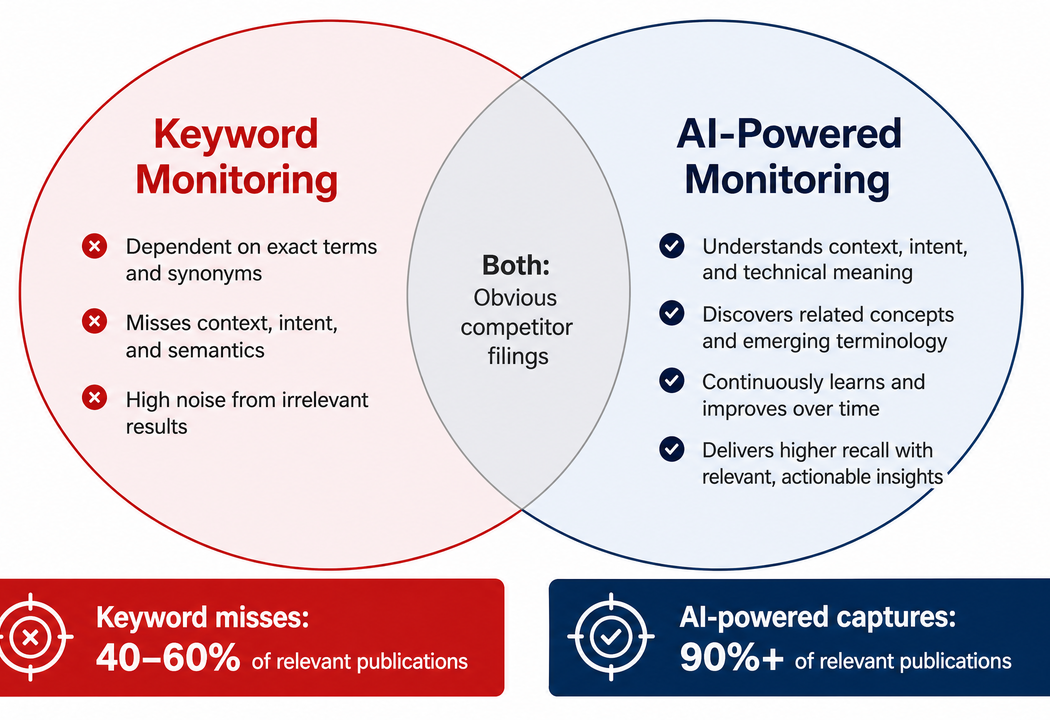
Figure 2: Keyword monitoring vs semantic AI classification — what each method captures in technically complex Nordic cleantech and telecom patent domains
The UPC Nordic-Baltic Dimension
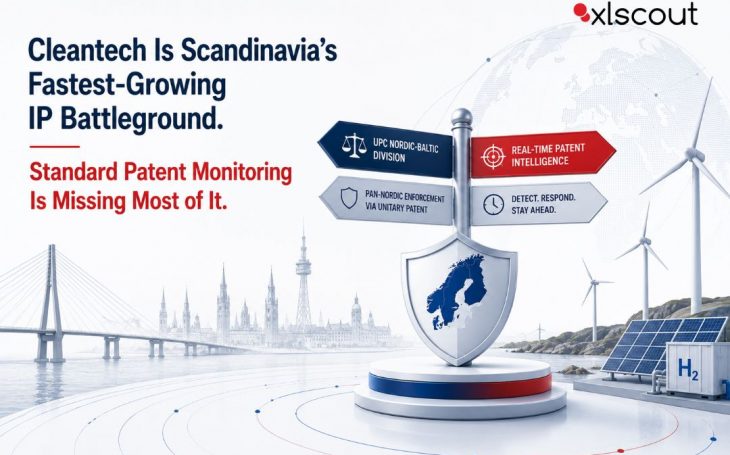
Denmark and Sweden are both parties to the Unified Patent Court agreement, and the UPC Nordic-Baltic regional division — based in Stockholm — has jurisdiction over disputes in Denmark, Sweden, Finland, Estonia, Latvia, and Lithuania. This means that a Unitary Patent obtained by a non-Nordic competitor creates enforcement exposure across the entire Nordic-Baltic region from a single UPC filing.
For Nordic IP teams monitoring offshore wind, marine energy, or telecommunications patents, the UPC regional division in Stockholm changes the enforcement calculus. A competitor who files in these domains and obtains a Unitary Patent can seek pan-Nordic enforcement without navigating six separate national court systems. The monitoring timeline for detecting these potential threats needs to match the enforcement speed of the UPC — not the cadence of a quarterly report.
Continuous semantic patent monitoring delivers a different capability: the ability to detect a competitor’s grant event — including Unitary Patent conversion — within hours of publication, while there is still time to respond strategically rather than reactively. The whitespace that exists in the Nordic cleantech landscape is also continuously updated — filing opportunities identified in February remain visible as open space in March, rather than appearing in a report delivered in May that describes the landscape as it was in January.
TechScaper LLM for Nordic IP Teams
XLSCOUT’s TechScaper LLM addresses the specific monitoring challenges of high-velocity, semantically complex technical domains. The LLM classification model finds new publications based on technical concept — not keyword matching — which means it captures the new terminology as it emerges in the literature, without requiring continuous keyword list maintenance.
The taxonomy system is configured to your organisation’s technology classification — not a generic CPC hierarchy. For a Danish cleantech company, the taxonomy reflects the specific offshore wind, hydrogen, or marine energy sub-domains that matter. For a Swedish pharmaceutical company, it reflects the specific therapeutic areas and formulation technologies in scope.
Alert noise reduction of 92% relative to keyword monitoring means that Danish and Swedish IP teams receive the signals that matter — not a weekly inbox full of tangentially related publications that consume attention without providing actionable intelligence.
What This Means for Danish and Swedish IP Strategy
The Nordic cleantech patent landscape is accelerating. The offshore wind sector alone is seeing filing velocity that did not exist five years ago, driven by the expansion of global installed capacity and the technology development that accompanies it. The telecommunications sector is in a continuous investment cycle around 5G deployment and 6G development — with patent activity that directly affects the licensing exposure of every Nordic company that uses wireless connectivity in its products.
Standard patent monitoring tools — keyword-based, periodically updated, general-purpose — were not built for this environment. The IP teams that are navigating it effectively are those that have moved to semantic monitoring with continuous updates, configured to their specific technical taxonomy, with UPC-speed alerting that can detect threats before they become enforcement actions.
XLSCOUT TechScaper LLM delivers continuous semantic patent intelligence for Nordic cleantech and telecom IP teams — auto-tagged to your taxonomy, with 92% noise reduction and real-time whitespace scoring.