

Patent Portfolio Pruning with AI: How to Cut Maintenance Costs Without Cutting Value


Introduction
The average Fortune 500 company spends $2-5 million per year in patent maintenance fees. Industry estimates suggest 20-30% of those patents no longer cover any active product or meaningful technology area.
That is $400,000 to $1.5 million per year in fees on patents that earn nothing and protect nothing. They persist because nobody has the time to review them systematically.
AI changes that calculation — and it does something more interesting than just identifying which patents to abandon.
Why Portfolios Accumulate Dead Weight
Patent portfolios accumulate dead weight for predictable reasons. Filing-first cultures prioritise volume over strategic alignment. Technology shifts over time, and patents filed against product roadmaps from five years ago often protect nothing in the current product line.
The systematic review problem is real: manually evaluating 2,000 patents for strategic value requires significant attorney time and budget. Most organisations review their portfolios annually at best — which means patents that became dead weight two years ago are still generating renewal fees.
- USPTO maintenance fees: $1,600-$12,000 per patent per renewal cycle
- Typical large corporate portfolio: 2,000-10,000 active patents
- Dead weight estimate: 20-30% across most large portfolios
- Manual review cost: prohibitive at scale without AI
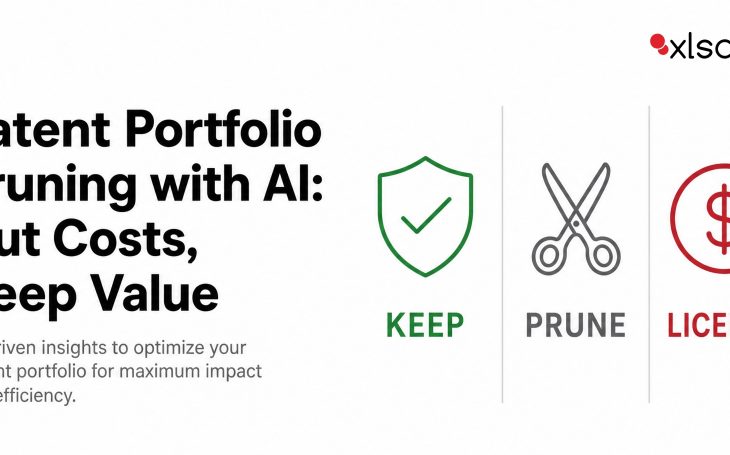
The Three Decisions AI Helps You Make
Keep — active protection, core product coverage
Patents that protect current products, block competitor workarounds, or support ongoing prosecution strategy should stay. AI identifies these by mapping patent claims against current product features and active technology areas.
Prune — abandon, stop paying renewal fees
Patents that no longer cover any active product, have no licensing potential, and are unlikely to be asserted or needed defensively are candidates for abandonment before the next renewal deadline.
AI makes this decision faster and more systematically than manual review. A portfolio of 2,000 patents can be screened in hours rather than weeks.
License — the category most portfolios ignore
This is the part that changes the economics: many patents that look like candidates for pruning are actually candidates for licensing. The same patent that no longer covers your own product may cover a competitor’s product perfectly.
XLSCOUT’s PatDigger LLM identifies potential licensees by screening patent claims against company product databases — surfacing organisations whose products may be practising your claims, before you spend on outreach or enforcement.
The AI Pruning Workflow
The AI portfolio review workflow starts with a full upload of the portfolio to PatDigger LLM — patent numbers, claim text, and filing dates. The AI analysis runs across three dimensions:
- Product alignment: does this patent claim cover anything in the current product portfolio?
- Prior art exposure: does this patent have known prior art that would make it difficult to enforce?
- Licensing potential: are there companies in the market whose products may practise these claims?
The output is a ranked portfolio list — keep, prune, or license recommendations for each patent, with supporting evidence for each decision.
The Monetisation Angle Most Teams Miss
The most valuable outcome of AI-powered portfolio pruning is not cost reduction. It is discovering that patents you were about to abandon have active licensing potential.
A mechanical engineering patent that no longer covers your own product line may be exactly what a foreign manufacturer is practising. A software patent that predates your current codebase may cover functionality that three competitors are now shipping.
PatDigger LLM’s licensing candidate identification uses claim-level analysis to find product-patent overlaps at scale — across US, EU, and APAC markets. The result is a ranked list of licensing opportunities from your existing portfolio, ranked by claim overlap score, that your team can act on before the next renewal deadline forces an abandonment decision.
Patents you almost abandoned can earn licensing revenue. AI surfaces this before the abandonment decision is made — not after.
Making Portfolio Review Continuous
Annual portfolio review is too infrequent for most technology portfolios. New products launch. Competitors enter new technology areas. Claim scope that was irrelevant last year becomes commercially significant this year.
AI makes continuous portfolio review operationally feasible. PatDigger’s automated analysis can flag changes in licensing potential as new competitor products appear — turning portfolio management from an annual audit into a continuous intelligence function.
XLSCOUT PatDigger LLM — AI-powered portfolio analysis: keep/prune/license recommendations and licensing candidate identification across US, EU, and APAC markets.
Why stay behind? Get in touch with us!





© 2026 XLSCOUT. All Rights Reserved.