

$1.9 Billion in Patent Damages in Six Months: Is Your R&D Team Flying Blind?



Introduction
$1.9 billion. That’s what US courts awarded in patent infringement damages in just the first half of 2025. Across 21 cases. The largest single award involved semiconductor technology that had been in development for years.
The common denominator across these cases isn’t bad technology. It’s the gap between how fast R&D teams build and how often they check the patent landscape around what they’re building.
A lot changes in 18 months.
$1.9B
THE NUMBER DRIVING THIS
Patent infringement damages awarded in H1 2025 alone — across just 21 cases. Average award: $90 million per case.
Why R&D Teams Are Structurally Exposed to Patent Risk
Product development cycles run 12 to 18 months. Patent searches happen at the start and are rarely revisited. By the time a product ships, the patent landscape it was cleared against is out of date.
Over 50,000 AI-related patent applications are filed annually in the US alone. A patent that didn’t exist when you started your project can be granted and asserted against your finished product before your launch date
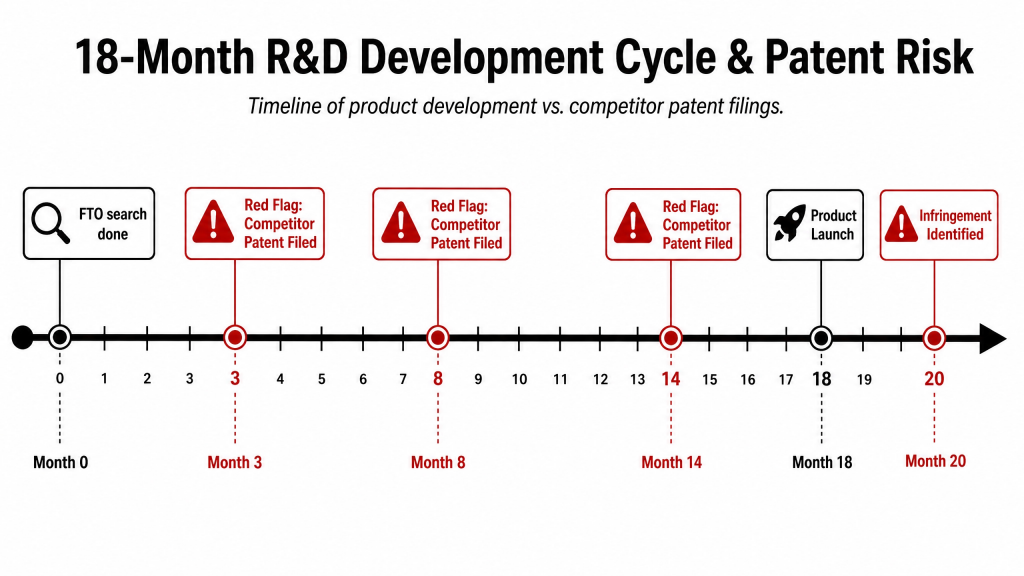
The Old Model: Search Once, Hope for the Best
The traditional FTO workflow was built for a slower patent environment. One search, at project start, reviewed by outside counsel, filed away. That model is broken — not because the analysis was wrong at the time, but because it expires.
What $1.9 Billion in Damages Has in Common:
Late Detection identified a clear pattern:
-
Litigation hotspots in WDTX and EDTX favor plaintiffs who catch R&D teams post-launch.
-
At that point, the product is shipping, revenue is committed, and redesign costs are layered on top of legal exposure.
-
Earlier detection changes the math entirely.
-
A design-around at the prototype stage costs weeks. A redesign post-launch costs months, revenue, and customer trust.
How PatDigger LLM Changes the R&D Risk Equation
PatDigger LLM was built for companies that need to identify potential infringers of their own patents. But the same underlying technology — claim-level patent analysis at scale — runs in both directions.
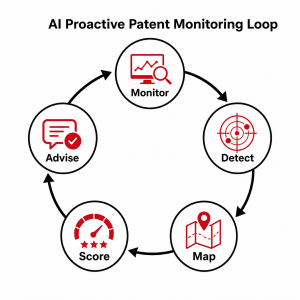
For R&D teams, PatDigger LLM can be deployed as a continuous monitoring tool: you define your product’s technology space and feature architecture, and the platform monitors the active patent landscape around it. When a competitor files a continuation with broader claims that now read on your product, or an NPE acquires a portfolio in your space, PatDigger surfaces it.
The specific workflow looks like this:
- Set your monitoring parameters. Define your product’s technology landscape in PatDigger LLM — the core technical claims, feature categories, and relevant CPC classifications.
- Automated landscape scanning. PatDigger runs continuous analysis across active patent portfolios, pending applications, and recent grants in your defined space.
- Claim-level alert generation. The platform generates claim-level alerts: not just ‘a relevant patent was filed’ but ‘this claim element in this newly published application maps to this feature in your product architecture.’
- Structured IP team review. Your IP team reviews prioritized alerts, escalates to prosecution counsel where warranted, and logs design-around decisions in the product development record.
- EoU chart generation on high-risk patents. High-risk patents receive detailed EoU mapping — a complete claim chart showing exactly where and how your product reads on the asserted claims. This becomes the starting point for any licensing negotiation or litigation defense.
The output isn’t a list of patents to worry about. It’s a continuously updated, claim-mapped risk register that integrates into your R&D workflow — giving your team the same intelligence advantage that previously required a full-time patent monitoring retainer with outside counsel.
Teams using this workflow don’t discover infringement risk after their product ships. They find it when a design-around is still just an engineering decision.
Don't discover patent risk after your product ships. PatDigger LLM monitors the landscape in real time.
Recent Blogs


Why stay behind? Get in touch with us!





© 2026 XLSCOUT. All Rights Reserved.